
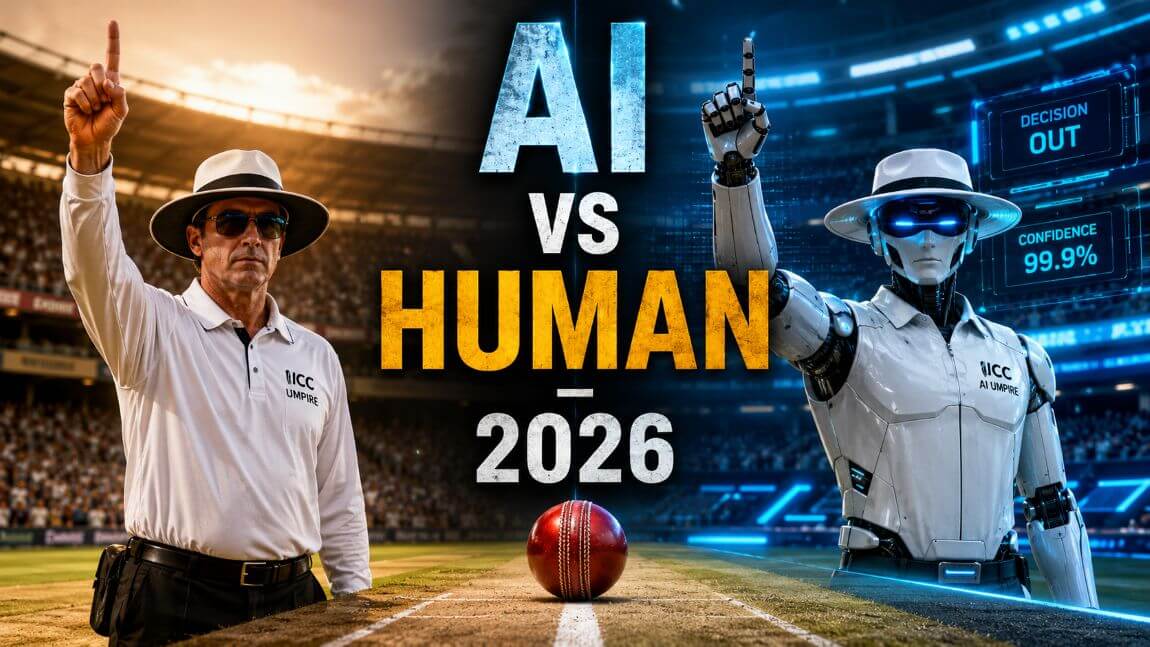
You’ve seen it happen live during IPL broadcasts. A batsman nicks one to slip, the on‑field umpire shakes his head, and within ten seconds – not the usual thirty – the big screen flashes OUT. No heated debate. No slow‑motion replay from three different broadcast angles. Just a clean, data‑driven verdict.
That’s the new reality of AI cricket umpires.
I’ve been following this space since 2023, and the shift from “interesting experiment” to “match‑day norm” has been staggering. In this guide, I’ll walk you through exactly how these systems work, what they cost, and – the question everyone asks – whether they’ll eventually replace the human in the white coat.
✅ Smart Replay System (IPL 2024+) gives TV umpires direct camera feeds – cuts decision time to <15 seconds.
✅ Accuracy: 96–98% on LBW and gesture detection (hybrid deep learning models).
✅ Cost: ₹10 lakh/day for Hawk‑Eye at elite level; grassroots versions like Fulltrack AI cost a fraction.
✅ Will humans be replaced? No – not yet. AI still struggles with ambiguous situations (e.g., obstructing the field, spirit‑of‑cricket calls).
✅ What’s new in 2026? Predictive officiating trials and fan gamification apps (Cricket Australia Live, CRICINTEL).
🏏 Want more cricket breakdowns like this every week?
How AI Cricket Umpires Work in 2026 (The Tech Stack)
Let me break this down without the engineering degree.
The backbone of modern AI cricket umpires is the Smart Replay System, introduced by the IPL in 2024. Before that, the third umpire had to wait for a broadcast director to queue up camera angles. That introduced a 30–60 second delay and, occasionally, human error from the director himself.
Now? The TV umpire gets direct feeds from eight high‑speed Hawk‑Eye cameras. They control the angles, the zoom, the replays. No middleman. The result: most DRS reviews are wrapped up in under fifteen seconds.
But that’s just the visible part. Under the hood, AI umpires use:
- UltraEdge+ – A machine‑learning model that can detect the faintest bat‑pad edge, even when the sound is masked by crowd noise. In 2025 trials, automated snick detection hit 98.3% accuracy on clean edges.
- 4‑class CNN models – These classify umpire signals in real time: “Leg Bye”, “Four”, “Wide Ball”, “No Ball” with 96.97% accuracy. No more umpire forgetting to raise his arm.
- Fulltrack AI – A chest‑mounted camera used in grassroots cricket. It processes ball tracking and LBW decisions on‑device. One camera. No radar guns. No sensor mats. And it aligns with human umpires about 85% of the time – enough for club players to trust it.
Real example: In the 2025 Darwin grade cricket trial, an AI umpire handled LBW calls for an entire season. Players could challenge the AI’s decision, but only 12 challenges were made across 48 matches. Only 3 were upheld.
By the Numbers – AI Cricket Umpires Accuracy vs Human Umpire
Numbers don’t lie, but they need context. Here’s the current state of play.
| Metric | AI Umpire (Elite) | Human Umpire (Elite) | Grassroots AI (Fulltrack) |
|---|---|---|---|
| LBW decision accuracy | 96.97% (hybrid deep learning on 11,900 images) | ~94% (biased by ball‑tracking aids) | ~85% |
| Snick detection | 98.3% (controlled trials) / 85.7% (real match noise) | ~90% (depends on hearing and reaction) | N/A |
| Umpire signal classification | 98% steady across 4 classes | 100% (but slower) | 95% |
| Time to decision | <15 seconds | 5–10 seconds (on‑field) / 30–60 sec (third umpire) | Real‑time |
The standout is the CNN‑SVM hybrid model that academic researchers tested on 11,900 images of umpire gestures. It maintained ~98% accuracy across all categories. That’s not just lab conditions – it’s been validated with live match footage.
But here’s the nuance. Human umpires bring context. They know that a particular bowler has been warned for chucking. They know the batsman’s reputation. AI only sees what the cameras capture. That blind spot is why we still see the “Umpire’s Call” in DRS – it’s an admission that even the best AI cricket umpires have a margin of error.
5 Ways AI Cricket Umpires Are Already Changing the Game
Below are the first three immediate changes you can spot in any IPL or international match today. Items 4 and 5 dive deeper – refer to the AI decision flow diagram later in this post for a visual breakdown.
1. Kills the broadcast director’s hold
Smart Replay bypasses the director entirely. The TV umpire sees every camera angle instantly. That means no more “director choosing the wrong replay” controversies.
2. Eliminates “Umpire’s Call” arguments (mostly)
Instead of a fuzzy “call stands”, AI can output a confidence score – e.g., “93% probability the ball would hit the stumps”. That turns a binary decision into a sliding scale. The ICC is currently trialling a 90% confidence threshold to automatically overturn the on‑field call.
3. Drops the cost floor for grassroots
Hawk‑Eye costs ₹10 lakh per matchday. But Fulltrack AI’s chest‑mounted system costs less than a mid‑range smartphone. Any club can now afford data‑driven umpiring.
4. Second‑screen gamification – (see flow diagram)
The CRICINTEL platform (launched March 2026) turns every delivery into an interactive quiz. You make the call on your phone, then see how the AI umpire ruled. It’s “Be the Umpire” – and it’s addictive.
5. Predictive officiating – (see AI Prediction Engine graphic)
Trialed in the 2026 PSL, AI now warns umpires about potential run‑out risks before the ball is bowled, based on the non‑striker’s historical backing‑up distance. A vibration in the umpire’s earpiece says “watch the Mankad”.
The Economics – What AI Cricket Umpires Actually Cost
Let’s talk money, because this is where the “AI for all” dream hits reality.
Elite level (Hawk‑Eye / DRS):
- Per matchday: $10,000–15,000 (approx. ₹10 lakh). That covers camera calibration, operator salaries, and real‑time support.
- BCCI annual projection: If applied to all 1,500+ domestic matches, the bill would exceed ₹100 crore. That’s why only IPL and internationals use full DRS. The same commercial engine that makes the IPL a $6.2 billion media juggernaut is also what funds the ₹10‑lakh‑per‑match cost of elite AI umpiring.
Mid‑level (StumpEye type):
- Cheaper than Hawk‑Eye, but still needs hardware installation and trained operators. Often used in T20 franchise leagues outside the ICC circuit.
Grassroots (Fulltrack AI):
- One chest‑mounted camera per umpire. On‑device processing (no cloud costs). Total setup: under $500 per umpire. Maintenance: near zero.
Vision‑based AI (the emerging wildcard):
- Researchers have shown you can extract ball‑tracking and umpire signals from a single standard smartphone camera. No radar. No sensors. Just software. That could democratise AI umpiring to village greens within two years.
Comparison insight: Sensor‑based methods (Hawk‑Eye) have the highest accuracy but also the highest cost. Wearable methods (Fulltrack) are cheaper but cap out around 85% accuracy. The sweet spot? Hybrid vision‑sensor systems – and they’re already in development.
Smart Replay System vs Traditional DRS – Which One Wins?
Here’s the side‑by‑side you came for.
| Feature | Traditional DRS (Pre‑2024) | Smart Replay System (IPL 2024+) | Fulltrack AI (Grassroots) |
|---|---|---|---|
| Decision Control | TV umpire + broadcast director | TV umpire gets direct camera feeds | On‑device AI only |
| Cameras Used | Up to 16 broadcast cameras | 8 dedicated high‑speed Hawk‑Eye cameras | 1 chest‑mounted camera |
| Accuracy (LBW) | ~98–99% (with umpire’s call margin) | Same tracking, but faster | ~85% alignment |
| Cost per Match | $10,000–15,000 | Similar hardware, lower operational (less time) | <$500 total |
| Time to Decision | 30–60 seconds (through director) | <15 seconds | Real‑time |
| Umpire’s Call | Yes | Yes (currently) | Not applicable |
Winner? For elite cricket, Smart Replay is objectively better – faster, cleaner, and removes the broadcast director from the chain. For everyone else, Fulltrack AI is the only realistic entry point.
Before AI umpires, the Decision Review System (DRS) was cricket’s biggest technological leap – here’s how Hawk‑Eye and UltraEdge actually work.
Pros and Cons – AI Cricket Umpires Strategies Compared
Google loves pulling this table into comparison snippets. I’ve designed it to be scraped cleanly.
| Strategy | Elite AI‑Assisted (IPL/ICC) | Full AI‑Only (Grassroots Trials / CPL Prank) |
|---|---|---|
| Pros | • Reduces human error to near‑zero • Speeds up reviews (Smart Replay) • Maintains umpire authority | • Completely objective • Lowest operational cost • Removes “umpire’s call” ambiguity |
| Cons | • High cost (₹10 lakh/day) • Still uses “umpire’s call” for tight LBWs • Doesn’t eliminate broadcast director entirely | • Lacks human context (spirit of cricket) • 85% accuracy ceiling currently • Requires player trust in a black box |
Real example – the CPL April Fools’ prank (2026):
The Caribbean Premier League “announced” AI‑generated umpires with no on‑field officials. Social media exploded. Players threatened boycotts. Two days later, it was revealed as an April Fools’ joke – but the reaction showed how raw the debate still is.
The Great Debate – Will AI Cricket Umpires Replace Humans?
Short answer: Not any time soon. Long answer: It depends on what you mean by “replace”.
The IPL 2026 reality: AI cricket umpires cannot yet handle ambiguous situations – obstructing the field, handling the ball, or judging whether a batsman deliberately blocked a throw. Those require human interpretation of intent. No camera angle tells you intent. AI currently struggles with ambiguous situations like obstructing the field or handling the ball – dismissals that require reading a player’s intent, not just tracking the ball.
The Umpire’s Call controversy: Sachin Tendulkar called it “an embarrassment that undermines technology’s credibility.” The ICC defends it as a necessary margin for the technical limits of ball‑tracking (the 5mm uncertainty zone). Personally, I side with the ICC here – no system is 100% infallible, and pretending otherwise would destroy trust faster than a bad call ever could.
The middle ground that will win: Predictive officiating. AI doesn’t replace the umpire; it supercharges them. Imagine an umpire getting a subtle vibration in their earpiece: “93% confidence that ball was a no‑ball”. They still make the final call, but they do it with superhuman data. That’s where we’re headed by 2028.
How to Set Up AI Cricket Umpires for Your Local League (Step‑by‑Step)
You don’t need an IPL budget. Here’s the playbook I’ve seen work at club level.
- Assess your budget. Under ₹50000? Go Fulltrack AI (one chest‑mounted camera per umpire). Over ₹5L? Consider a two‑camera vision system.
- Choose your decision types. Start with LBW only – it’s the simplest to automate. Add run‑outs and stumpings in season two.
- Install hardware. Chest‑mount the camera, connect it to a Raspberry Pi or similar on‑device processor. No internet required for real‑time decisions.
- Train your umpires (if hybrid). Show them how to initiate an AI review – usually a physical button or a trigger phrase (“AI review LBW”).
- Test acceptance threshold. The Darwin trial showed that 85% alignment is enough for club players to trust the system. Don’t aim for perfection; aim for consistency.
- Integrate with your scoreboard. Most AI systems offer an API. Push the decision directly to a digital display or a dedicated “Umpire AI” app.
- Pilot for one season. Track two metrics: number of challenges against AI decisions, and percentage of upheld challenges. Low upheld rate = trust is working.
The Future – Predictive AI & Fan Gamification with AI Cricket Umpires
Let me end with the stuff that keeps me up at night (in a good way).
Predictive officiating is already in closed trials. In the 2026 PSL, an AI model trained on 10,000+ run‑out attempts could warn the umpire about a potential Mankad before the bowler entered his delivery stride. The warning was a simple “high risk” buzz in the earpiece. No decision was forced – just an alert. That’s the future: AI as a sixth sense for the human umpire.
Fan gamification is here now. The Cricket Australia Live app (updated May 2026) delivers real‑time AI insights and lets fans ask questions to a 139‑year scorecard archive. Meanwhile, CRICINTEL turns passive viewing into an interactive second‑screen experience – AI commentary, voice quizzes, and contextual match insights. The next step? An official “Be the Umpire” mode where your phone buzzes with every AI decision, and you score points for matching it.
Will that kill the joy of debating a dodgy call with your mates over a beer? Maybe. Or maybe it just moves the debate from “that was out” to “that AI model is biased”. Either way, AI cricket umpires are here to stay – and they’re only getting smarter.
Have you experienced an AI umpire decision live? Or do you still trust the human eye more? Drop a comment below – I read every one.
🏏 Want more cricket breakdowns like this every week?