
Stop Guessing, Start Knowing
I have a confession.
For years, I watched cricket thinking there were just two lines on the pitch. The one the bowler runs up to, and the one the batter stands behind. Simple, right?
Then one evening, I was watching a match with a friend who umpires local club games. A tight run-out decision went to the third umpire. I confidently declared the batter safe. My friend quietly said, “Watch the split screen. His bat hasn’t crossed the popping crease.”
I nodded as if I understood. I didn’t. I had no idea which line was the popping crease, what a return crease did, or why there was so much fuss about the bowler’s back foot. The truth is, cricket creases had confused me for years, and I’d never bothered to actually learn them.
If you’ve ever felt that same quiet confusion, this guide is for you. No jargon. No rulebook lectures. Just a clear, human explanation of every line on the pitch and how it shapes the game you love.
The Quick, No-Nonsense Answer: What Are Cricket Creases?
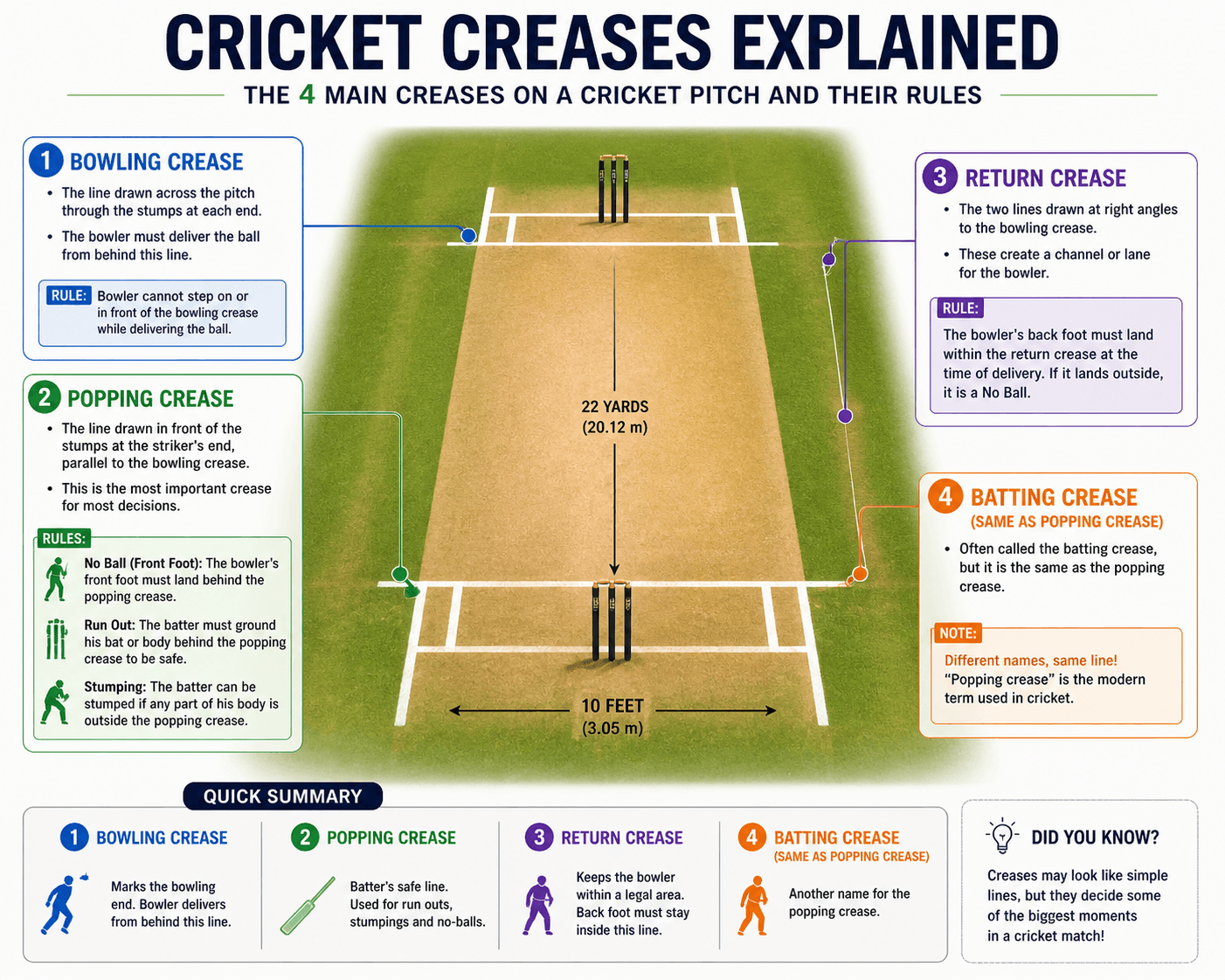
There are exactly four creases on a cricket pitch. Not two. Not three. Here they are, in plain English:
Why should you care about cricket creases? Because these four lines decide no-balls, run-outs, stumpings, and sometimes entire tournaments. Know them, and you’ll never feel lost during a third umpire review again. Ignore them, and you’ll keep shouting “out” at the wrong moments. Understanding cricket creases is what separates a casual viewer from someone who truly sees the game.
How to Read a Cricket Creases Instantly: The 4 Creases Explained
The measurements and rules for each line aren’t arbitrary; they are precisely defined in the official Laws of Cricket. Here’s a simple breakdown.
Close-up diagram of cricket creases showing popping crease and safe zoneThe Bowling Crease: Where It All Starts
Picture the stumps at one end of the pitch. Now draw a straight line right through the middle of those three sticks. That’s your first introduction to cricket creases, and this one is called the bowling crease.
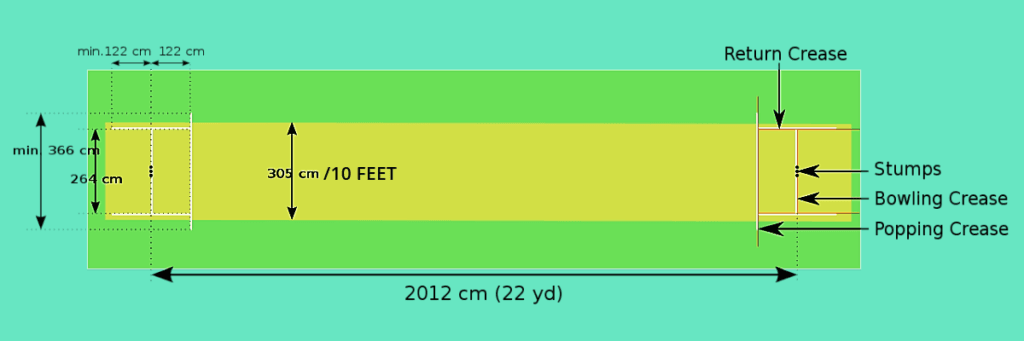
It’s 2.64 meters long, which is about 8 feet 8 inches. The rule is simple: the bowler has to deliver the ball from behind this line. If they’re running in to bowl and their front foot lands beyond it, that’s a problem—but that’s actually judged by the next line we’ll talk about.
The thing most fans miss: When a run-out happens at the bowler’s end, this is the line that matters. The non-striker has to get back behind this bowling crease, not the popping crease. I’ve watched people argue bitterly about this in living rooms, pointing at the wrong line.
The Popping Crease: The Line That Decides Everything
If the bowling crease is the start line, the popping crease is the border wall. It sits 1.22 meters (exactly 4 feet) in front of the bowling crease and runs parallel to it.
Of all the cricket creases, this single line is responsible for more drama than any other piece of white paint in sport. Here’s why:
- For the batter, this is home. You’re safe only if some part of your bat or body is grounded behind this line. Not on it. Behind it. The line belongs to the fielding side.
- For the bowler, this is the point of no return. The front foot must land with something behind this line. If the heel is on the line and there’s no green between the foot and the line’s front edge, you’ve just bowled a no-ball.
I remember watching a World Cup semi-final where a perfect yorker shattered the stumps. The bowler wheeled away in celebration. The entire stadium erupted. Then the replay came up on the big screen. The bowler’s front foot had landed maybe a centimeter over the popping crease. The wicket was cancelled. The batter got a free hit. I’ve never seen a crowd’s mood swing so violently in three seconds.
That’s the power of this line.
The Return Crease: The One Nobody Talks About
Of all the cricket creases, this is the one that made me feel truly foolish during that conversation with my umpire friend. He asked me, “What’s the return crease for?” and I just blinked at him.
The return crease consists of two lines drawn at right angles to the bowling crease, one on each side of the stumps. They extend backward for 2.44 meters (8 feet). Together, they create a lane, a corridor, within which the bowler must operate.
The rule that matters: The bowler’s back foot must land inside this corridor. If it lands on the line or outside it, that’s a no-ball.
Why does this rule exist? Because without it, a crafty bowler could run in from somewhere near the square-leg umpire and deliver the ball from an absurd angle. The return crease keeps things fair. It says, “You can be creative, but you’re bowling from here, not from sideways.”
Next time you see a bowler really stretching wide to change the angle, watch their back foot. If you can spot when they’ve gone too far, you’re already ahead of 95% of the crowd.
The Batting Crease: The Phantom Line
Let me clear this up once and for all.
There is no separate thing called the batting crease. It’s just what people used to call the popping crease back in the old days of cricket. The word “popping” comes from a “popping hole” that batters used in the earliest forms of the game, before creases were even drawn.
So when a commentator says, “He’s safely back in his crease,” they mean the popping crease. When a coach shouts, “Get in your crease!” they mean behind the popping crease.
If you’ve been looking for a fifth line all these years, you can stop. It doesn’t exist. You’re now free of that confusion forever.
How to Judge a Front-Foot No-Ball Using Cricket Creases (Before the Third Umpire Does)
This is the skill I wanted more than anything. I wanted to watch a bowler deliver the ball and know, in real time, whether it was legal. Here’s what I’ve learned.
Step 1: Pick your spot.
As the bowler enters their delivery stride, don’t watch their face. Don’t watch the ball. Lock your eyes onto the popping crease. Just that line.
Step 2: Watch the landing, not the slide.
This is the most important thing I can teach you. The law cares about the exact moment the front foot first lands. If the heel plants behind the line and then slides forward over it, that’s legal. The delivery is fine. Many fans scream “no ball!” at a sliding foot, but they’re wrong. The slide doesn’t count. The landing does.
Step 3: Look for green.
When the TV umpire freezes the side-on replay, they’re looking for one thing: a strip of green grass visible between the back edge of the shoe and the front edge of the popping crease. If there’s green, the foot is behind the line. No green, no-ball. Simple.
I’ve practiced this at home, pausing live matches and trying to guess before the replay is shown. I’m wrong maybe one time in ten now. It’s strangely satisfying.
How Cricket Creases Decide Every Run-Out and Stumping (Without the Confusion)
Run-outs and stumpings are the moments that divide a room, and understanding cricket creases is the only way to know who’s right. Half the people shout “safe!” and half shout “out!” with complete confidence, often based on loyalty rather than evidence. Here’s how to actually know.
The Safe Zone Rule: A batter is safe if some part of their bat or body is grounded behind the popping crease. “Grounded” is the key word. A bat sliding in the air over the line doesn’t count. It must touch down.
When Is It Out? The batter is out if the stumps are broken while no part of their bat or body is grounded behind the line. The TV umpire uses a split screen to match the exact frame where the bails leave the grooves with the frame showing the bat’s position.
I once watched a batter dive full length, bat outstretched, looking completely safe. The replay showed the bat was a single frame away from grounding when the bails lit up. Out by a millimetre. The batter looked devastated, and honestly, so was I. But the rule was clear.
A Quick Tip for Watching at Home: If the batter is sliding and you see even a sliver of green grass between the bat’s back edge and the popping crease’s front edge, they’re safe. If the bat is hovering over the line or touching it without being clearly past it, brace yourself for an “out” call.
Think You Have Quick Reflexes?
A stumping happens in a fraction of a second. A run-out is decided by a single frame. Now it’s your turn to find out where you stand.
It’s quick, free, and genuinely eye-opening.
For the Players: How to Stop Bowling No-Balls (Actual Advice That Works)
I’m not a professional coach. But I’ve talked to enough people who are, and I’ve battled my own overstepping problem in casual games. Here’s what actually helps, separated by what kind of bowler you are.
If You’re a Fast Bowler
My problem was always the run-up. I’d start from a mark, but by my fourth over, I’d crept forward half a yard without realizing it. Everything felt normal, and suddenly I was overstepping.
What fixed it for me: I stopped measuring only my starting point. I now mark my last five strides with small chalk marks during warm-ups. If I’m not hitting those marks, something’s off, and I adjust before the delivery, not after the no-ball is called.
Another drill that helped: bowl from a standing start, a full foot behind the crease. It retrains your brain on where your body should be at release. Do this for ten deliveries before every session. It feels strange at first, then it becomes instinct.
If You’re a Spinner
A spinner friend of mine told me his no-ball problem was entirely mental. He’d rush his approach because he was thinking about beating the batter in the air, not about his feet.
His solution was beautifully simple: a tiny pause at the point of delivery. Load up, pause for a heartbeat to feel where your front foot is, then follow through. It kills the forward rush and has the added benefit of messing with the batter’s timing.
He also swears by focusing on his front arm. If he pulls it straight down instead of letting it fling wide, his body stays controlled, and his front foot lands legally. I’ve tried it. It works.
How Cricket Crease Rules Feel Different Across Formats
The laws don’t change, but the consequences do. And that changes everything about how players behave.
| What Changes | Test Cricket | One-Day Cricket | T20 Cricket |
|---|---|---|---|
| Cost of a No-Ball | 1 run. That’s it. In a 5-day game, it’s a rounding error. | 1 run plus a free hit. Suddenly painful. | 1 run plus a free hit. A potential 6-run swing. Catastrophic. |
| Bowler’s Mindset | Relaxed. Experiment with angles. Use the return crease to create footmarks. | Cautious, especially at the death. Discipline trumps creativity. | Paranoid. The front foot becomes an obsession. Conservative foot placement only. |
| Run-Out Calls | Umpire’s call carries weight. DRS has a margin of error. | Almost every close call goes upstairs. Trust the technology. | Instant referral. The TV umpire is the primary decision-maker. |
| Stumping Chances | Rare. Batters prioritize crease safety over aggression. | More common in middle overs when batters look to rotate. | Constant. Batters charge everything. Keepers stand up to every ball. |
The Zing Bails Factor
You’ve seen the stumps light up like a Christmas tree when disturbed. Those are Zing Bails, and they’ve changed crease decisions forever.
The good part? When those bails flash red, the TV umpire knows exactly which frame to sync with the bat replay. There’s no debate about when the stumps were broken. The light tells the truth, instantly. In a night match, when shadows hide everything, that red flash is a godsend.
The frustrating part? Zing bails are heavy. Heavier than standard wooden bails. I’ve seen the ball crash into the stumps with enough force to knock over a full set, but the bails just wobble and settle back down. The batter stands there, half-walking off, then stops. Not out. It looks wrong. It feels wrong. But by the law, it’s correct. The bails weren’t fully dislodged.
This technology costs thousands of dollars. Your local club will never use it. My Sunday league certainly doesn’t. There’s a strange divide now between the professional game and everyone else, where the same ball hitting the same stumps produces different outcomes depending on the weight of the bail.
7 Times Cricket Creases Changed Everything (And Why I Remember Them)
Some cricket moments stick with you forever. These are the ones where a white line decided the story.
- The Wicket That Wasn’t. A searing yorker. The stumps cartwheel. The bowler sprints toward the boundary in celebration. And then the big screen shows the replay. The bowler’s front foot. Not a millimeter behind the popping crease. Of all the ways cricket creases decide a match, this is the cruellest. The crowd’s roar turns to stunned silence. No-ball. Wicket cancelled. Free hit coming up. I’ve seen this break a team’s spirit in a single frame.
- The Dive That Fell Short. A batter throws themselves at the crease, bat outstretched, body horizontal. The keeper breaks the stumps. The replay freezes on the exact frame where the bat hovers just above the grass, not yet grounded. Out. By the width of a fingernail. You feel the despair through the screen.
- The Keeper’s Instant Kill. A spinner floats one up. The batter takes two steps down the track, misses, and the keeper’s hands move faster than thought. The stumps are broken while the batter’s back foot is still drifting forward, on the line but not behind it. Stumped. The batter stands there frozen, already knowing.
- The Wide-Angle No-Ball. A bowler trying to sling one across the right-hander from way wide on the crease. The delivery looks awkward. The square-leg umpire’s arm is already out. The back foot landed right on the return crease line. You’d never spot this from the front-on camera, but the umpire saw it clear as day.
- The Mankad That Divided Cricket. The non-striker is wandering out before the ball is delivered. The bowler stops, turns, and breaks the stumps at the bowling crease. The debate isn’t about the cricket creases; it’s about the spirit of the game. But the law is clear. The crease is the boundary, and the batter was outside it.
- The Hit-Wicket Heartbreak. A batter rocks back to pull, swings hard, and their back foot clips the stumps. The bail drops almost in slow motion. The batter sinks to their knees. Their crease, their safe zone, became their undoing because the follow-through took them too far back.
- The Drawn Test Survival. Final over of a five-day match. One wicket left. The fielding side needs a run-out. The batter jabs the ball away and refuses to run. The throw comes in, hits the stumps, but the batter’s foot is planted firmly behind the popping crease. No need to dive. No drama. Just calm, cricket creases-bound survival. The match is saved.
#8 (Bonus). The No-Ball That Sparked a Rulebook Debate. Sometimes, the cricket crease doesn’t just decide a wicket. It ignites a full-blown controversy that rumbles on long after the stumps are drawn.
I remember watching a match where Joe Root was dismissed, and within minutes, social media exploded. The debate wasn’t about the shot or the catch. It was about where the bowler’s front foot had landed. Replays were shared, freeze-frames were dissected, and fans were genuinely split. Had the umpire missed a no-ball? Was the technology fooled?
These moments are uncomfortable, but they’re also strangely valuable. They force us back to the rulebook. They remind us that the four lines on the pitch aren’t just paint—they are precise legal boundaries, and a fraction of an inch can make the difference between a fair dismissal and an umpiring blunder. If you want to go deep into that specific incident, the ICC playing conditions make for fascinating reading.
Quick Answers to Questions I Get Asked All the Time
How wide is the cricket pitch?
It’s 10 feet wide, or about 3.05 meters. The creases extend beyond the width of the stumps to create the legal zones for bowlers and batters.
Which crease matters the most?
The popping crease, without question. It decides front-foot no-balls, run-outs at the striker’s end, and stumpings. More match-turning decisions happen on this line than any other.
What exactly are the umpires checking with the bowler’s feet?
Two things, on two different creases. The front foot must land with something behind the popping crease. The back foot must land inside the return crease corridor. Fail either test, and the delivery is illegal.
Do the crease measurements ever change?
Never. The physical dimensions of cricket creases are fixed by Law 7 of the MCC and do not change. What changes between formats isn’t the distance; it’s the technology watching it and the consequence of violating it.
What is the exact distance between the popping crease and the stumps?
The popping crease is exactly 4 feet (1.22 meters) in front of the bowling crease, and the stumps sit on the bowling crease itself
Why is it called a “popping” crease? What does the name actually mean?
The term goes back to the very early days of cricket, long before painted lines existed. Batters used to ground their bat in a small hole called a “popping hole” to mark their safe territory. The act of “popping” the bat into the hole gave the crease its name.
Can a batsman be out stumped if only their toe is on the popping crease line?
The rule is unforgiving: the line belongs to the umpire, which means it belongs to the fielding side. To be safe, some part of the bat or foot must be behind the line. If the toe is merely resting on the line and not behind it, the batter is out of their ground.
What happens if the bowler’s back foot lands exactly on the return crease line?
The bowler’s back foot must land inside the return crease. “Inside” does not include the line itself. If any part of the back foot touches the return crease, the umpire is supposed to call a no-ball.
What I Hope You Take From This
I wrote this guide because I remember how frustrating it was to nod along during close decisions, pretending to understand lines I couldn’t name.
Now you don’t have to pretend. Now you know the invisible constitution of the game – Cricket creases.
You know the four creases. You know the popping crease is the one that really runs the game. You know how to watch a bowler’s front foot and guess the no-ball call before the replay confirms it. You know why the return crease exists and where to look for it. You know that the batting crease is just a ghost, a name from history, and not a line you need to search for.
Next time you’re watching a match and someone asks, “Wait, why was that a no-ball?” you’ll have the answer. And you’ll explain it clearly, without jargon, because someone once did the same for you.
Enjoy the game. You’re going to see it differently now.