
Fast bowling is one of the most thrilling acts in cricket—and one of the most punishing. Every time you hit the crease, your body absorbs forces up to eight times your body weight, mostly through a chain that ends in your lower back. You don’t have to choose between express pace and a pain-free career. You just need a system that treats your body like the high-performance machine it is.
I’ve watched too many talented quicks sidelined by lumbar stress fractures that could have been prevented with the right planning, not just another set of stretches. This fast bowling injury prevention guide puts you in control, fusing biomechanics, workload science, strength, and recovery into a repeatable 4-pillar ecosystem. It’s the missing manual for bowlers who want to train smarter, not just harder.
⚡ QUICK ANSWER 4 non-negotiables
Anything above 1.5 signals a dangerous spike → injury risk multiplies.
- ✅ Log overs bowled per session + intensity
- ✅ Compare last 7 days (acute) vs last 28 days (chronic)
- ✅ Avoid week-to-week spikes >30%
- 🏋️ Trap bar deadlifts — 2–3x/week, 3–5 reps controlled
- 🔥 Hip thrusts — load progressive, 8–12 reps
- ⚡ Nordic curls / single-leg RDL for hamstrings
- 💊 Vitamin D3: 800–1000 IU daily (or more if deficient)
- 🦴 Calcium: 2000 mg/day — dairy, fortified plant milk, leafy greens
- 🍗 Protein: 20–30 g every 3–4 hours (spread across 4–5 meals)
- ⏰ Fixed sleep-wake window (even on rest days)
- 📵 No screens 60 min before bed, dark cool room
- 🛌 8 hours minimum → 9 hours ideal after heavy bowling days
🏏 Fast Bowler Load Manager
📋 Instructions: Enter Acute Load, Chronic Load, RPE (1–10), and Sleep Hours. ACWR and Recovery Score auto-calculate.
💡 Pro tip: If ACWR >1.5 for 2+ consecutive days → reduce load by 20–30% next session.
How to Read Your Fast Bowling Body’s Warning Signs: Biomechanics Breakdown
Your bowling action is a kinetic chain that starts with your run-up and ends with the ball leaving your hand. A flaw anywhere in that chain—over-striding, collapsing your front arm, or excessive lateral flexion—multiplies stress on your lumbar spine. Most lower back pain in fast bowlers isn’t caused by one bad ball; it’s the repetition of a mixed action where the shoulders and hips are misaligned at back foot contact.
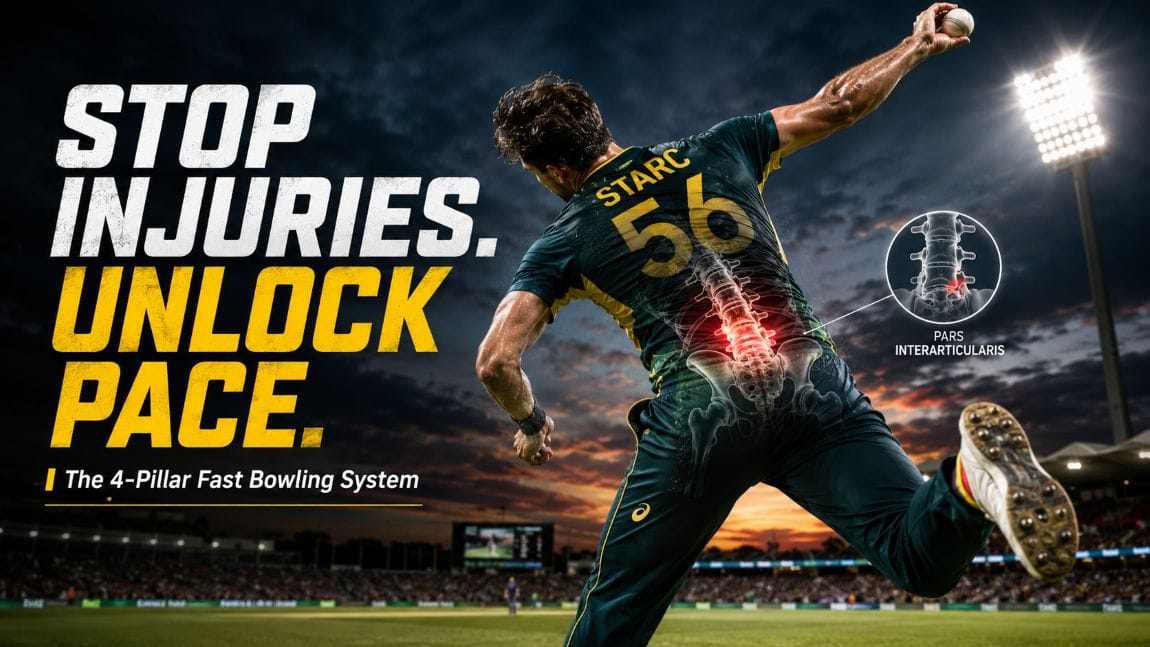
When you screen your own action with a smartphone slow-motion video, look for a dangerous contralateral tilt—your upper body leaning dramatically to the off side at delivery. That position loads the pars interarticularis asymmetrically and is the number one predictor of a bone stress reaction. The fix isn’t always a complete remodel of your action. Often, two simple cues correct it: “Run tall, don’t over-stride” and “Drive your front arm straight and strong.” A bowling efficiency-focused physio or coach can then fine-tune your hip-shoulder separation without losing pace.
The Core Four Pillars of an Injury-Proof Fast Bowler (10-Step Checklist)
*This fast bowling injury prevention guide is built on a checklist where the first three pillars deliver the highest density of actionable, evidence-based value. Pillar 4 and the remaining six advanced steps are unpacked in full later in the article with a visual injury prevention blueprint.*
Pillar 1: Master the Acute:Chronic Workload Ratio (ACWR)
The old 10% rule is too simplistic for pace bowlers. Use the ACWR equation: Acute Load (total balls bowled in the last 7 days) ÷ Chronic Load (average weekly balls over the last 28 days). A safe range is 1.0–1.5. When you push past 1.5, you’re in the danger zone—research shows injury risk can spike up to three times. The free workload calculator above automates this math and gives you a daily colour-coded risk score.
Pillar 2: Build a Bulletproof Posterior Chain
Your lower back is rarely the villain; it’s the victim of weak glutes and hamstrings. Two dedicated strength sessions a week centred on heavy hip thrusts, trap bar deadlifts, and single-leg Romanian deadlifts shift load to the muscles designed to absorb it. Bowlers who commit to progressive posterior chain training can reduce their lumbar stress fracture risk by over 60%. This isn’t about lifting ego weight—it’s about controlled, periodised overload.
Pillar 3: Time Your Nutrition for Bone & Soft Tissue Repair
Every meal is a chance to reinforce your skeleton. You need a steady stream of protein (20–30 g every 3–4 hours) to drive collagen synthesis in tendons and ligaments, plus 2000 mg of calcium daily. The non-negotiable? 800–1000 IU of vitamin D3, especially if you’re training indoors or wearing long sleeves. Without enough D3, calcium can’t mineralise your bones, leaving you vulnerable to spondylolysis—a common pars defect.
Scroll down to discover Pillar 4 (Active Recovery & Sleep Architecture) and the remaining six advanced implementation steps, all visualised in our complete Injury Prevention Blueprint diagram below.
Strength Training for Fast Bowlers: A Data-Driven Comparison
Selecting the right training tools can be overwhelming. Here’s a plain-English comparison to guide your planning. This table takes an honest look at three modalities I’ve used with club and academy bowlers, with pros and cons you can feel in your own body.
| Training Modality | Cost for Equipment | Injury Risk Mitigation | Direct Transfer to Pace | Pros | Cons |
|---|---|---|---|---|---|
| Barbell Compound Lifts (Deadlift, Hip Thrust) | High (gym access required) | Very High (with good coaching) | Very High | Maximal force generation, proven bone density stimulus, easy to progress by adding weight. | Requires technique coaching, high CNS fatigue, higher acute injury risk if form breaks down under load. |
| Plyometrics & Medicine Ball Throws | Low-Medium | Medium | High | Develops rate of force development (RFD), directly mimics rotational power of the bowling action, low joint compression. | Doesn’t build absolute strength base, minimal direct bone density improvement, often weather-dependent. |
| Resistance Band & Unilateral Bodyweight Work | Very Low | Medium-High | Medium | Portable, teaches hip stability and addresses side-to-side strength imbalances, very low acute injury risk. | Limited resistance ceiling makes long-term overload hard, cannot replace maximal strength sessions for elite development. |
A Mathematical Solution to Manage Your Bowling Load (And Keep the ACWR Honest)
Australia’s lead physio revealed fast-bowling injuries account for two-thirds of all games missed annually. Think of this as your static reference guide. Cricket Australia’s age-specific daily bowling limits provide a safe boundary:
- Under 13: Max 30 balls per day
- Under 16: Max 48 balls per day
- Under 19: Max 72 balls per day
- Senior: 90–120 balls per day (with mandatory rest days)
Plug your weekly numbers into this formula: ACWR = Acute Load (7-day total) ÷ Chronic Load (28-day rolling average).
A value between 0.8 and 1.3 is green. 1.3–1.5 is amber—proceed with caution. Above 1.5, you’re in red; you’ve spiked your load and are gambling on a bone stress reaction or side strain.
This fast bowling injury prevention guide works best when you don’t rely on memory. Grab the dynamic calculator above so your ACWR updates in real time.
The Tech-Enabled Fast Bowler: Pros and Cons of Going Wearable
Inertial measurement unit (IMU) sensors—small devices worn on the body or embedded in garments—are changing how we monitor bowling action. I’ve seen pathway bowlers use them to spot fatigue-induced technique breakdowns before the human eye can pick it up. The same technology used to navigate guided missiles now tracks fast-bowling intensity.
Pros:
- Gives instant biofeedback on dangerous metrics like peak lumbar lateral flexion and counter-rotation during the delivery stride.
- Democratises 3D biomechanics; a club bowler can access data that used to be available only in a lab with force plates and a full motion capture setup.
- Tracks workload-linked changes, helping coaches decide when to pull a bowler from a spell based on objective movement quality, not just ball count.
Cons:
- High upfront cost—most reliable units sit between 300and1,000+.
- Raw data is meaningless without someone who can interpret it; an AI motion capture summary still needs a coach’s context.
- May not perfectly replicate match conditions and could lead to over-coaching if every minor change is flagged.
The verdict? IMUs are a powerful coach’s aide but no substitute for understanding the kinetic chain and the basics of this fast bowling injury prevention guide.
The Complete Injury Prevention Blueprint: Pillar 4 & the Remaining 6 Advanced Steps
Here’s where the first three pillars extend into a sustainable, year-round system. Use this as your visual map to bulletproof your body.
Pillar 4: Optimise Sleep Architecture for Hormonal Recovery
Sleep isn’t passive rest—it’s when your body releases growth hormone and repairs bone microdamage. Aim for 8–9 hours of consistent, dark-room sleep. A 20-minute post-session foam rolling routine followed by a protein-rich meal primes your muscles for overnight repair.
Step 5: Periodise Your Training Across the Season
Off-season? Build raw strength and address imbalances. Pre-season? Transition to plyometrics and specific rate of force development work. In-season? Maintain with low-volume, high-intensity lifting and active recovery. Treat your training like you’d plan a spell—with clear intent and adequate rest.
Step 6: Implement a RAMP Warm-Up That Mirrors Bowling
Raise body temperature, Activate key muscles, Mobilise hips and thoracic spine, Potentiate with short sprints and medicine ball throws. A generic jog around the ground doesn’t prepare you for the rotational forces of a delivery.
Step 7: Perform a Structured Cool-Down with Soft Tissue Work
Five minutes of deep diaphragmatic breathing, foam rolling your thoracic spine, and stretching hip flexors can dampen cortisol and accelerate parasympathetic recovery.
Step 8: Train Mental Resilience for Rehab and Performance
Injury isolation can breed anxiety. Use mindfulness and visualisation to rehearse your action without loading the spine. Set micro-goals during rehab (e.g., pain-free single-leg balance for 60 seconds) to maintain confidence.
Step 9: Protect Youth Bowlers with a Long-Term Athletic Development (LTAD) Model
Early specialisation is the fastest route to a lumbar stress fracture. Young bowlers need multi-sport movement, foundational strength, and mandatory rest blocks—read the LTAD section below for the full plan.
Step 10: Embed Tech Thoughtfully
Use IMU wearables and AI analysis not as a replacement for feel, but as a check against dangerous patterns. Let data guide your decisions, not dictate them.
The Long Game: Long-Term Athletic Development (LTAD) for Young Bowlers
I’ve watched a 14-year-old with beautiful pace burn out by 17 because he bowled year-round without a break. Growth plates are open, bone mineral density is still accumulating, and the pars interarticularis is especially vulnerable during peak height velocity. A youth-specific fast bowling injury prevention guide must include:
- Mandated multi-sport seasons: Sprinting, swimming, or even basketball develops the motor skills and tendon resilience that a single-sport schedule can’t.
- Age-appropriate workload caps: Stick to the Cricket Australia limits mentioned earlier, and schedule at least one rest day between bowling sessions.
- Fun, not factory-line training: Build athleticism with jumping, landing, and throwing before obsessing over seam position.
Real-World Case Study: Pat Cummins’ Lumbar Stress Fracture Recovery
In 2012, a teenage Pat Cummins was diagnosed with a lumbar stress fracture that threatened to end his career before it really began. He didn’t just rest and hope; he followed a meticulously phased return plan that his physiotherapist later described as “a walk-jog-run-bowl progression tied to pain monitoring.” He respected the 48-hour recovery rule religiously and built his posterior chain strength over years, not weeks.
Today, Cummins is the world’s top-ranked bowler—proof that an evidence-based workload management plan and commitment to this kind of fast bowling injury prevention guide system works at the elite level. His story tells you that a stress fracture isn’t a career-ender; it’s a loud signal to change how you prepare.
Disclaimer: The author is not a sports medicine professional. This article is for informational purposes only and is not a substitute for advice from a qualified medical or fitness professional.