

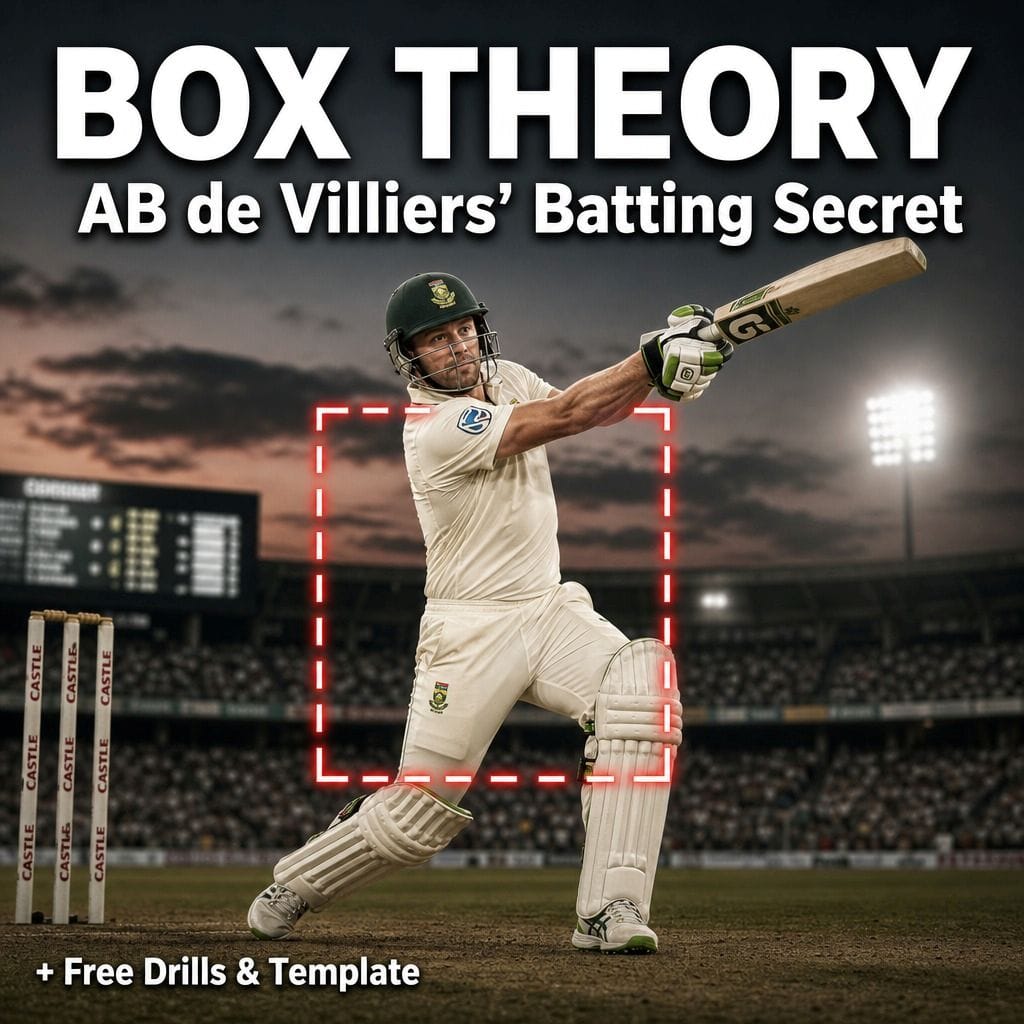
You have seen those innings. The ones where AB de Villiers looks like he is playing a different sport altogether. The ball rockets to the boundary, and his head does not move an inch. His feet shuffle, his bat swings, but everything stays locked inside a tiny, invisible rectangle. That is not magic. That is the AB de Villiers’ box theory in action.
In this guide, I will break down exactly what the box theory is, how ABD himself described it, and—most importantly—how you can train it in your own batting. You will get science-backed explanations, a side‑by‑side comparison with other techniques, three net drills, and a free downloadable mental scorecard. No fluff. Just actionable batting intelligence.
📥 Get Your Free “Box Theory Batsman’s Scorecard” Right Now!
Don’t just read about ABD’s method—use it. Download this printable PDF checklist to track your focus, balance, and execution in the nets.
Quick Answer: What is the AB de Villiers Box Theory?
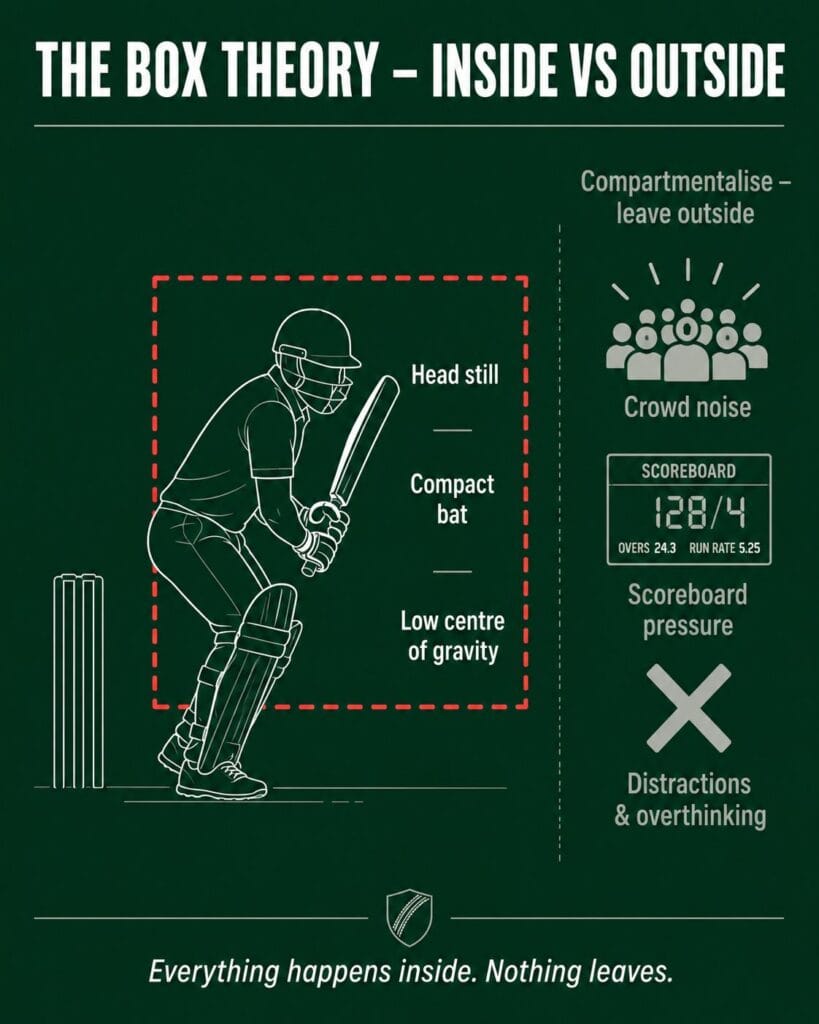
The AB de Villiers box theory is a batting mindset + technique where you imagine a small, invisible box around your stance. Rule #1: No part of your bat, head, or feet leaves that box during the shot.
Inside the box: still head, compact backlift, low centre of gravity. Outside the box: scoreboard pressure, crowd noise, previous ball → all compartmentalised.
- Physical win: Better balance + clearer vision (your head doesn’t wobble).
- Mental win: “See ball, hit ball” – no mental clutter.
- Real example: ABD’s 73* off 33 balls (IPL 2020) – he didn’t even know the required rate.
👉 Bottom line: It’s not magic. It’s a teachable system of stillness + compartmentalisation.
Getting your gear right is step one; the best cricket bat under ₹2000 guide can help you start with the right tool before you dive into our technique drills.
Now let us go deeper.
What Is AB de Villiers’ Box Theory? in His Own Words
In a masterclass session (mentioned on The genius of AB by Wisden), AB Devilliers explained the box theory using almost the exact words that have become legendary among batting coaches:
“I don’t want any part of my bat, feet, head, nothing to leave this box. Everything must happen in this box.”
He drew an imaginary rectangle around his stance—roughly from his shoulders down to his knees, and about shoulder‑width wide. Inside that box, his entire batting mechanism must function. The backlift stays short. The head stays absolutely still. The feet adjust subtly, but they never slide outside the box.
Real example: Watch ABD’s 133 not out against MI in IPL 2015. At 0:23 in the highlights, he faces a short ball. His head does not tilt back. His bat does not go higher than his shoulder. Everything stays inside that imaginary box, yet the ball travels over point for six. That is the box theory in real time.
For you, the takeaway is this: the box theory is not a gimmick. It is a constraint that builds elite habits. By limiting movement, you actually gain control.
The Two Core Components of the AB de Villiers’ Box Theory
The AB Devilliers box theory is not only about physical stillness. It has two equally important halves. Ignore one, and the other falls apart.
Physical Component – The Biomechanical Box
- Still head: Your head is heavy (about 5 kg). Every millimetre of head movement shifts your balance and degrades your vision. The box forces you to lock your head in place.
- Short, compact backlift: The bat never goes past your shoulder. This shortens the time from decision to contact.
- Low centre of gravity: Knees slightly bent. Weight on the balls of your feet. You become harder to dislodge.
- Controlled follow‑through: The bat finishes inside the box, not wrapped around your back.
Mental Component – Compartmentalisation
This is where the AB de Villiers’ box theory becomes a superpower. Compartmentalisation means you mentally put every distraction into a separate box and close the lid. Scoreboard pressure? Outside the box. Hostile crowd? Outside. Previous ball that beat your edge? Outside.
The only thing inside your mental box is the next ball, your balance, and your intent to hit it.
Real example: During RCB vs KKR in IPL 2020, ABD walked in at 45 for 3, chasing a steep target. Later, he said he did not even know the required rate. He had compartmentalised everything. His brain was inside the box. Only the ball existed. He scored a match‑winning 73* off 33 balls.
Why the AB de Villiers’ Box Theory Works: The Science of the Still Head
You might think the box theory is just a neat visualisation trick. It is not. There is real biomechanics and neuroscience behind it.
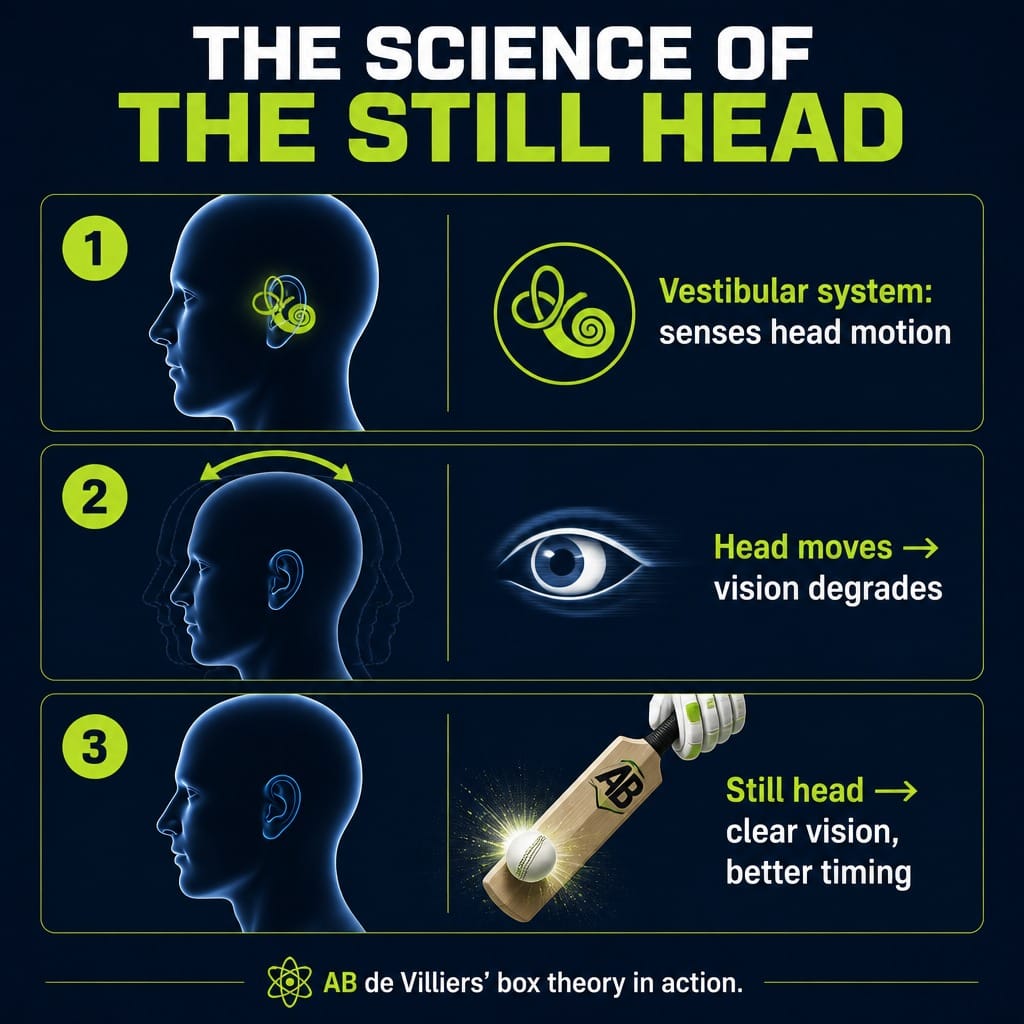
The Vestibular System – Your Hidden Gyroscope
Inside your inner ear, you have the vestibular system. It senses head motion and sends signals to your eyes to stabilise your gaze. When your head moves, your eyes have to make rapid corrections. That takes milliseconds.
A still head means your vestibular system is calm. Your eyes can track the ball seamlessly from the bowler’s hand to the bat. That is why AB de Villiers could pick slower balls and yorkers later than almost anyone. He literally saw the ball longer.
Balance and Force Transfer
A moving head leaks power. Try this at home: stand on one leg and move your head side to side. You wobble. Now keep your head frozen. Your balance improves instantly. In batting, a still head allows you to transfer your body weight smoothly into the shot. You generate power from your legs and hips, not from throwing your head at the ball.
Why this matters for you: Most club cricketers miss because their head falls over. The box theory directly fixes that.
AB de Villiers’ Box Theory vs. Other Batting Philosophies: A Technical Comparison
To understand how unique the AB Devilliers box theory is, compare it with two other well‑known batting approaches. Use this table to decide which style fits your game.
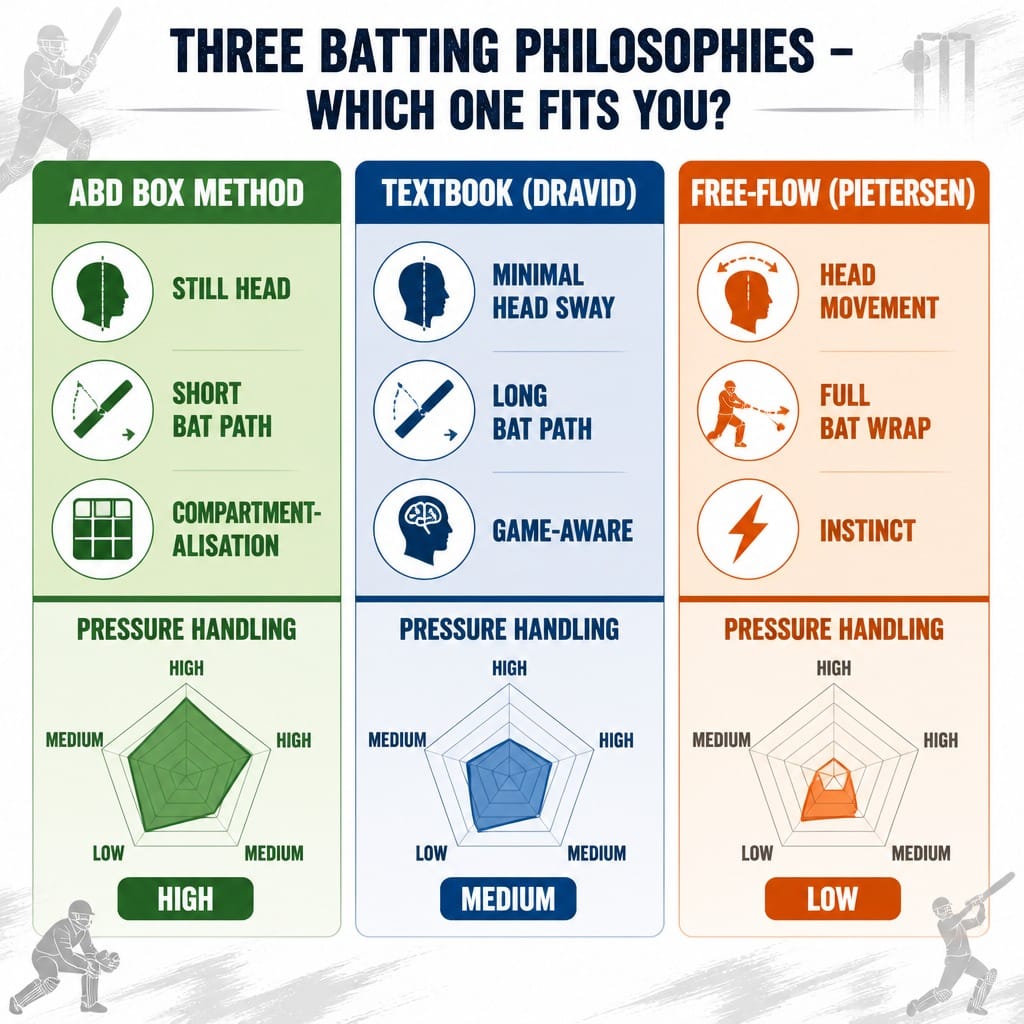
| Variable | 🟢 ABD Box Theory Method | 🟡 “Textbook” Method (e.g., Dravid) | 🔴 “Free-Flow” Method (e.g., Pietersen/Gayle) |
|---|---|---|---|
| Core Principle | Compartmentalisation & Stillness | High-volume, high-discipline repetition | Aggression & Instinctual reaction |
| Head Movement | Almost zero | Minimal, but more vertical sway | Often pronounced, using momentum for power |
| Bat Path | Short, compact, “cut-off” follow‑through | Long, straight, classical through the V | Full, flowing, wrap‑around |
| Mental State | “See ball, hit ball”—clears all other noise | Scoreboard and game‑situation aware | Calculated risk‑taking |
| Best Suited For | High‑pressure chases and variable pitches | Building long Test innings | Flat, high‑scoring T20 wickets |
| Criticism | Can feel restrictive to creative players | Can be predictable in modern T20 | High risk of dismissal |
Where does your batting sit? If you struggle under pressure, the box theory is your answer. If you enjoy long, classical drives, blend Dravid’s discipline with ABD’s still head. If you are a power hitter, adopt at least the head stillness component from the box.
A Step‑by‑Step Guide to Mastering the Box Theory (With Downloadable Template)
You cannot learn the box theory by reading alone. You need to train it. Here is a practical, 4‑phase system. Use the free downloadable scorecard (linked above and below) to track your progress after every net session.
Phase 1: Stance Setup (Off the Pitch)
Stand in front of a mirror in your batting stance. Using your fingers, trace an imaginary box on the mirror:
- Top edge = just above your shoulders.
- Bottom edge = just below your knees.
- Left edge = outside your left shoulder.
- Right edge = outside your right shoulder.
Now move your head. See how fast it touches the top or sides? That is failure. Practice holding your head still for 30 seconds. Then add small foot movements. Keep the head frozen.
Phase 2: Shadow Batting with Box Awareness (In the Nets – No Ball)
Stand at the crease. Visualise the box. Shadow a forward defence. Your bat must not cross the side edges. Your head must not move. Your follow‑through must stop before the box boundary. Do 20 shadow shots.
Phase 3: Slow Throw‑Downs (Execution)
Have a coach throw underarm from 8 metres. Your only goal: keep the bat inside the box. Do not care where the ball goes. Care only about staying compact. After 20 balls, start adding power—but still, the box is the boss.
Phase 4: Match Simulation (Use the Scorecard)
Download the scorecard. For each ball in a net over, rate:
- Head stillness (1–5)
- Compact backlift (1–5)
- Compartmentalisation (1–5) – did you reset after each ball?
Target a score of 12 or higher per over.
The 5‑Step Pre‑Delivery Mental Checklist (From AB de Villiers’ Box Theory Routine)
Before every ball, AB Devilliers runs a silent mental checklist. You can copy it word for word. Write it on your bat grip if needed.
| Step | Mental Cue | Why It Works |
|---|---|---|
| 1 | “Box on.” | Visualise the imaginary rectangle around you. |
| 2 | “Head locked.” | Feel your neck muscles engage. |
| 3 | “Outside noise gone.” | Compartmentalise the score, the crowd, the previous ball. |
| 4 | “See the release.” | Focus only on the bowler’s hand and the seam. |
| 5 | “Trust the box.” | Whatever the ball does, you react—without leaving the box. |
Real example: In the 2015 World Cup semi‑final, ABD faced Mitchell Starc’s searing yorkers. He later said his only thought was “head still, bat straight”. That is step 2 and step 5 combined. He scored 65 off 45 balls under extreme pressure.
3 Elite Drills to Train the AB de Villiers Box Theory in the Nets
These drills are designed to ingrain the AB Devilliers box theory into muscle memory. Do them twice a week for four weeks.
Drill 1: The Head‑on‑a‑Shelf Drill (Physical)
Place a foam roller or a rolled‑up towel across your shoulders. Now bat against throw‑downs. The roller must not fall off. If it falls, your head moved. This brutally enforces still head. Start with slow balls, then increase pace.
Drill 2: The Distraction Drill (Mental)
Have a friend stand behind the bowler’s arm. Before each ball, they shout a number (e.g., “required rate 12” or “last ball wicket”). Your job: ignore it completely. Answer only after the ball is dead. This trains compartmentalisation exactly like ABD.
Drill 3: The Box Boundary Tape (Visual)
Place two pieces of coloured tape on the net floor: one under each armpit (shoulder‑width apart). Your feet must never step outside these tapes during the shot. This restricts unnecessary lateral movement and keeps your power aligned.
Applying the Box Method: Power Hitting vs. Defensive Play
The AB Devilliers box theory is not one‑size‑fits‑all. You tweak it based on the match situation. Here is a pros‑and‑cons breakdown for two common roles.
Pros & Cons: The Box Method for Power Hitters vs. Technical Anchors
| Strategy | Primary Role | ✅ Pros (When to Use It) | ❌ Cons (The Trade‑Offs) |
|---|---|---|---|
| The Box Method (ABD style) | All‑round approach | • Unshakeable focus in high‑pressure moments. • Eliminates technical flaws. • Adaptable to any format. • Data point: ABD could defend a 145kph ball to “rest at his feet”. | • Can feel restrictive for natural aggressors. • Requires significant mental discipline. • The “cut‑off” bat follow‑through may reduce raw power. |
| The Power‑Hitter Adaptation | T20 finisher (e.g., Jos Buttler) | • Generates maximum bat speed and power. • Arms free from the body for full extension. • Natural for lofted six‑hitting. | • Higher risk of head movement. • More prone to mis‑hits or edges. • Requires a very still head at the core to work. |
| The Anchor Adaptation | Test accumulator (e.g., Dravid/Cook) | • Perfect for long, attritional battles. • Low‑risk, high‑reward for survival. • Aids in judging the ball late. | • Harder to accelerate quickly. • Can become defensive. |
My recommendation: Start with the pure box method. Once it is automatic, loosen the follow‑through for power or tighten it for defence. The still head and compartmentalisation remain non‑negotiable.
Beyond the Boundary: How the Box Theory Enhances Focus in Business and Life
You came here for cricket, but the AB Devilliers box theory has travelled well beyond the crease. High‑performing professionals in finance, surgery, and even parenting have adopted it. Here is how you can use it tomorrow morning.
- Presentations: Your “box” is the slide deck. Ignore the faces in the room. Ignore the question about last quarter’s dip. Focus only on the next slide and the one idea you must communicate.
- Stressful negotiations: Your “box” is the contract clause. Compartmentalise the personal relationship, the time pressure, and the other party’s bluffing. Only the words on the page matter.
- Parenting a toddler meltdown: Your “box” is the next 10 seconds. Do not think about the mess, the grocery shopping, or the meeting you are late for. Just handle the immediate physical safety of your child.
The common thread: you choose what enters your awareness. Everything else stays outside the box.
Common Mistakes When Trying the Box Method (And How to Fix Them)
Even committed cricketers mess up the AB Devilliers box theory. Watch out for these three errors.
Mistake 1: The “Turtle Neck” – Holding the Head So Still That You Get Stiff
Fix: Still does not mean rigid. Your neck should be relaxed, not clamped. Think of a lighthouse: the base is still, but the light beam moves freely. Your head is the base. Your eyes move, your neck stays soft.
Mistake 2: Forgetting to Reset After Every Ball
Fix: Compartmentalisation is repetitive. After each ball, consciously say “reset”. Wipe the previous ball’s result from your mind. Then rebuild the box.
Mistake 3: Making the Box Too Big
Fix: A wide box lets your bat wander. Keep it snug. Shoulder‑width only. If you can touch the box edges with your elbows, it is too wide.
Your Next Step: Download the Scorecard and Hit the Nets
The AB Devilliers box theory is not a secret talent. It is a system. And systems can be learned. Stop treating ABD’s batting as magic. Treat it as a blueprint.
Here is what you do now:
- Download the free Batsman’s Box Scorecard (again, here is the link).
- Print it and take it to your next net session.
- Run Drill 1 (Head‑on‑a‑Shelf) for 15 minutes.
- Score yourself honestly.
Within three sessions, your head will be stiller. Your focus will be sharper. And you will start to understand why AB Devilliers always looked like he had more time than everyone else.
👉 [Download the Batsman’s Box Scorecard Now (Free PDF)]
Frequently Asked Questions
Got questions about the box theory? Here’s what cricketers usually ask.
❓ Can a beginner learn the AB de Villiers box theory?
Absolutely. In fact, beginners benefit the most. The box theory forces you to build a still head and compact technique from day one – two habits that most club cricketers take years to fix. Start with shadow batting and the “Head‑on‑a‑Shelf” drill. Within two weeks, your balance will be visibly better.
❓ Does the box theory reduce power hitting?
Not if you adapt it. Pure box method has a shorter follow‑through, which slightly caps raw power but massively increases control and timing. For power hitting, keep the still head + compartmentalisation but allow a fuller bat swing after contact. That’s how ABD himself switched from defence to six‑hitting – the box is for setup, not for shackling.
❓ How long does it take to master the box theory?
You will see head stillness improvement in 3‑4 net sessions (about 2 weeks). Mastering mental compartmentalisation takes 6‑8 weeks of deliberate practice – meaning you consciously reset after every ball. Use the free Box Scorecard (download above) to track your progress. Most players reach “automatic” box awareness after 15‑20 hours of focused training.
❓ What if I face a yorker or a bouncer – does the box still apply?
Yes – even more so. Against a yorker, a still head and compact bat are your only chance to jam it out. Against a bouncer, you duck or weave – but your head should stay level, not tilt back. Watch ABD face Mitchell Starc’s yorkers in the 2015 WC semi: his head never moved. The box theory actually improves your reaction time because your eyes aren’t fighting head wobble.
❓ Can I use the box theory in tennis / baseball / other sports?
Yes – the principle of compartmentalisation + still head transfers directly. Tennis players use a “quiet eye” technique (same vestibular science). Baseball hitters talk about “staying inside the ball”. Even golfers keep their head still through impact. The box theory is just a vivid way to describe elite focus under pressure. Give it a try in your sport – you will be surprised.
❓ Why is AB de Villiers the only player famous for the box theory?
He isn’t the only one – but he is the best spokesperson. Many top batters (Kane Williamson, Hashim Amla, even Virat Kohli in his early years) use a still head and compact game. ABD gave it a name and explained it publicly. The difference is his 360‑degree shot selection while keeping the box intact – that is uniquely rare. He turned a basic coaching cue into an art form.
📌 Still have questions? Drop a comment below or tag me on social – I reply to every cricket question.
Once you have mastered the box theory in the nets, you will want a dedicated space to practise it daily. – our Home Cricket Training Setup Guide: Build Your Perfect Practice Space on Any Budget breaks down the must‑have items that every home setup needs.