
1. Introduction – The Question Most Fans Get Wrong
You may have watched hundreds of cricket matches, celebrated last-ball finishes, and argued over LBWs — but here’s a surprising question: How many creases are actually there on a cricket pitch?
If you answered two, three, or said “the batting and bowling crease”, you’re not alone. Many fans notice the lines but don’t fully understand their purpose. Yet these simple white lines decide no-balls, run-outs, stumpings, and even match results.
Let’s break it down in the simplest way possible.
2. The Quick Answer
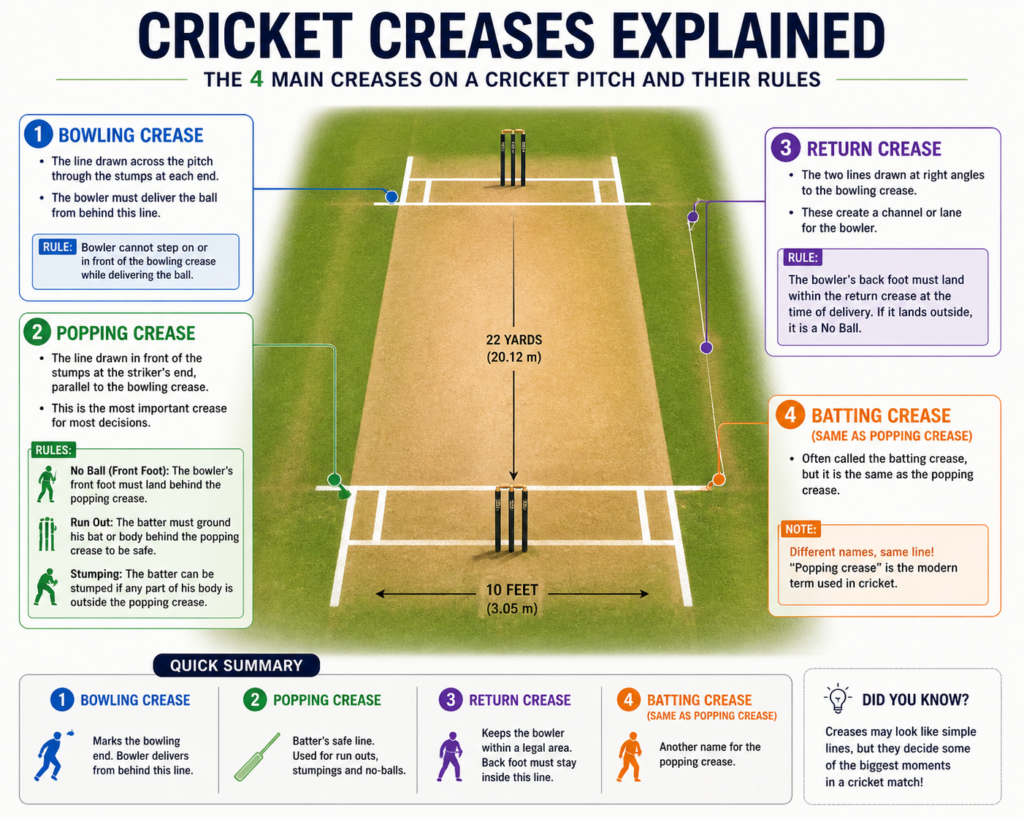
There are 4 main creases on a cricket pitch:
- Bowling crease
- Popping crease
- Return crease
- Batting crease (often confused with popping crease)
Most fans only know 2–3 of them, which causes confusion during umpire decisions.
3. Why Creases Exist in Cricket
Creases are not decorative lines — they are rule boundaries. They help:
- Keep competition fair between batter and bowler
- Provide reference points for umpires
- Define legal and illegal movement during play
- Prevent unfair advantages
Without creases, judging no-balls, stumpings, or run-outs would be impossible.
Think of them as cricket’s invisible rulebook drawn on the ground.
The Four Cricket Creases Explained
4. The Bowling Crease Explained
What is the Bowling Crease?
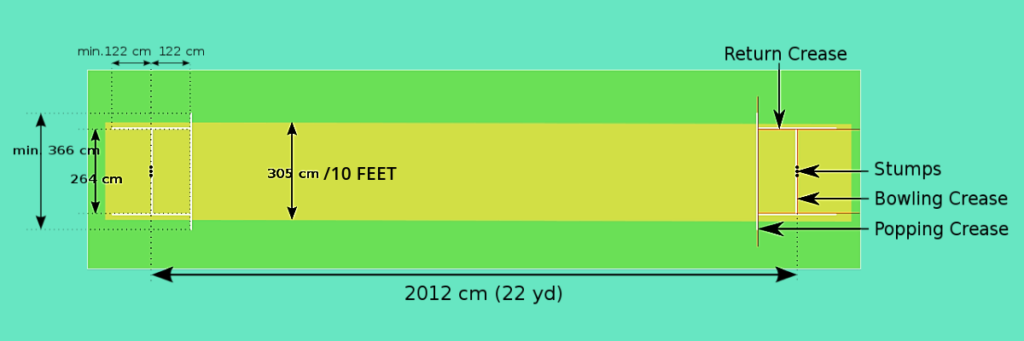
The bowling crease is the line that runs across the pitch through the center of the stumps at both ends.
Key Rule
The bowler must deliver the ball from behind this line.
Why It Matters
This line determines whether a delivery is legal.
Important Rules
- The bowler’s front foot must land behind the popping crease, but the bowling crease helps define the bowling area.
- Run-outs at the striker’s end are judged relative to this crease.
- Fielding positions close to the wicket also use this line as reference.
In Simple Words
It marks where the bowler is allowed to bowl from.
5. The Popping Crease Explained (The Most Important Line)
If there is one crease that decides the most match moments, it is the popping crease.
What is the Popping Crease?
It is the line in front of the batting stumps, parallel to the bowling crease.
Why It Matters
This line defines the batter’s safe zone.
If any part of the batter or bat is grounded behind this line → the batter is safe.
Major Decisions Based on Popping Crease
1. No-Ball Rule (Front Foot No Ball)
A bowler’s front foot must land behind the popping crease when delivering the ball.
If the foot crosses the line → No Ball.
This gives:
- 1 extra run
- Free hit in limited-overs cricket
2. Run-Out Rule
A batter is safe if:
- Bat or body is grounded behind the popping crease.
If outside the crease and the stumps are broken → Run-Out.
3. Stumping Rule
When a batter steps out to hit and misses:
- If wicketkeeper breaks the stumps while batter is outside the popping crease → Stumped.
Why Commentators Talk About It Constantly
Every close decision uses this line.
6. The Return Crease Explained (The Forgotten Crease)
Most fans don’t even know this crease exists!
What is the Return Crease?
Two lines drawn perpendicular (vertical) to the bowling crease on both sides of the pitch.
These lines create a lane for the bowler.
Key Rule
The bowler’s back foot must land inside the return crease during delivery.
If the foot lands outside → No Ball.
Why This Rule Exists
Without it, bowlers could:
- Bowl from extremely wide angles
- Gain unfair advantage over batters
This rule ensures fair bowling angles.
Simple Explanation
Return creases keep bowlers within a legal bowling corridor.
7. Batting Crease vs Popping Crease – The Biggest Confusion
Many fans think the batting crease is a separate line.
In reality:
- The batting crease is simply another name for the popping crease.
Why Two Names Exist
Historically:
- Early cricket called it the batting crease.
- Modern cricket uses the term popping crease.
So when commentators say:
- “He’s safe in his crease”
They mean the popping crease.
8. How Creases Decide Real Match Moments
Let’s look at real match scenarios.
Scenario 1 — The Dramatic No Ball
Bowler bowls a perfect yorker and takes a wicket.
Replay shows the foot crossed the popping crease → No Ball → wicket cancelled.
Match turning moment.
Scenario 2 — Run-Out by Inches
Batter dives. Bat lands just short of the popping crease.
Bails removed → OUT.
Matches have been won and lost by millimeters here.
Scenario 3 — Classic Stumping
Batter charges down the pitch, misses the ball.
Keeper removes bails instantly → OUT stumped.
All judged using the popping crease.
Scenario 4 — Bowler Foot Fault
Bowler delivers from too wide, back foot outside return crease → No Ball.
9. Easy Trick to Remember All Creases
Use this simple memory hack:
- Bowler starts → Bowling Crease
- Batter safe → Popping Crease
- Bowler stays inside → Return Crease
That’s it!
10. Beginner FAQ
How wide is the cricket pitch?
The pitch is 10 feet (3.05 m) wide.
Which crease matters most?
The popping crease — it decides most dismissals and no-balls.
Why do umpires check the bowler’s feet?
To ensure:
- Front foot behind popping crease
- Back foot inside return crease
Are crease measurements fixed?
Yes. International cricket follows strict pitch measurement laws.
11. Conclusion
So, how many creases are there in cricket?
Four.
- Bowling Crease
- Popping Crease
- Return Crease
- Batting Crease (same as popping crease)
These simple white lines decide no-balls, stumpings, run-outs, and sometimes entire matches.
Next time you watch cricket, look closely at the pitch — you’ll suddenly understand every close decision like an expert. 🏏
You can read the official rule here: https://cricket.velsarena.com/2020/09/04/law-7-the-creases/
Read more posts:
- https://overthewicket.in/chennai-super-kings-2026-squad-analysis-new-era-led-by-ruturaj-gaikwad-sanju-samson/
- https://overthewicket.in/can-sanju-samson-deliver-again-ipl-form-ahead-of-mi-rivalry/
- https://overthewicket.in/why-ipl-is-the-richest-cricket-league/
- https://overthewicket.in/statement-comeback-by-dc-won-by-7-wickets/