
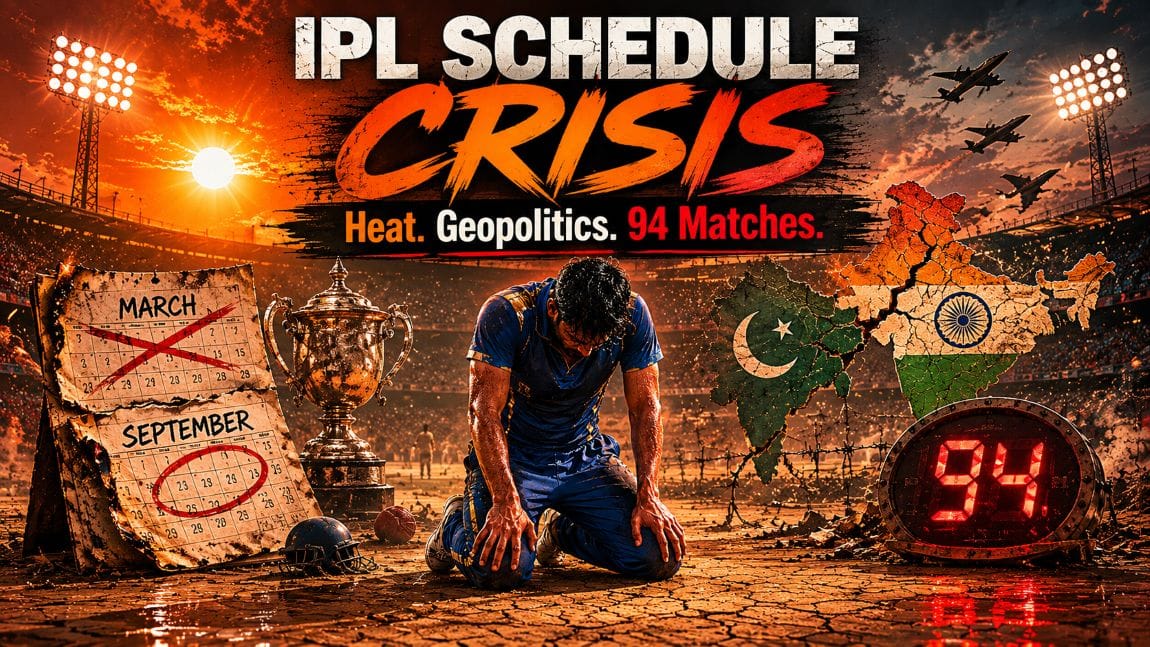
Let me be honest with you: I’ve been following the IPL since the days of green jerseys and Sony Max. And never—never—has the IPL schedule crisis felt this close to a breaking point.
We saw players collapsing from heatstroke, a military conflict actually suspended matches. And quietly, behind the scenes, the BCCI is trying to cram 94 matches into a calendar that can barely handle 74.
This isn’t a “scheduling issue.” It’s a five-headed monster. And if you care about cricket—real cricket, not just the glitz—you need to understand what’s actually going on.
Below, I’ve broken down everything: the heat data, the geopolitical wildcard, the 94-match math trap, the international player squeeze, the silent death of Ranji Trophy, and the carbon elephant no one wants to talk about.
Let’s get into it.
✅ Quick Answer: What Is The IPL Schedule Crisis In One Paragraph?
The IPL schedule crisis refers to the growing impossibility of fitting a 74‑match (Soon to become 94 matches) T20 league into the traditional March–May window without breaking players, clashing with international cricket, colliding with India’s domestic season, and literally cooking athletes in extreme heat. The crisis has five distinct layers: climate (48% of matches now in “danger” heat), geopolitics (the 2025 India‑Pakistan suspension proved no schedule is safe), commercial pressure (94 matches require double‑headers that lose ₹47 crore each), international player conflicts (South Africa vs Australia ultimatums), and the slow erasure of Ranji Trophy. The BCCI is exploring a September–October shift, but that brings its own nightmares. This is not a small problem.
🏏 Want more cricket breakdowns like this every week?
IPL Schedule Crisis: Why IPL Heat Crisis 2025 Was Only The Beginning
Let me give you a number: 48%. That’s the proportion of IPL 2025 matches played under either “extreme caution” or “danger” heat ratings, according to the Hit for Six report by the British Association for Sustainability in Sport.
Let that sink in. Nearly half the tournament happened in conditions where any sensible employer would have sent workers home.
But cricketers aren’t office workers. They run, dive, bowl 140kph, and stand in the sun for seven hours. And last season, we saw the results.
Real examples – not hypotheticals
- Ravindra Jadeja made an abrupt early exit during an IPL 2026 playoff match. According to reports, his departure was linked to physical discomfort and exhaustion, with the all‑rounder experiencing cramps and intense fatigue after spending a long time at the crease under severe heat conditions.
- Vaibhav Sooryavanshi – the 15‑year‑old Rajasthan Royals batter – was forced off the field during a match in Jaipur after four overs in the second innings. Initially feared to be a hamstring injury, the team coach later clarified that the youngster had been hit by severe cramps, which are extremely common when playing in intense heat.
- Krunal Pandya played through a dramatic innings for RCB despite being so badly affected by cramps that he could barely hobble between wickets. He switched to hitting sixes rather than running singles, collapsed after some shots, but got back up to face the next ball – a raw display of what extreme heat forces players to endure.
- Cameron Green struggled with cramps during a match against Gujarat Titans in Ahmedabad, where the extreme conditions caused a relapse of physical distress. His captain Ajinkya Rahane later spoke publicly about how the oppressive heat was affecting players’ ability to perform.
- Rasikh Salam Dar bowled through severe cramps in his first game of the season for RCB, continuing to deliver despite being in obvious pain. After the match, he admitted, “After almost every ball, I was cramping”.
- In the CSK vs DC clash at Chepauk, players were visibly struggling with Chennai’s notorious humidity. David Miller was seen completely drained, splashing water on his face during a break just to stay functional in the extreme heat. The same match saw Tristan Stubbs repeatedly pouring water over his head, highlighting how routine cooling measures have become a survival tactic rather than a comfort. In a separate incident during RCB vs MI, Rasikh Salam Dar triggered multiple medical time‑outs due to recurring heat‑induced cramps, prompting commentator Sunil Gavaskar to accuse the team of time‑wasting – a reminder that even public frustration sometimes overshadows the genuine physical toll on players
A note on hospitalisations: While IPL 2025 saw stark examples like Ishant Sharma being helped off the field and Shah Rukh Khan (the bowler) hospitalised, media coverage in 2026 has focused more on frequent cramping, on‑field exhaustion and medical time‑outs rather than headline‑grabbing heatstroke cases. That shift doesn’t mean the crisis has eased – it means the league and its medical staff have adapted, often keeping players on the field when they probably shouldn’t be. The absence of a dramatic collapse doesn’t equal safety.
Here’s the climate data the articles don’t show you:
Hazardous heat days in major IPL cities (1970 vs 2025vs 2026)
Context on the 2026 Data: Because the India Meteorological Department (IMD) has shifted its reporting to focus on “heatwave days” rather than just “days over 40°C,” the 2026 data reflects this more precise metric. A heatwave is declared when maximum temperatures are 4.5°C to 6.4°C above normal. This change provides a clearer picture of the escalating crisis, showing it’s not just about a single high temperature, but the sustained, dangerous intensity of the heat.
Source: India Meteorological Department collation
By 2035, climate models suggest 70% of the traditional March–May window could fall into red‑zone classification. That’s not a scheduling headache. That’s a medical lawsuit waiting to happen.
Dr. Mike Tipton, a leading heat‑stress researcher, put it bluntly: “Players are being asked to perform in potentially dangerous environments, and the response has been reactive, not preventive.”
The BCCI’s answer? Explore a September–October window. Cooler weather, yes. But that shift triggers the next four crises simultaneously.
IPL Schedule Crisis: How IPL Suspended India Pakistan Exposed A Geopolitical Nightmare
You know what makes the IPL schedule crisis truly unfixable? War.
Not “tensions.” Actual military conflict.
On April 22, 2025, following the Pahalgam attack and India’s “Operation Sindoor” response, the BCCI did something unprecedented: they suspended the IPL for one week.
No contingency plan was fully ready. Franchises scrambled. Players were stuck in hotels. Broadcasters lost prime‑time inventory. And for seven days, the richest cricket league in the world looked genuinely fragile.
This wasn’t hypothetical – it happened
Pakistan simultaneously shifted the PSL to the UAE. But the IPL couldn’t move that fast. The BCCI’s crisis playbook – which I’ve seen fragments of from team insiders – contains seven options. Let me rank them for you by feasibility.
IPL Suspension Contingency Options – Realistic Ranking
| Contingency Plan | Feasibility | Cost Impact | Player Availability Risk | Has It Been Used? |
|---|---|---|---|---|
| Resume post‑monsoon (Sept–Oct) | High | Medium (broadcaster renegotiation) | Low – but clashes with international calendar | ✅ 2021 (COVID) |
| Shift to UAE | High (proven) | High | Medium – neutral venue acceptance | ✅ 2020, 2021 |
| Bio‑secure Southern India hubs | Medium | Medium | Low – domestic travel only | ✅ 2020 bio‑bubble |
| Shift to South Africa | Medium | High | High – CSA player duty conflicts | ⚠️ 2009 (partial) |
| Condensed “Mini IPL” | Low | High (revenue loss) | Medium – compressed fatigue | ❌ No precedent |
The most frightening part? The BCCI doesn’t control any of these triggers. A single border incident, a drone allegation (Pakistan claimed Rawalpindi stadium was targeted – unverified, but it shaped decisions), or even a political speech can unspool months of planning.
This is the wildcard that no scheduling algorithm can solve. The IPL schedule crisis isn’t just about heat or double‑headers. It’s about the fact that the league can be switched off by forces outside cricket.
And yet, the BCCI is pushing for 94 matches. In a country with a volatile neighbour. Tell me that makes sense.
IPL 94 Matches Expansion – The Double‑Header Math Problem
Here’s where the IPL schedule crisis becomes a pure numbers game.
The BCCI wants a 94‑match season. That means each of the 10 teams plays 9 home + 9 away games. Sounds great for fans. Sounds great for broadcasters – until you do the math on double‑headers.
A 94‑match season in the current March–May window is impossible without extensive double‑headers (two matches per day). The problem? Afternoon matches lose viewers. A lot of viewers.
The advertising math – no fluff, just numbers
Let me walk you through it:
- A standard evening match (7:30 PM IST) gets full viewership. Call it 100% revenue potential.
- An afternoon match (3:30 PM IST) typically gets around 60% of evening viewers. People are working, commuting, napping.
- JioHotstar currently pays approximately ₹118 crore per match for the IPL media rights.
Now calculate a double‑header (afternoon + evening):
Afternoon value = ₹118 cr × 0.6 = ₹70.8 cr
Evening value = ₹118 cr × 1.0 = ₹118 cr
Double‑header total = ₹188.8 cr
Now compare to two separate evening matches:
₹118 cr + ₹118 cr = ₹236 cr
Loss per double‑header = ₹47.2 crore (about $5.6 million)
A 94‑match season would require at least 20 double‑headers (because you can’t fit 94 evenings into 60 days). That’s a projected loss of ₹944 crore – nearly a billion dollars in unrealised revenue.
Broadcasters have made it quietly clear: they do not want double‑headers. They’d rather have 74 evening‑only matches than 94 matches with afternoon slots.
So the IPL schedule crisis here is a beautiful paradox:
- Franchises want more matches (more ticket, merch, sponsor revenue)
- Broadcasters want fewer but higher‑quality matches
- BCCI wants expansion but can’t force double‑headers
- The calendar can’t accommodate 94 evening matches
The September–October window? That would solve the double‑header problem – but then you clash with international cricket (see next section). No free lunch.
IPL vs International Calendar – The Player Workload Crossfire
Let me paint you a scene from the 2025 IPL playoffs.
In one dressing room, two overseas players are sitting next to each other. One is Australian. One is South African.
The Australian gets a call: “You can stay for the full IPL. No problem.”
The South African gets a call: “You must leave by May 26. CSA needs you for the WTC final. No exceptions.”
That actually happened.
South Africa’s hardline vs Australia’s flexibility
| CSA (South Africa) | CA (Australia) |
|---|---|
| 8 players ordered to leave IPL before playoffs | Pat Cummins played full season |
| WTC final preparation declared non‑negotiable | No ultimatum issued |
| Players privately furious but can’t say publicly | Player‑centric approach |
| Consequence: CSA-branded leagues may lose IPL favour | Consequence: Australian players now expect IPL first, country second |
This creates real intra‑squad tension. Imagine you’re an IPL team owner. You’ve paid millions for a South African star. He has to leave before the knockout matches. Meanwhile, your Australian player stays. How do you plan? How do you build loyalty?
Now multiply that by ten teams and six national boards.
The IPL schedule crisis here is structural: the league now demands so much calendar space that it inevitably crushes bilateral and Test cricket. The BCCI has asked all boards to release players for the full IPL window. Most say yes – but with growing resentment.
The West Indies, already struggling with player availability, faced additional travel chaos during the 2025 Gulf crisis. Sri Lanka, Bangladesh, Afghanistan – they all bend. But South Africa drew a line.
That line is only going to get harder. More boards will start saying “no” as the IPL window expands into September–October, which directly overlaps with the traditional start of the northern hemisphere international season.
Result? Fewer top international stars in future IPLs. Or a two‑tier league where only Indian and Australian players are reliably available. Neither is good for the product.
IPL vs Ranji Trophy Conflict – Domestic Cricket’s Silent Death
Now we get to the part that makes me genuinely sad.
I grew up watching Ranji Trophy highlights on DD Sports. It wasn’t glamorous. But it produced Dravid, Sehwag, Ashwin, Jadeja – the spine of Indian cricket.
Today? The IPL schedule crisis is quietly strangling Ranji.
Let me show you a comparison that the BCCI doesn’t publish.
| Parameter | Ranji Trophy | IPL |
|---|---|---|
| Matches per team per season | 8–10 (first‑class, 4 days) | 14 (T20, 3 hours) |
| Rest days between matches | 3 (historically) | 2–4 (flexible) |
| BCCI scheduling priority | Secondary | Primary |
| Player selection incentive | Required for India consideration | Required for financial survival |
| Broadcast revenue | Minimal (not disclosed) | ₹118 crore per match |
| Match fee (approx.) | ₹1–2 lakh per game | ₹3 crore+ annual average |
The message is clear: play Ranji if you want to be selected for India. But we’ll schedule Ranji matches with 48‑hour turnarounds, in the same heat, with no broadcast money, while we give IPL its own bespoke window and sports science teams.
The result? A quiet exodus.
This slow collapse of domestic cricket isn’t just hurting Ranji Trophy — it’s one of the biggest reasons Why 99% Fail to Become a Professional Cricketer in India (And 1% Blueprint to Survive)— because without a functional red‑ball pathway, thousands of talented youngsters never get the structured development they need.
What players actually say (anonymously, because they have to)
- “Why would I risk injury in a Ranji game for ₹1 lakh when I can rest and prepare for IPL auctions?”
- “Ranji feels like a formality. Three days of my life that don’t move my career forward.”
- One current India international (off the record): “The board tells us to play domestic red‑ball. Then they schedule Ranji rounds during IPL preparation camps. You do the math.”
The BCCI has actually formed a committee to evaluate the “necessity of domestic cricket tournaments.” Read that again. They’re questioning whether Ranji Trophy – 90 years old, producer of legends – is necessary.
That’s not a crisis. That’s an obituary being drafted.
The IPL schedule crisis isn’t just about dates on a calendar. It’s about what we’re losing. Ranji Trophy might not be around in its current form by 2030. And when it’s gone, Indian cricket will produce fewer Test players. Mark my words.
IPL Carbon Footprint Per Match – The Greenwashing Paradox
I’ve saved the most uncomfortable part for last.
The BCCI talks about sustainability. They launched the Green Dot Ball initiative. “Trees for Dot Balls.” Nice slogans.
But here’s the number no press release mentions: 10,000 to 14,000 tonnes of CO₂ equivalent – per IPL match.
Let me break that down for you.
One IPL match = one small district’s daily emissions
| Source | CO₂e (tonnes) | What it equals |
|---|---|---|
| Spectator travel (35,000 fans driving) | ~4,000 | 1,600 cars running for a month |
| Digital streaming (100M+ viewers) | ~3,000 | 3 million hours of video streaming |
| Stadium ops (lights, AC, giant screens) | ~2,500 | 10,000 homes’ daily electricity |
| Team travel (flights + buses) | ~1,200 | 5 chartered flights Delhi–Mumbai |
| Food waste (15–20 tonnes per stadium) | ~500 | 100 garbage trucks to landfill |
| Total per match | 10,000–14,000 | ≈ daily emissions of a Tier‑3 Indian city |
Multiply that by 74 matches: 740,000 to 1,036,000 tonnes CO₂e per season. That’s roughly the annual emissions of a city like Ujjain or Kakinada.
Now add water. 3 lakh litres of water per pitch per week – in Chennai, in Delhi, in cities that face severe water stress. The Supreme Court actually moved IPL matches out of drought‑hit Maharashtra in 2016. We’ve forgotten that lesson.
And air quality? The Next Test research found that not a single IPL 2025 match was played in “good” AQI. 47% were in “poor” or worse.
The greenwashing gap
The BCCI’s “Green Dot Ball” campaign plants a tree for every dot ball. Admirable, but let’s do quick math:
- Average IPL match: ~120 dot balls
- Trees planted per match: ~120
- CO₂ absorbed by a mature tree per year: ~22 kg
A match emits 10 million kg of CO₂. Those 120 trees absorb about 2,640 kg per year. That’s 0.026% offset.
You see the problem. This is not environmental action. This is a PR fig leaf.
The IPL schedule crisis is also an environmental crisis. Longer seasons, more matches, more travel, more fans driving, more cooling, more water. The BCCI wants 94 matches? That’s up to 1.3 million tonnes of CO₂ per season.
You cannot claim to be sustainable while emitting a city’s annual carbon in two months. You can’t preach green values while draining 3 lakh litres of water per pitch in a water‑scarce state.
I’m not saying cancel the IPL. I’m saying: be honest. Don’t sell me a “Green Dot Ball” while the stadium generators run on diesel.
Final Take: No Easy Fix, But Silence Isn’t An Option
The IPL schedule crisis isn’t going to be solved by a single window shift. Moving to September–October fixes the heat but breaks the international calendar. Staying in March–May keeps broadcasters happy but cooks players. Expanding to 94 matches enriches franchises but destroys Ranji Trophy and doubles the carbon footprint. And none of these options protect against a geopolitical suspension.
So where does that leave us?
Honestly? The BCCI needs to stop pretending that growth is always good. Sometimes 74 matches is enough. Sometimes cooler weather isn’t worth losing your best overseas players. Sometimes protecting domestic red‑ball cricket is more important than adding another double‑header.
But I’m not naive. Money talks. And the IPL has more money than any league outside the US.
So here’s my request to you, the fan, the analyst, the person who actually watches the matches: ask the hard questions. When you see a player sweating through his shirt in a 42°C Ahmedabad afternoon, ask why. When you hear about another Ranji Trophy round scheduled during IPL camps, ask why. When you read a feel‑good “trees for dot balls” press release, do the math.
The IPL schedule crisis is not a technical problem. It’s a choice. And right now, the people making that choice aren’t the ones collapsing on the field, or missing their national team’s final, or watching Ranji stadiums sit empty.
They’re in boardrooms. And they need to hear us.
Did I miss something? Think the September–October window is actually the answer? Or do you believe the IPL should just stay as 74 evening matches and call it a day? Will there be an end to IPL Schedule crisis? Drop your take in the comments – I read every single one.
🏏 Want more cricket breakdowns like this every week?



Pingback: Is Test Cricket Dying? Financial Data, WTC Flaws & 2026 Verdict