

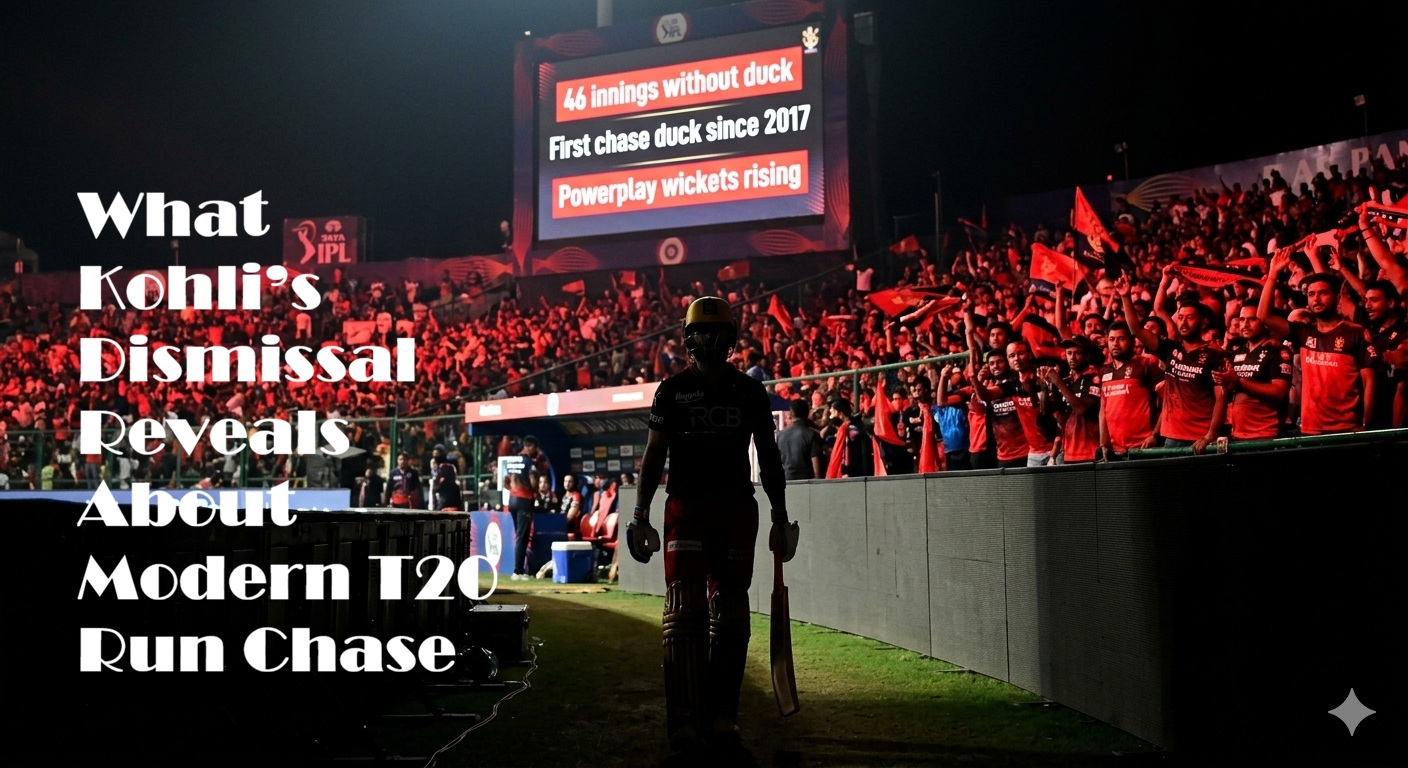
For 46 IPL innings, one thing felt almost guaranteed: Virat Kohli would give his team a start.
Not necessarily fireworks.
Not always dominance.
But stability. Control. Continuity.
Then came the duck.
His first IPL duck since 2023.
His first duck in a chase since the infamous 49-all-out collapse.
On paper, it’s just a number.
In reality, it tells a much bigger story about how IPL run chases have quietly become brutal for top-order batters.
Because today, even the most reliable run chasers are one ball away from disaster.
And that’s not about form.
That’s about how T20 cricket has changed.
2️⃣ Why This Topic Matters in Modern Cricket
Run chases in T20 used to follow a familiar script:
- Survive the new ball
- Build a platform
- Accelerate late
That blueprint built the careers of modern anchors.
But the IPL has evolved faster than batting philosophies.
Today’s chasing teams face:
- Deeper bowling attacks
- Matchups from ball one
- Aggressive field placements early
- Powerplay specialists trained to attack, not contain
This means the risk window for top-order batters has expanded dramatically.
And when an anchor falls early, the entire chase model collapses.
Kohli’s duck is not the story.
The environment that created it is.
3️⃣ Core Analysis — What This Dismissal Reveals
Insight 1 — The Powerplay Is No Longer About Survival
The biggest shift in IPL chases?
The powerplay has become a wicket-taking phase again.
For years, teams bowled defensively early:
- Protect boundaries
- Save best bowlers for death overs
That era is gone.
Modern bowling plans now aim to break the chase immediately.
Teams like Lucknow Super Giants attack with:
- Swing bowlers upfront
- Hard lengths into the pitch
- Packed off-side fields forcing risk shots
The message to batters is clear:
If you don’t score quickly, you’ll be forced into mistakes.
Anchors can no longer “play themselves in.”
They must score from ball one.
And that increases the probability of early dismissals — even for the best.
Insight 2 — Anchors Face the Highest Pressure in Run Chases
Here’s the paradox of modern T20:
The most consistent batter is often the most pressured.
Why?
Because anchors carry invisible responsibilities:
- Control the run rate
- Bat deep into the innings
- Prevent collapses
- Rotate strike against matchups
When they fall early, the batting order loses its structural spine.
This is why Kohli’s dismissal matters more than most ducks.
It exposes how fragile modern run chase structures really are.
Insight 3 — Bowlers Now Hunt Matchups From Ball One
Modern captains no longer wait for overs 7–10 to introduce strategy.
They attack immediately with:
- Left-arm seam vs right-hand openers
- Hard length into big square boundaries
- Slip fielders in T20
Yes — slips in T20 chases.
This isn’t about containment.
It’s about creating doubt early.
Even elite batters must take risks earlier than ever.
And when risk starts in over one, ducks become inevitable.
Insight 4 — The Psychological Weight of Big Targets
Chasing today feels different.
The scoreboard pressure starts instantly.
A required rate of 9–10 per over means:
- Every dot ball feels expensive
- Every good over shifts momentum
- Every early wicket amplifies panic
The moment an anchor falls, the batting order feels the tremor.
That pressure ripple is why early wickets are now match-defining events.
Insight 5 — The Ghost of the 49 All-Out
Kohli’s last chase duck came against Kolkata Knight Riders, during Royal Challengers Bengaluru’s infamous collapse.
That match became a case study in what happens when the chase loses its foundation early.
Not because Kohli got out.
But because the run chase lost its stabiliser.
Years later, the lesson still applies.
4️⃣ Tactical / Strategic Breakdown
Batting Strategy Changes
In modern run chase, teams have to now design line-ups with collapse insurance:
- Floaters at No.3/4
- Finishers promoted early
- Flexible batting orders
Because the top order is no longer guaranteed stability.
Teams now expect early wickets.
That expectation has changed batting construction entirely.
Bowling Strategy Evolution
Bowling plans now prioritise:
- Early wickets over economy
- Hard lengths over full swing
- Matchups over traditional roles
Powerplay bowling is now closer to Test match intent than T20 containment.
Aggression has moved to the start of the innings.
Captaincy Decisions in Chases
Captains are more reactive than ever:
- Promote hitters earlier
- Delay anchors until spin overs
- Attack powerplay matchups aggressively
Chases are no longer linear stories.
They’re constantly rewritten mid-innings.
5️⃣ The Future Trend — What Happens Next
Over the next five years, expect:
1. More flexible batting orders
The fixed No.3 and No.4 roles will disappear.
2. Increased importance of multi-phase batters
Players must survive powerplay AND finish games.
3. Even more aggressive powerplay bowling
New-ball specialists will become premium assets.
4. Anchors will evolve, not disappear
They’ll score faster early and adapt to matchups.
The role won’t die.
It will mutate.
6️⃣ Conclusion
A duck after 46 innings sounds like an anomaly.
But it’s actually a signal.
Run chases are no longer built on certainty.
They’re built on chaos management.
And in modern T20 cricket, even the most reliable chaser can be undone in one over.
That’s not failure.
That’s evolution.
FAQs
Why is Virat Kohli’s duck significant in IPL chases?
Because he rarely gets dismissed early in chases, making it a strong indicator of rising powerplay pressure.
Are IPL powerplays becoming more difficult for batters?
Yes. Teams now attack for wickets early instead of containing runs.
Is the anchor role still important in T20 cricket?
Yes, but anchors must now score faster and adapt to matchups.
Why do early wickets impact run chases so heavily?
They disrupt batting structure and increase pressure on middle-order hitters.
How are teams adapting to tougher powerplays?
By using flexible batting orders and aggressive powerplay strategies.