

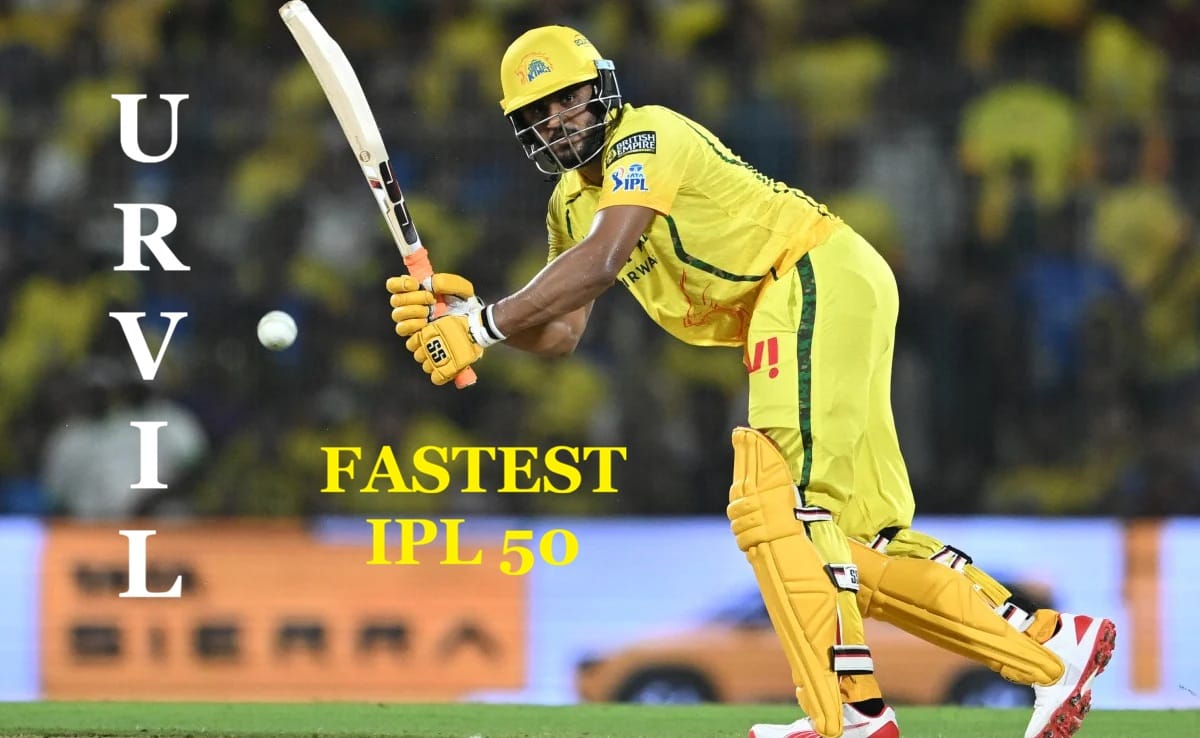
The IPL powerplay is no longer about survival — it’s about instant destruction.
Most teams still plan the first six overs like it’s 2018. Build slowly. Assess conditions. Avoid risk. But one innings at Chepauk shattered that outdated blueprint in just 13 balls.
This article breaks down how the Urvil Patel fastest 50 in IPL happened, why it terrified bowlers, and what it reveals about the future of T20 batting. This also connects with our pillar guide: Can Chennai Super Kings Still Qualify for IPL 2026 Playoffs? Full Scenario Breakdown.
The Night Chepauk Witnessed Pure Carnage
Chasing 204 against Chennai Super Kings vs Lucknow Super Giants, the match looked balanced early. CSK started aggressively, racing to 45 in the opening stand before Sanju Samson’s quick 28 off 14 ended.
That wicket mattered.
CSK have struggled while chasing recently.
The leading run-scorer gone.
A 200+ chase at Chepauk.
LSG sensed a turning point.
Then Urvil Patel walked in and changed the game in minutes.
The Record-Breaking Start That Shocked IPL History
The Urvil Patel fastest 50 in IPL equals the all-time tournament record:
Fastest IPL fifties (balls faced)
13 – Yashasvi Jaiswal vs KKR (2023)
13 – Urvil Patel vs LSG (2026)
14 – KL Rahul vs DC (2018)
14 – Pat Cummins vs MI (2022)
14 – Romario Shepherd vs CSK (2025)
But the fifty alone doesn’t tell the full story.
What made this innings historic:
- First batter in IPL history to hit six sixes in first 8 balls
- 41 runs from first 8 deliveries (IPL record)
- 42 after first 10 balls* (IPL record)
- Final score: 65 off 23 balls (8 sixes)
This wasn’t acceleration.
This was instant takeover.
The Fifth Over That Broke the Chase
The match flipped in the 5th over vs Avesh Khan.
Urvil launched:
- Three consecutive sixes
- 25 runs in the over
What went wrong for the bowler?
Length mistakes under pressure
Avesh tried standard powerplay tactics:
- Back of length outside off
- Occasional fuller ball
- Defensive leg-side field
Urvil punished every predictable length:
- Slot ball → mid-wicket six
- Hard length → muscled over wide mid-on
- Overcorrection → deep into stands
This is the key lesson:
Modern hitters don’t wait for bad balls —
they punish predictable plans.
The Sixth Over That Destroyed Momentum
If over five hurt LSG, over six broke them.
Facing Digvesh Rathi, Urvil unleashed another 25-run over.
Highlights:
- Multiple sixes over mid-wicket & long-on
- Monster 98-metre six
- Powerplay completely hijacked
By the end of the powerplay:
The chase had flipped.
LSG went from controlling the match
to defending boundaries everywhere.
This is how fast fifties change match psychology.
The First 10 Balls Record Tells the Real Story
One stat explains why this innings matters.
Highest scores after first 10 balls of an IPL innings
42* – Urvil Patel vs LSG (2026)
41* – AB de Villiers vs MI (2015)
41* – Yashasvi Jaiswal vs KKR (2023)
40* – Abhishek Sharma vs DC (2024)
This list is elite T20 royalty.
Joining it means one thing:
This wasn’t a cameo.
It was an elite-level powerplay assault.
Why Captains Lose Control Against Fast Starters
Here’s what fans miss.
When a batter reaches 40 inside the powerplay:
Captains are forced to:
- Push mid-off deeper
- Drop square leg to boundary
- Protect long-on earlier
Suddenly:
Singles become easy.
Twos become safe.
Pressure disappears.
Fast starts create fielding panic.
That panic wins matches.
How the Innings Finally Ended
Even chaos ends eventually.
Shahbaz Ahmed slowed the pace and bowled wide outside off.
Urvil chased the ball and mistimed it to deep extra cover.
Out for 65 off 23 balls.
But by then, the damage was irreversible.
The chase had already been rewritten.
Why This Innings Changes IPL Strategy
The Urvil Patel fastest 50 in IPL represents a bigger trend.
T20 evolution in phases
2008–2015 → Survive powerplay
2016–2021 → Accelerate after 10 overs
2022–Present → Attack from ball one
Young Indian batters now grow up in:
- Tennis ball cricket
- Franchise leagues
- Flat T20 surfaces
They arrive in IPL ready to attack instantly.
This innings wasn’t a one-off.
It’s a preview of the future.
The Real Takeaway
This wasn’t just an unforgettable innings.
It was a tactical warning.
Powerplay bowling plans are becoming outdated — and players like Urvil Patel are exposing the gap.
The next evolution of IPL cricket has already started.
Teams just haven’t caught up yet.
FAQs
How fast was Urvil Patel’s IPL fifty?
He reached fifty in just 13 balls vs LSG in IPL 2026.
Who holds the fastest IPL fifty record?
Urvil Patel and Yashasvi Jaiswal jointly hold the record (13 balls).
How many sixes did Urvil hit?
Eight sixes in his 65 off 23 balls.
What is the record for runs after 10 balls in IPL?
Urvil Patel holds the record with 42 runs.
Why was this innings important?
It changed momentum of a 204 chase instantly.
Who dismissed Urvil Patel?
Shahbaz Ahmed with a slower delivery.
Which overs changed the match?
Overs 5 and 6 — both went for 25 runs.
Why are fast fifties increasing in IPL?
Modern batters attack from ball one.
What does this mean for bowlers?
They must rethink powerplay plans.