

Think about what Virat Kohli does before a high-stakes Test series. He doesn’t just show up to nets and wing it. His team runs structured 3-week conditioning blocks — specific exercises, specific meals, specific recovery windows — all designed to peak his body at exactly the right time.
You don’t need to be a cricketer to train like one. And you definitely don’t need a gym.
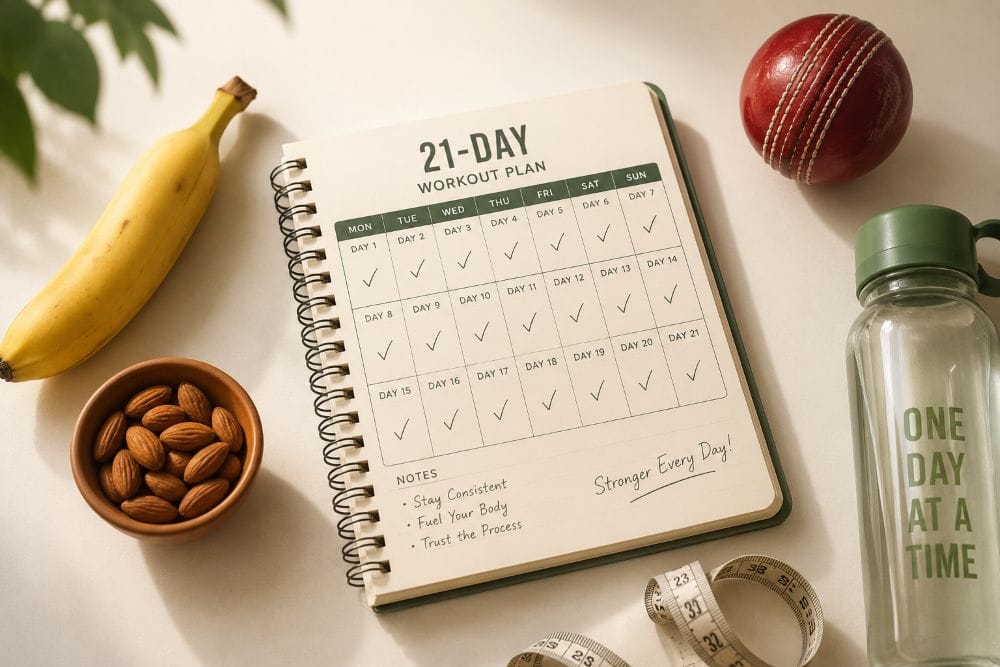
This 21 day home workout and diet planner is built on the same principle elite athletes use: short, focused blocks with progressive intensity, paired with a nutrition plan that actually supports what your body is doing each day. Whether you’re a cricket fan who wants to move better, someone trying to lose weight at home without a gym, a total beginner looking for a structured start, or someone who’s tried and abandoned five other plans — this one is different because it treats diet and training together, not as two separate chapters.
By the end of Day 21, you won’t just look different. You’ll have built a system you can actually continue. I am not qualified expert in this field. However I would like to share this knowledge with everyone in need. But I would definitely suggest The Ultimate Guide to Fast Bowling in Cricket (Beginner to Pro).
GET STARTED TODAY !!
21 DAYS WORKOUT+DIET PLANNER
Why 21 Days Is the Perfect Window to Build a Home Workout Habit
Here’s something most fitness content won’t tell you about a 21 day home workout plan: 21 days won’t transform your body. But it absolutely will transform your behaviour — and that’s the part that actually matters.
The “21 day habit” idea comes from a misquote of Dr. Maxwell Maltz’s 1960 research, but the underlying neuroscience holds up. Habit formation works through a three-part loop: cue → routine → reward. The cue triggers the behaviour (your alarm goes off at 6:30am), the routine is the action (you do your home workout), and the reward is what reinforces it (better energy, clearer head, the small pride of ticking a box). When you repeat this loop consistently, your brain starts automating the routine — you stop thinking about whether to work out and just do it.
21 days is the minimum realistic window to start locking in that loop. A 2010 study in the European Journal of Social Psychology found that on average, new habits take 66 days to fully automate — but the pattern starts forming in the first three weeks. This plan gives you a running start.
Cricket teams use this exact framework. When the Indian team’s conditioning coach builds a pre-tour block, it’s always structured in 3-week phases. Week one is foundation. Week two raises the load. Week three simulates match conditions. You’re going to follow the same logic — just without the physio room and the BCCI budget.
One important expectation to set: this plan builds a base, not a miracle. You may lose 2–4 kg. You will feel stronger. You’ll sleep better. But the biggest win is that on Day 22, you won’t want to stop.
Before You Start: Know Your Fitness Level and Your Real Goal
Most 21 day plans hand everyone the same worksheet and call it personalised. That’s why most people quit by Day 6. Before you do a single squat, take five minutes to figure out where you’re starting and what you’re actually trying to achieve.
Which Starting Profile Fits You?
Profile A — Absolute Beginner: You haven’t exercised consistently in the last 3 months. You get winded climbing two flights of stairs. Start here, no shame — cricket’s greatest comeback stories started from zero too.
Profile B — Recreationally Active: You walk regularly, maybe do occasional workouts, but nothing structured. You have a baseline, you just need direction and motivation to exercise at home consistently.
Profile C — Sport-Specific (Cricket or Field Sport Player): You play weekend cricket, train occasionally, but your conditioning is patchy. Your goal isn’t just fitness — it’s functional performance: faster running between wickets, stronger throws, sharper agility in the field.
Quick Self-Assessment (Takes 3 Minutes)
Do this before Day 1:
- Resting heart rate: Check your pulse for 60 seconds first thing in the morning. Under 70 = solid base. 70–85 = average. Above 85 = start at Profile A intensity.
- Push-up test: How many full push-ups can you do before form breaks? Under 5 = beginner. 5–15 = intermediate. Above 15 = Profile C ready.
- Squat test: 10 bodyweight squats. If your knees cave inward or you can’t hit parallel, start with the modified versions in Week 1.
Pick Your Goal Track
| Goal | Track | What You’ll Feel by Day 21 |
|---|---|---|
| Lose body fat and tone up at home | Fat Loss Track | Leaner, lighter, better endurance |
| Build strength and stamina | Performance Track | Stronger, more explosive, better posture |
| Cricket-specific conditioning | Athlete Track | Better agility, stronger core, faster recovery |
A fast bowler and a middle-order batter have completely different conditioning needs. Ben Stokes does heavy gym work for explosive short-ball pace; a finisher like MS Dhoni built rotational core strength and fast-twitch leg power. Even at a 30-minute home workout level, knowing your goal shapes every choice — especially how you eat.
Once you know your track and profile, calculate your rough daily calorie target: multiply your bodyweight in kg by 30 (for fat loss) or by 35 (for performance/muscle). That’s your daily calorie deficit starting point. We’ll build your full weekly meal plan around it in the diet section.
KNOW YOUR REFLEX SPEED
TAKE YOUR REACTION SPEED TEST
The 21 Day Progressive Home Workout Plan (Week by Week)
Here’s where this 21 day home workout and diet planner separates from every other plan you’ve seen. Instead of handing you the same 5 exercises for 21 days straight, this follows a progressive overload structure — the same system cricketers use in pre-season conditioning blocks. Each week raises the physical demand in a specific way so your body keeps adapting and you don’t plateau by Day 9.
You need zero equipment. A yoga mat or a folded blanket. That’s it.
Week 1: Foundation (Days 1–7) — Build Your Base
Goal: Build movement quality, activate muscles you’ve been ignoring, and get your joints ready for what’s ahead.
Session length: 20–25 minutes | Schedule: 5 training days, 2 rest days (rest on Days 4 and 7)
Focus: Slow, controlled reps. Form first, speed never. If it feels too easy, you’re probably doing it right.
| Day | Workout Focus | Exercises | Sets × Reps |
|---|---|---|---|
| 1 | Lower body | Bodyweight squats, glute bridges, reverse lunges | 3 × 12 each |
| 2 | Upper body | Push-ups (knee or full), shoulder taps, Superman holds | 3 × 10 each |
| 3 | Core strengthening | Dead bugs, bird dogs, side plank holds | 3 × 45 sec |
| 4 | Rest | Light walk, 10-min stretching routine | — |
| 5 | Full body | Squat + press (no weight), inchworms, step-back lunges | 3 × 10 each |
| 6 | Cardio | March in place, step touches, low-impact jumping jacks | 20 min continuous |
| 7 | Rest | Yoga or full-body flexibility work | — |
Modifications: If squats hurt your knees, do sit-to-stand from a chair. If full push-ups aren’t happening yet, do them on your knees or against a wall. Every elite cricketer started with a modified version of something — there’s no shortcut past the foundation.
Warm-up (all days, 3 minutes): Arm circles, hip rotations, leg swings, 20 jumping jacks. Never skip this — cold muscles under load is how injuries happen.
Week 2: Build (Days 8–14) — Raise the Intensity
Goal: Increase intensity, add explosive movements, and introduce circuit training to challenge your cardiovascular system.
Session length: 25–35 minutes | Schedule: 5 training days, 2 rest days (rest on Days 11 and 14)
This is where the plan starts to feel like actual training. You’ll add tempo (slower lowering phase = harder muscle work), increase reps by about 20%, and introduce plyometric movements. Think of this as the Indian team’s second week of a pre-series camp — the warm welcome is over.
| Day | Workout Focus | Exercises | Sets × Reps |
|---|---|---|---|
| 8 | Lower body power | Jump squats (or fast squats), walking lunges, wall sit | 3 × 15 |
| 9 | Upper body strength | Push-ups (slow 3-sec lower), tricep dips on chair, plank shoulder taps | 3 × 12 |
| 10 | Core + agility drills | Mountain climbers, bicycle crunches, lateral hops | 3 × 20 sec on |
| 11 | Rest | Foam roll or stretching routine | — |
| 12 | Full body circuit training | Squat jumps → push-ups → glute bridges → plank (no rest between) | 4 rounds, 40 sec each |
| 13 | Cardio HIIT | 30 sec high knees / 30 sec rest, repeat 10 rounds | 20 min |
| 14 | Rest | Active recovery walk | — |
The cricket parallel: Agility drills like lateral hops and fast direction changes directly mirror the movements a fielder makes in the ring. You’re not just getting fit — you’re building sport-useful movement patterns that translate directly to the ground.
Week 3: Peak (Days 15–21) — Match Simulation Intensity
Goal: Full-body compound movements, 30-minute home workout circuits at peak intensity, and match-simulation conditioning. This is where the transformation becomes visible.
Session length: 30–40 minutes | Schedule: 5 training days, 2 rest days (Days 18 and 21)
Cricket teams call their final pre-match training week “match simulation conditioning” — high output, short rest, full intensity. That’s exactly what Week 3 delivers. Your body is ready for this now because Weeks 1 and 2 built the base.
| Day | Workout Focus | Exercises | Sets × Reps |
|---|---|---|---|
| 15 | Lower body + core | Bulgarian split squats, single-leg deadlift (bodyweight), hollow body hold | 4 × 12 |
| 16 | Upper body compound | Diamond push-ups, pike push-ups, plank-to-downward dog | 4 × 12 |
| 17 | Full HIIT circuit | Burpees, jump squats, push-ups, mountain climbers, high knees (45 sec on / 15 off) | 5 rounds |
| 18 | Rest | Stretch, hydrate, sleep 8 hrs | — |
| 19 | Endurance + power | 400m run (or 2-min jog in place) + 10 push-ups + 20 squats × 5 rounds | Timed |
| 20 | Full body superset | Lunge + rotation, push-up + shoulder tap, squat jump + plank | 4 × 10 |
| 21 | Active rest + retest | Repeat your Day 1 self-assessment. Count push-ups. Time your squats. See the difference. | — |
GET STARTED TODAY
FREE HOME CRICKET TRAINING SCHEDULE
The 21 Day Diet Planner: Your Weekly Meal Plan for Fat Loss and Performance
Diet is where most plans fail people — not because the food advice is wrong, but because it assumes you shop at a Whole Foods in California. This 21 day diet planner includes real food from real Indian and South Asian kitchens alongside international options, because knowing how to stick to a diet plan only matters if the food is actually available to you.
The macro split for this plan: 40% carbohydrates / 30% protein / 30% fats. This ratio works for both fat loss and performance — it keeps energy stable during workouts, provides enough protein to protect and build muscle, and doesn’t cut fat so low that your hormones suffer.
Weekly Meal Plan Structure
You’re eating 5 times a day — 3 main meals and 2 snacks. This is exactly how cricket teams structure nutrition during training camps: smaller, frequent meals keep blood sugar stable, reduce cravings, and ensure there’s always fuel available for the next session.
Sample Daily Meal Timeline:
| Time | Meal | Example (Indian) | Example (International) |
|---|---|---|---|
| 7:00 AM | Breakfast | 2 eggs + 2 rotis + chai (no sugar) | Oats with banana + boiled eggs |
| 10:00 AM | Mid-morning snack | Handful of almonds + 1 banana | Greek yogurt + berries |
| 1:00 PM | Lunch | Dal + 1 cup brown rice + sabzi + salad | Grilled chicken + quinoa + greens |
| 4:30 PM | Pre-workout snack | Banana + peanut butter | Apple + almond butter |
| 7:30 PM | Dinner | Paneer bhurji + 1 roti + cucumber raita | Baked fish + roasted vegetables |
Week 1 Meal Plan: Clean Eating, Keep It Simple
Week 1 is not the time to overhaul your entire kitchen. The goal is clean eating, affordability, and consistency. Eat from the framework above without obsessing over perfection.
Grocery staples for Week 1 — these are the protein-rich Indian foods and whole food staples that cover your nutrition without supplements:
- Proteins: Eggs, dal (masoor/chana), paneer, canned tuna or chicken breast — all affordable protein-rich Indian foods that cost a fraction of protein powder
- Carbs: Brown rice, oats, whole wheat roti, sweet potato — complex carbohydrates that release energy slowly and fuel long training sessions
- Fats: Almonds, walnuts, peanut butter, mustard oil or olive oil — healthy fats that support hormone function during a calorie deficit
- Produce: Spinach, tomatoes, cucumber, banana, apple, lemon — nutrient-dense whole foods that fill your plate without filling your calorie budget
Target calories: bodyweight (kg) × 30 for fat loss. So if you weigh 75 kg, your calorie deficit target is roughly 2,250 calories/day.
Week 2 and 3: Calorie Cycling for Faster Results
This is one of the most effective tools in a cricketer’s nutritional playbook — and one that no competing 21-day plan teaches. Calorie cycling means eating slightly more on your hardest training days and slightly less on rest days, so your body always has the fuel it needs and never stores excess.
| Day Type | Calorie Adjustment | Practical Change |
|---|---|---|
| Heavy training day (Weeks 2–3) | +200–300 calories | Add a cup of rice or an extra egg |
| Moderate training day | Baseline calories | Stick to the standard meal plan |
| Rest day | −100–200 calories | Smaller dinner, skip the afternoon snack |
Cricketers on tour eat differently on match days versus travel days — same principle, same result. When your body is working harder, it needs more fuel. When it’s recovering, it doesn’t.
Hydration rule (non-negotiable): 3 litres on training days, 2.5 litres on rest days. Even 2% dehydration measurably drops strength output and makes every session feel harder than it should. Rohit Sharma’s support team tracks sweat loss during Test matches in the heat of Mumbai and Chennai. You don’t need a sports scientist — you just need to keep filling your bottle.
Pre and Post-Workout Nutrition: How to Sync Your Diet Plan with Home Training
This section makes this 21 day home workout and diet planner genuinely different from every other plan in this space. Most plans treat food and exercise as two separate chapters. But what you eat around your workouts determines whether those sessions actually build something — or just wear you out.
Pre-Workout Meal Ideas: What to Eat 60–90 Minutes Before Training
The goal before a session is fast energy without a full stomach. A heavy meal before training diverts blood to your digestive system, away from your muscles.
| Workout Type | Pre-Workout Meal Idea |
|---|---|
| Strength session (Weeks 1–2) | 1 banana + 1 tbsp peanut butter |
| HIIT or circuit training (Week 3) | 1 roti with a boiled egg, or oats with milk |
| Light cardio / active recovery | Just water, or a small piece of fruit |
Cricketers in pre-season don’t eat a full chicken breast before sprinting drills — they have a carb-rich snack 90 minutes out and hydrate throughout.
Post-Workout Recovery Foods: The 30–45 Minute Window
After training, your muscles are primed to absorb nutrients. The combination you need is protein + fast-acting carbs within 45 minutes of finishing.
Post-workout recovery foods that are affordable:
- 2 boiled eggs + 1 banana — roughly 25g protein, fast carbs, costs almost nothing
- Curd (dahi) + 1 scoop of rice or a roti
- Paneer slice + dates (2–3 dates give fast glucose without a sugar spike)
- If you use protein powder: 1 scoop with water + any fruit
You don’t need supplements. Real food works exactly as well when portions are right.
Rest Day Nutrition
On rest days, reduce carbohydrate intake slightly and focus on protein and vegetables. Your muscles are still recovering — actually growing — on rest days. They need protein, not carbs. Drop the afternoon snack, make dinner lighter, and go heavier on greens and dal-based proteins.
Quick Reference Table:
| Day Type | Before Workout | Post-Workout Recovery Foods | Water Target |
|---|---|---|---|
| Strength training | Banana + PB | 2 eggs + fruit | 3 litres |
| HIIT / circuit | Roti + egg | Dahi + rice | 3 litres |
| Light cardio | Water only | Small meal with protein | 2.5 litres |
| Rest day | N/A | N/A | 2.5 litres |
7 Mistakes That Derail Most 21-Day Home Fitness Plans (And How to Avoid Them)
These are the seven things that cause people to quit — usually between Days 5 and 10. Knowing them in advance is half the battle.
1. Skipping rest days because you feel good This is how injuries happen. Muscle growth doesn’t occur during the workout — it happens during recovery. Cricket teams build compulsory rest into every training block. On Days 4, 7, 11, 14, 18, and 21, rest is not optional. Use rest days for a stretching routine, a walk, or yoga. That’s active recovery, not wasted time.
2. Eating too little because the scale isn’t moving If you slash calories below 1,500/day, your body starts breaking down muscle for energy. You’ll feel weak, look flat, and the scale will mislead you. Stick to the bodyweight × 30 formula. The scale also takes 7–10 days to reflect real fat loss — in the meantime it fluctuates with water, food volume, and sodium.
3. Confusing water weight with fat loss In Week 1, you may drop 1–2 kg quickly. That’s mostly water and glycogen, not fat. Track progress with a tape measure around your waist and hips, and take weekly photos. How to track fitness progress properly: the mirror and measurements tell a more honest story than the scale every time.
4. Going too hard in Week 1 and burning out Week 1 soreness (technically called DOMS — Delayed Onset Muscle Soreness) is a sign your muscles are being challenged. It peaks 24–72 hours after training. If you can barely walk after Day 1, you went too hard. Walk the next day. Hydrate. Eat your protein. The soreness passes — but only if you don’t skip Day 3 because Day 2 hurt.
5. No accountability system — and relying on motivation to exercise at home alone Cricketers train in squads, not alone. Research consistently shows that social accountability is the single most effective habit-reinforcement tool outside structured environments. Find a check-in partner. Text them your daily tick. Post in a WhatsApp group. The motivation to exercise at home is weakest on your worst days — an accountability system fills that gap when willpower can’t.
6. All-or-nothing thinking You miss Day 9. Life happens. The trap is deciding that one missed day means the plan is ruined. Miss one day, note it, show up on Day 10. A missed day is a comma, not a full stop. People who rebound quickly from missed days consistently get better final results than those who restart from Day 1.
7. Sleeping 5–6 hours and wondering why progress stalled Poor sleep spikes cortisol — your primary stress hormone — which directly slows fat loss and raises appetite, particularly for high-carb foods. The sleep and fat loss connection is well-documented in sports science literature. India’s elite cricketers target 8–9 hours during training camps. Below 7 hours consistently will fight your results harder than any diet mistake.
After Your 21 Day Home Workout Plan: How to Keep the Results You’ve Built
This is the section that no competing 21 day plan bothers to include — and it’s arguably the most important one.
Here’s what typically happens: Day 21 arrives. You feel great. You’ve built a routine. Then nothing. No plan for Day 22. Within two weeks, the old habits quietly return, the workouts get skipped, and by Week 4 you’re back where you started. Sound familiar?
The reason isn’t lack of willpower. It’s the post-plan regression problem — you’ve removed the structure without replacing it with anything.
The Maintenance Week Protocol (Days 22–28)
The week after your 21 day block should be a deload — not a stop. Reduce training volume by about 30% (3 sessions instead of 5), keep meals clean, and keep protein intake constant. This is exactly what international cricket squads do after an intensive training camp: one week of reduced load before the next phase begins.
What a deload week looks like in practice:
- 3 workouts (Monday, Wednesday, Friday), each 20 minutes
- Repeat your favourite Week 2 exercises at lower intensity
- Continue the 5-meal weekly meal plan structure, just reduce portions slightly
- Sleep 8 hours minimum. This week is recovery disguised as a plan.
Build a 90-Day Roadmap
21 days is Block 1. Stack two more blocks behind it with a progressive goal shift:
| Block | Days | Focus | Key Change |
|---|---|---|---|
| Block 1 | Days 1–21 | Foundation + fat loss | Learn the movements, build the habit |
| Block 2 | Days 29–49 | Body recomposition | Add light resistance (water bottles, backpack with books) |
| Block 3 | Days 57–77 | Performance | Speed, agility, and stamina — full cricket-fitness conditioning |
By Day 77, you’re not following a plan anymore. You’ve built a lifestyle. That’s the real goal of this 21 day home workout and diet planner.
Signals That Your Plan Needs to Evolve
Watch for these signs it’s time to increase the challenge:
- You can complete Week 3 circuits without getting out of breath
- The same meals aren’t filling you up (your metabolism has risen)
- You’ve plateaued on measurements for 2+ consecutive weeks
When these happen: add one more round to each circuit, increase reps by 15%, and add 150–200 calories on training days.
Read more on importance of physical activity in daily life and a greater good life.
Frequently Asked Questions
Can I lose weight with this 21-day home workout plan without any equipment?
Yes — and the research backs this up. A well-structured 21-day home workout plan built on bodyweight exercises with consistent calorie control delivers fat loss results comparable to gym-based training, particularly for beginners. The key is progressive overload, which this plan delivers through the Week 1 → 2 → 3 intensity ramp. You don’t need a gym to get fit in 21 days — you need structure and consistency.
How many calories should I eat on this 21-day diet plan?
Start with your bodyweight in kg multiplied by 30 for fat loss (e.g., 70 kg × 30 = 2,100 calories/day calorie deficit target). Add 200–300 on heavy training days in Weeks 2 and 3. Adjust by feel — if you’re constantly dizzy or exhausted, eat more. If the scale hasn’t moved after 10 days of honest tracking, reduce by 100–150 calories.
What do cricketers eat to stay fit during training?
Elite cricketers eat high-protein, moderate-carb diets timed around training sessions. Rohit Sharma has spoken publicly about avoiding refined sugar and prioritising lean proteins. Virat Kohli switched to a largely plant-based diet after 2018, focusing on nutrient-dense whole foods and reducing dairy. The IPL player fitness routine that most international squads follow centres on 5 meals a day, calorie cycling around match days, and high daily water intake — the exact framework this planner uses.
Is 21 days really enough to build a workout habit?
It’s enough to start one. Research suggests the habit loop (cue → routine → reward) begins forming in the first 3 weeks. Full automaticity takes closer to 60–90 days — which is why the 90-day roadmap above matters. But the first 21 days of your home workout and diet planner are the hardest, most important, and the ones most people never complete. Finishing them is the real win.
What should I eat before and after a home workout?
Before: a small carb + protein snack 60–90 minutes prior (banana + peanut butter, or roti + egg). After: protein + fast carbs within 45 minutes (2 boiled eggs + banana, or curd + rice). See the full pre-workout meal ideas and post-workout recovery foods table in the nutrition sync section above.
Can absolute beginners follow this plan?
es. Profile A modifications are built into every week — knee push-ups, chair-assisted squats, shorter plank holds. Start there and don’t rush to the harder versions. A solid Week 1 at modified intensity beats a spectacular Week 1 that leaves you injured and off the plan by Day 5.
What if I miss a day?
Note it, let it go, show up tomorrow. Do not restart from Day 1. Do not double up the next day. Just continue from where you are. Consistency across the full 21 days matters far more than perfection on any single day.
Your 21 Day Starting Checklist
Before Day 1, do these five things. This 21 day home workout and diet planner is designed to be as simple as possible to start:
- Complete the self-assessment (push-ups, resting heart rate, squat test) and write down your baseline numbers
- Calculate your daily calorie target using your bodyweight × 30 and note it somewhere visible
- Stock Week 1 groceries — eggs, dal, brown rice/oats, banana, almonds, one green vegetable. That’s all you need.
- Choose your accountability system — one person, one WhatsApp group, or a habit-tracking app
- Take a starting photo and measurements — waist, hips, weight. You’ll want these on Day 21 to see how far you’ve come.
No expensive equipment. No complicated meal prep. No gym membership. Weight loss without gym is absolutely achievable — this 21 day home workout and diet planner is proof of that.
Just 21 days of showing up — and a system that works when you do.
Ready to extend beyond Day 21? Follow the 90-Day Fitness Challenge — the next phase of your home training journey.
Disclaimer: The author is not a sports medicine professional. This article is for informational purposes only and is not a substitute for advice from a qualified medical or fitness professional.