
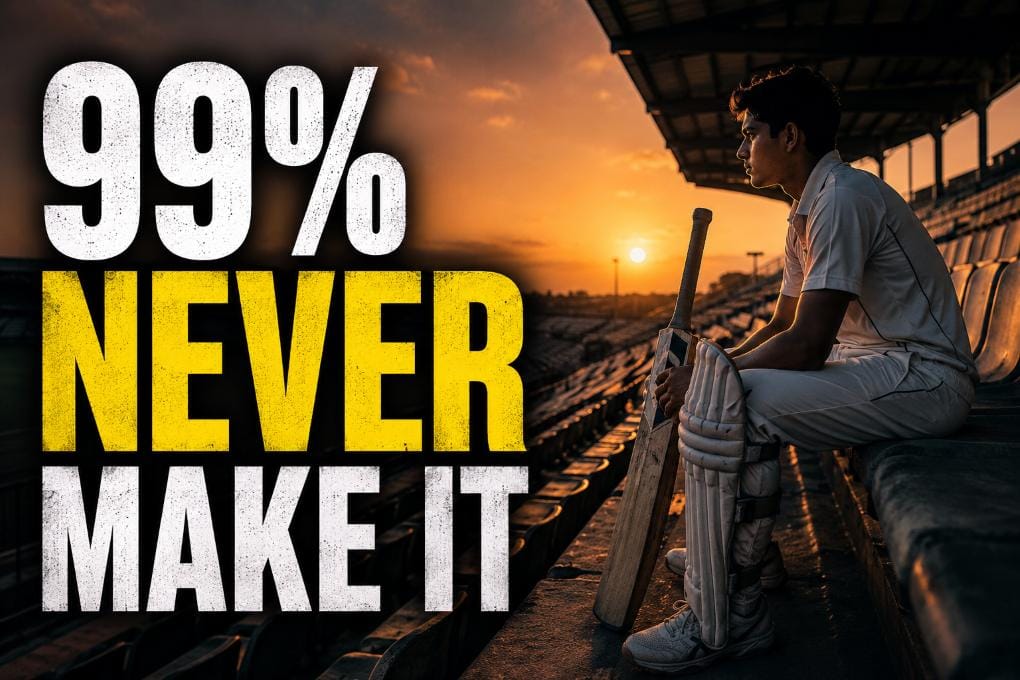
To become a professional Cricketer in India is a distant dream for many. For the 300 million playing cricket in India, fewer than 500 earn a stable living by making it to professional cricket. The system isn’t just competitive; it’s designed to filter by access before it filters by talent.
Before you invest in that ₹12,000 academy fee or a ₹35,000 English willow bat, understand this: a beginner aged 8-12 needs a lightweight bat and a tennis ball to build technique, not a heavy pro-grade bat. Your gear must match your stage. This isn’t a vague roadmap. It’s the 1% survival blueprint—a stage-by-stage guide that diagnoses the invisible walls in India’s cricket pipeline and gives you the exact tools (and honest financial plan) to navigate them.
I’ve spent years watching India’s cricket pipeline — from Under-16 district trials to Ranji Trophy debuts and IPL auctions — and the thing that still surprises me isn’t how brutal the odds are. It’s how few people actually understand why cricketers fail. Not because they weren’t good enough. Because they didn’t understand the invisible walls in the system.
In this article, we’re going to pull apart exactly why cricketers fail to make it in India — not with generic advice, but with real structural analysis of the selection pipeline, the talent gap, and what separates the 1% who do break through. If you’re serious about understanding this game and this country’s obsession with it, keep reading. And if you want to understand the physical and technical blueprint of a fast bowling career specifically, we’ve covered it in depth here: The Ultimate Guide to Fast Bowling in Cricket — Beginner to Pro
⚡ Quick Answers: India’s Pro Cricket Reality
Exactly how many make it?
Out of 300 million players, fewer than 500 cricketers earn a stable full-time living from the game in India.
Where do most players fail?
The biggest dropout point is the district-level trial (U-16). The second is the U-23 to senior Ranji transition.
What weight bat for a beginner (8-12 years)?
A beginner aged 8-12 should use a lightweight bat in the 1.02 kg to 1.13 kg range. Avoid full-size, heavy senior bats.
Is the IPL helping young cricketers?
The IPL creates a T20 specialisation trap. Players optimised for T20 from age 13 often struggle with red-ball demands in Ranji Trophy.
What separates the 1% from the rest?
Beyond talent: one elite specialist skill (not general competence), mental resilience, and the ability to navigate the selection system strategically.
Does age fraud affect selection?
Yes. Age manipulation distorts performance benchmarks, causing legitimate late developers to be cut prematurely from age-group teams.
Data sourced from BCCI reports and analysis of India’s cricket pipeline. Player counts are indicative estimates.
Why This Topic Matters Today
Why This Topic Matters in the IPL Era? It seemed that, the distant dream to become a professional cricketer in India came little closer in 2008 when IPL started. lets see the reality in this paragraph.
The IPL changed everything. It created a completely new definition of “professional cricketer” — one that didn’t exist before 2008. Suddenly, a T20 specialist could earn more in six weeks than a Ranji regular earned in a decade. And that visibility — millions of people watching franchises like Rajasthan Royals or Sunrisers Hyderabad — made young cricketers believe the path to the top was wider than it actually is.
The brutal truth is the opposite happened. The IPL created a new elite ceiling that is harder to reach, not easier. Because now every academy-trained kid is chasing the same handful of slots. The question of why cricketers fail in India has become more urgent — and more analytically interesting — than ever before.
Note: Player estimates are indicative based on publicly reported BCCI data and cricket board registrations. For updated BCCI stats, see bcci.tv.
The Real Reasons Failure to become a Professional Cricketer in India
The reasons why cricketers fail aren’t mysterious — they’re structural. Here’s what the pipeline actually looks like, broken down into five honest insights.
1. The District-Level Wall Nobody Talks About
The biggest dropout point isn’t at the state level. It’s at the district trial. Every year, tens of thousands of Under-14 and Under-16 cricketers attend district selection camps. Most never make it past this stage — not because of skill, but because of access. Academy-trained kids from urban centres have better gear, better coaching contacts, and frankly, better nutrition than their counterparts from smaller towns and villages.
I’ve watched district trials in Maharashtra and Karnataka — kids showing serious raw talent who were visibly malnourished, using bats too heavy for their body type, facing category-A academy players who had been coached for this specific selection format. This isn’t a fair funnel. It’s a filter that rewards access, not just ability.
The reason why cricketers fail at this stage isn’t lack of talent. It’s that the trial format itself is designed around resources that only urban, middle-class families can provide. Their dream to become a professional cricketer in India ends there.
2. State-Level Selection Is a Political Cricket Match
Let’s be direct about something that every serious cricket analyst knows but rarely writes about openly. State selection in India has historically had two problems: genuine subjectivity in evaluation, and the influence of personal relationships. A player from a smaller district who performs identically to a player from the state capital will, in many cases, not receive the same consideration — simply because one of them has a selector’s contact in their corner.
The BCCI has been working to digitise performance tracking and standardise metrics. But the data gap between what is recorded and what is actually observed at the district and state level remains enormous. Until regional cricket boards invest seriously in performance analytics — not just scorecards, but ball-by-ball data, video analysis, and context-adjusted statistics — why cricketers fail at the state level will remain a question with a frustratingly political answer as much as a sporting one.
3. The Mental Game Is Never Coached
Walk into any Indian cricket academy. You will find fielding drills, batting tee stations, bowling machines. You will almost never find a sports psychologist, a mental skills coach, or even a structured conversation about competition anxiety. And yet every experienced analyst and selector I’ve spoken to agrees: the biggest separator between a talented Ranji player and a Test cricketer is mental resilience, not technical ability.
Think about how Rishabh Pant plays. The technical flaws were always visible. What wasn’t coachable — and what separated him from dozens of equally talented wicketkeeper-batters — was his competitive shamelessness. His ability to stay in the present after a rash shot. That’s a mental skill. And for the vast majority of cricketers who fail in India, the mental wall hits them hardest at the senior domestic level, not the junior one. The Under-23 to senior Ranji transition is where careers end quietly.
4. The T20 Specialisation Trap
The IPL era created a specific tactical problem: young cricketers are increasingly optimising their game for T20 from age 13 onwards. That means they’re learning to hit over the top, bowl bouncers, and find boundary options — all valuable skills — while neglecting the long-form foundations that make a proper professional. Red-ball technique. Building an innings under pressure. Bowling six-over spells on flat tracks.
This is a systemic reason why cricketers fail at the domestic level once they’re selected. They’ve been shaped by T20 formats their entire junior career, then asked to perform in four-day Ranji matches. The game they trained for and the game they’re now being selected in are different sports. Look at the 2025 Ranji Trophy — several promising U-23 players, all IPL camp attendees, struggled badly with red-ball conditions not because they lacked talent, but because their training diet was exclusively white-ball.
The IPL is not destroying Indian cricket talent — but it is creating a specialisation mismatch that is quietly ending careers before they begin.
5. Age Fraud and the Compressed Career Window
One of the most analytically uncomfortable topics in Indian cricket development is age manipulation. It’s well-documented that some players have historically entered age-group competitions with falsified birth certificates. The consequence of this isn’t just unfairness in the short term — it distorts the entire talent curve. Coaches and selectors make judgements about a 17-year-old’s physical development against a player who might actually be 19. The benchmarks get skewed. And legitimate players who are younger for their age group, or who develop later physically, get cut before they peak.
Tactical Breakdown: What the Surviving 1% Did Differently
When you study the careers of cricketers who actually broke through—not the ones with godfathers in the selection committee, but the genuine outsiders who forced their way in—patterns emerge. These aren’t theories. They’re survival adaptations.
The One-Weapon Rule (That Most Ignore)
Here’s something most young bowlers never hear: nobody at the state or IPL level is looking for a “complete” bowler. They’re looking for a reason to remember you after watching 200 others.
Bumrah didn’t arrive with a textbook action and five variations. He arrived with a slingshot arm and a yorker that made batters flinch. That was it. One weapon. Axar Patel didn’t confuse anyone with mystery spin. He landed the ball on the same blade of grass 36 times an over and let batsmen panic themselves out.
The bowlers who vanish are the ones who spent their academy years trying to build an entire arsenal before mastering a single bullet. Coaches often push this “well-rounded” mentality because it’s easier to teach than excellence. But selectors think differently. A selector at a district trial is half-asleep after watching 15 medium-pacers bowl identical outswingers. Then one kid shows up with a slower ball that actually deceives. That kid gets written down. Not because he’s better at cricket. Because he gave the selector a reason to wake up.
If you’re 16 and bowling, stop trying to be good at everything. Find your one thing—an action batters find awkward, a length that creates doubt, a variation that actually works in matches—and make it so reliable it becomes your signature. “Generally good” gets you a handshake. “One elite weapon” gets you a second look.
🎯 The One-Weapon Rule That Selectors Actually Reward
“Generally good” gets you a handshake. One elite weapon gets you a second look. Selectors at trials are exhausted—they need a reason to remember you among 200 others.
Bumrah arrived with just a slingshot arm and a yorker. Axar had nothing but accuracy. Stop building an entire arsenal before you’ve mastered a single bullet that actually wins matches.
The Format Decision Nobody Teaches You
At some point, usually around 21 or 22, every serious cricketer hits a fork in the road. They just don’t always recognise it.
The Indian domestic calendar is brutal. You can chase red-ball selection in the Ranji Trophy, white-ball visibility in the Vijay Hazare and Syed Mushtaq Ali, and T20 contracts in the IPL ecosystem simultaneously—and plenty of players try. Most end up exhausted, technically confused, and invisible across all three.
The ones who broke through did something counterintuitive: they quit something. They looked at their game honestly and asked, “Which format gives me the highest mathematical chance of being picked?”
Shreyas Iyer understood this early. He read the market. The Indian Test middle order was crowded with established names, but the IPL needed middle-order batters who could pace an innings and handle spin. So he built his reputation in List A and T20 cricket—not by accident, but by design. That wasn’t just a sporting choice. It was a career strategy disguised as a cricketing one.
The tragedy is that nobody teaches this. Coaches tell players to “work hard and be ready for anything,” which sounds virtuous and is functionally useless. The system rewards specialisation, but the culture still romanticises versatility. Players who try to stay relevant across all three formats often master none, and by 25, they’re watching former teammates on television wondering what they missed.
The answer is usually simple: they never chose a lane. The 1% did. They picked a format based on their skills, their state’s selection dynamics, and what the professional market actually needed—not what their childhood coach told them to want.
🧭 The Format Decision Nobody Teaches (But Everyone Faces)
The 1% quit something on purpose. They asked “Which format gives me the highest mathematical chance of being picked?” instead of chasing all three and mastering none.
Shreyas Iyer read the market, not just the game. He saw a crowded Test lineup and an IPL hungry for middle-order batters. That’s not talent—that’s career strategy disguised as cricket.
The Next 5 Years: How the Pipeline Will Change
The BCCI’s investment in infrastructure and the NCA (National Cricket Academy) under VVS Laxman’s oversight signals a shift in how India thinks about cricket development. We are likely to see three major changes in the talent pipeline by 2030.
First, performance analytics will finally reach district and state levels in a meaningful way. Ball-tracking, AI-powered video analysis, and standardised benchmarks are already being piloted. This should, in theory, reduce the selection bias that is a core reason why cricketers fail in India — though institutional resistance will slow the rollout.
Second, the introduction of more structured domestic T20 leagues beneath the IPL — and the expansion of Women’s T20 structures — will create more professional berths. The funnel will widen slightly, though not dramatically. Third, and most importantly, sports science and mental coaching are moving from being elite-only to being standard curriculum at mid-tier academies. By 2028-2030, a cricketer who has never worked with a sports psychologist will be the exception, not the rule, even at the U-19 level.
Will all of this fix the fundamental problem? Not entirely. The ratio of 300 million players to a few hundred professional slots will remain the defining structural reality of Indian cricket for a generation. But the reasons why cricketers fail should become slightly less about access and slightly more about genuine merit.
The Final Takeaway
The 99% who never go professional in India aren’t mostly failures. They’re casualties of a system that was never designed to be fair — it was designed to be competitive. And competitiveness at this scale produces extraordinary excellence at the very top, while quietly discarding enormous talent along the way.
The answer to why cricketers fail in India isn’t talent. It’s access, information, mental fortitude, strategic career thinking, and frankly, timing. The cricketers who make it aren’t always the most gifted. They’re the ones who understood the system they were navigating — and found a way through its invisible walls.
That’s the game within the game. And it’s one India is still learning to play.
Want to understand the physical and technical blueprint that separates elite fast bowlers from the rest? Read our full breakdown: The Ultimate Guide to Fast Bowling in Cricket (Beginner to Pro) —
🗣️ Your Story Matters More Than You Think
Which invisible wall did you hit in your cricket journey — and how did you deal with it? A selector who never watched your match? A format switch that came too late? Or maybe something nobody talks about?
Drop your experience below. Someone reading this is probably stuck in the exact same place right now — and your comment might be the thing that keeps them going.
FAQs
Why do most fail to become a professional cricketer in India?
Most cricketers fail due to a combination of structural barriers: unequal access to quality coaching at the district level, politically influenced state selection, lack of mental skills training, and a growing mismatch between T20-focused junior development and red-ball domestic demands at the senior level.
How many professional cricketers are there in India?
India has approximately 4,000 Ranji Trophy registered players and around 250 active IPL contract holders each season. Out of an estimated 300 million cricket participants in India, fewer than 500 cricketers earn a stable full-time professional living from the sport.
At what age do most cricketers in India fail to progress?
The biggest dropout points are at the district trial stage (Under-16) and the Under-23 to senior Ranji transition. The second stage is particularly brutal — cricketers who spent years in junior cricket often find their T20-focused development doesn’t translate to four-day red-ball demands.
Does the IPL help or hurt young cricketers in India?
The IPL creates enormous visibility and financial opportunity for cricketers who break through, but it also creates a T20 specialisation trap for developing players. Young cricketers who optimise too early for T20 formats often struggle with the red-ball demands of domestic first-class cricket, limiting their overall professional trajectory.
Is cricket selection in India fair?
Selection fairness varies significantly by state and level. At the district and state levels, selection has historically been influenced by personal relationships and geographic biases. The BCCI has been working to improve standardisation, but significant gaps remain between data-driven selection and subjective evaluation, particularly at the sub-national level.
What separates cricketers who make it from those who don’t?
Beyond talent, the separating factors are: developing one elite specialist skill rather than being generally competent; mental resilience and competitive self-belief; strategic format choices in the early-to-mid career; access to quality coaching and infrastructure; and understanding how to navigate the selection system — not just perform well in it..
How does age fraud affect cricket development in India?
Age fraud in youth cricket distorts performance benchmarks, meaning evaluators misjudge a player’s developmental stage. This leads to legitimate late-developing players being cut prematurely, while falsely registered older players take spots in youth competitions. The BCCI has implemented stricter age verification, but challenges remain in enforcement at the state level.
Will the BCCI’s NCA reforms improve the cricket talent pipeline?
The NCA under VVS Laxman’s direction has introduced more systematic sports science, data analysis, and structured development programmes. These reforms should gradually reduce access-based barriers and improve selection consistency. However, full implementation at the district and state level — where most dropout occurs — will take years.
Is mental coaching important for cricket in India?
Mental coaching is critically underutilised in Indian cricket development. Analysts and selectors widely agree that mental resilience — not technical skill — is the key differentiator at the senior domestic level. As sports psychology becomes more mainstream in Indian academies, the gap between talent and professional success should narrow.
How can a young cricketer improve their chances of going professional in India?
Key strategies include: developing at least one elite specialist skill rather than being broadly competent; investing in mental skills coaching; choosing the right format to specialise in based on physical attributes; engaging with state-level academies that have selector connections; and building a data-supported performance record through structured domestic tournaments.



Pingback: IPL Schedule Crisis: Heat, Geopolitics & 94-Match Time Bomb