
I’ll never forget the first time a cricket ball genuinely fooled me. I was 16, playing a senior club game way above my level. The opposition’s opening bowler was an old pro, the kind who’d lost a yard of pace but gained something far more dangerous. He ran in, seam bolt upright, and let go of a delivery that started a foot outside my off stump.
I watched it, calculated the line, and shouldered arms with all the arrogance of a teenager who thought he knew everything. The ball swerved in, late and vicious, and hit my middle stump halfway up. I stood there, bat still on my shoulder, completely humiliated. He didn’t say a word. He just winked.
That wink contained everything this guide is about. The hidden physics. The secret types of swing nobody talks about. The format-specific tactics. And, crucially, the survival manual I wish I’d had as a batter facing that old pro. This is not a dry textbook definition of swing bowling in cricket. This is the conversation I want to have with you about the game’s most beautiful, brutal art.
⚡ The Quick Answer
What actually makes a cricket ball swing, and how do batters survive it?
Swing bowling is the art of making the ball curve through the air by exploiting the boundary layer — a thin blanket of air hugging the ball’s surface. A raised seam, held at a slight angle, trips the smooth airflow on one side into chaotic turbulence. That turbulence clings to the ball longer, creating lower pressure, and the ball is literally pushed sideways. There are four types of swing, not two. Batters fight back not just with footwork, but by reading the bowler’s wrist angle at release and spotting which side of the ball the fielding team is shining. The deadliest weapon is late swing — movement that happens in the final few metres because the ball has decelerated into the perfect speed window right in front of the batter’s eyes.
If you’re just starting out and want to build every skill from the ground up — not just swing — you’ll find everything you need in The Ultimate Guide to Fast Bowling in Cricket (Beginner to Pro) .
What Actually Is Swing Bowling? Let’s Start Simple.
Before we go deep, let’s make sure we’re standing on the same ground. Swing bowling in cricket is simply the art of making the ball curve through the air, sideways, before it pitches. It is a fast bowling skill, and it’s completely different from seam movement, which happens when the ball hits the pitch, or spin, which relies on revolutions after landing.
There are two basic flavours you’ll already know. The outswinger curves away from the batter, teasing the outside edge. The inswinger curves in towards the body or the stumps, hunting the LBW or the bowled. What makes it so devastating is time. Facing a quick bowler, you have roughly half a second to react. If the ball changes its path mid-flight, your brain is forced to commit to a shot based on old, now false, information. You are, effectively, guessing.
And yes, most guides will only teach you those two types. Stick with me, and I’ll show you the other two they almost always miss.
The Four Types of Swing: Why Your Coach Probably Only Taught You Two
Here’s where we start peeling back the curtain. I used to think there was conventional swing and reverse swing, end of story. I was wrong. There are actually four distinct types, and understanding them is the difference between a one-dimensional bowler and a genuine artist.
The Classic: Conventional Swing
This is your new-ball friend. The ball is hard, the seam is proud, and one side is polished to a mirror shine. You angle the seam slightly—roughly 20 degrees—keep it upright, and let physics do the rest. The ball moves away from the shiny side. The sweet spot for speed is around 108-128 km/h. It’s the type of swing bowling in cricket that feels pure, rhythmic, and almost gentlemanly.
The Destroyer: Reverse Swing
Now the ball is old. One side is roughed up like sandpaper, the other is still being nursed like a precious gem. The physics flips. The ball now swings towards the shiny side. It’s called reverse swing cricket, and it’s terrifying because it’s a liar. The bowler’s grip looks like it’s set for an outswinger, but the ball’s surface condition makes it jag back in.
You need speed for this, generally above 128 km/h, which is why the Pakistan pioneers of the 80s—Imran, Wasim, Waqar—were so lethal. They had the pace and the knowledge.
The Commentator Confuser: Conventional Contrast Swing
I promise you’ve seen this and heard it called by the wrong name. Conventional contrast swing requires no seam at all. It works purely because one side of the ball is smooth and the other is rough. At lower speeds, the ball still swings away from the shiny side, even if the seam is scrambled or pointing in a random direction. It’s a subtle art, often hiding in a clever slow ball.
The Modern Marvel: Reverse Contrast Swing (or “Power Fading”)
Mitchell Starc calls it “power fading,” and honestly, that’s a perfect name. At extreme pace, on a dry, rough ball, the pressure differential flips again, and the ball darts towards the shiny side with the seam dead straight. The key difference from genuine reverse swing? The seam isn’t doing the work. The surface texture is. This is the cutting-edge secret of modern swing bowling in cricket, and now you know it.
The Science They Should Teach (But Don’t) Without the Boring Jargon
I’m not a physicist. But once I started digging into why a cricket ball swings, I became obsessed. The secret is a whisper-thin blanket of air hugging the ball’s surface, called the boundary layer. This layer can be smooth and orderly (laminar flow) or chaotic and energetic (turbulent flow). Picture a calm river versus white-water rapids.
Here’s the magic. The raised seam on one side of the ball trips the airflow into that chaotic, turbulent state. That turbulent air is energetic; it “sticks” to the ball’s surface for longer before separating. On the other, shiny side, the smooth air separates early. This creates a pressure difference, and the ball is physically pushed towards the turbulent, low-pressure side. That’s the Bernoulli Principle in action, right there on your TV screen.
But the thing that really blew my mind is the crossover velocity point, a concept almost no one discusses. A ball released at 145 km/h doesn’t stay that fast. By the time it reaches the batter, it might have slowed to 125 km/h. If the bowler’s raw pace is above the swing window at release, the ball won’t start moving until it decelerates mid-flight, right in front of the batter’s eyes.
That is the second, hidden reason for devastating “late swing.” The ball essentially discovers its movement in the final few metres. Mitchell Starc and Josh Hazlewood are absolute masters of this.
We know all this largely because of Dr. Rabindra Mehta, a NASA scientist who was friends with Imran Khan. In the early 1980s, Imran described reverse swing to Mehta, and Mehta, being a genius, put a cricket ball in a NASA wind tunnel and cracked the aerodynamic code. That conversation between a fast bowler and a rocket scientist changed our understanding of swing bowling in cricket forever.
The Ball Itself: Why Dukes, Kookaburra, and SG Change Everything
You can’t understand the art without understanding the canvas. A cricket ball is a beautiful construction of cork, string, and four pieces of leather stitched together with that crucial, raised seam. But which ball you hold changes the entire story.
- The Dukes Ball: Made in England, this is the Cadillac of swing. It has a higher, more pronounced seam and a harder lacquer that keeps one side shiny for ages. This is why English conditions seem to produce lavish, long-lasting conventional swing. The ball is simply built for it.
- The Kookaburra Ball: Used in Australia and much of the white-ball world. The lacquer wears off quicker and the seam flattens out faster. The conventional swing window is a fleeting, precious thing, but the reverse swing window arrives early. Australian bowlers grow up learning to attack with an older, rougher ball.
- The SG Ball: The ball of India. It has a distinct seam and softer leather, and on dry, abrasive subcontinental pitches, it scuffs up very quickly. It doesn’t stay shiny long, which is why Indian swing bowling in cricket has historically been less about the lavish outswinger and more about reverse and cutters.
Ball maintenance, then, isn’t just a chore for the fielding side. It’s a tactical mission. The obsessive polishing of one side, the deliberate roughing of the other—this is the fielding team collectively crafting their weapon. And yes, that’s the exact same aerodynamic shortcut that ball tampering illegally tries to achieve, the logic is brutally simple even if the ethics are not.
Your Grip and Your Action: The Stuff That Actually Works in the Middle
All the science in the world doesn’t matter if you can’t land it on a length. Let’s talk about what your hands and body are supposed to be doing.
The Outswinger Grip:
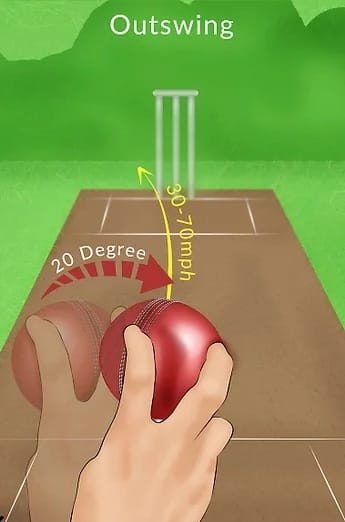
I want you to picture holding the ball with the seam angled towards first slip. Your first two fingers are close together, running along the top of the seam. The shiny side is facing the batter. This is the one that made me think I was a genius until I realised my wrist was collapsing inwards at release, killing the swing. Don’t be like me.
Keep that wrist cocked firmly towards slip as you let it go. .
The Inswinger Grip:
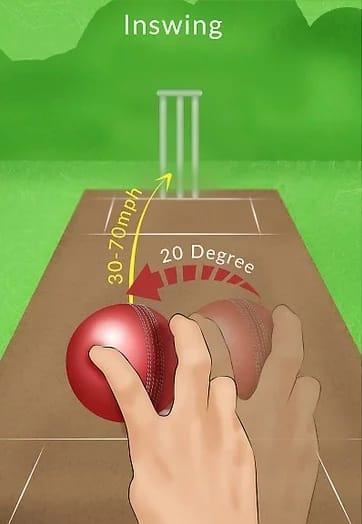
Now, the seam angles towards fine leg. The shiny side faces the leg side, away from the batter’s eyes. At release, your wrist rotates inwards—you “open up.” It’s a slightly more unnatural action, which is why so many bowlers have a beautiful outswinger and an inswinger they don’t quite trust. Control is the battle here.
The Reverse Swing Grip:
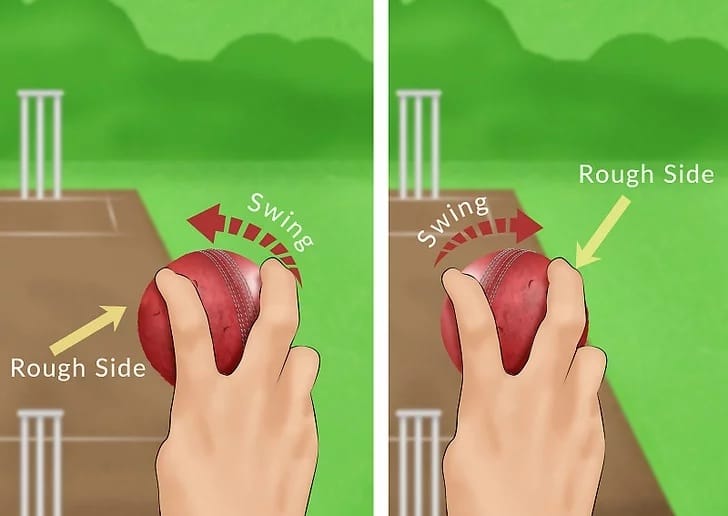
Here’s the mind game. You hold the ball exactly like an outswinger, but the shiny side is now facing the batter because the ball’s condition demands it.
You cannot bowl reverse swing at medium pace. You must push through that 128 km/h threshold, with an upright seam, and let the ball’s worn surface do the lying for you.
Now Put This Knowledge Into Practice
You’ve just unlocked the secrets of swing bowling.
The next step is building a training routine that sharpens your skills every single day — even at home. Grab your Free Home Cricket Training Schedule and turn theory into muscle memory with drills, fitness routines, and a structured plan you can follow anywhere.
📥 Download Your Free Training ScheduleNo spam. Just a structured plan to get better every day.
The Action:
A high, side-on action is your best friend. It allows you to get your wrist behind the ball and impart pure backspin, which acts like a gyroscope, keeping the seam bolt upright and stable for its entire journey. A scrambled seam or a wrist that spins the ball kills the swing instantly. You’ll know it when you do it because the ball just sits up and says “hit me.”
The Where and When: A Personal Tour of Swing’s Holy Places
I’ve always believed that swing bowling in cricket is a conversation between the bowler and the venue. Some grounds just listen better.
The old myth is that heavy, overcast humidity makes the ball swing more. The wind tunnel science doesn’t fully back this up, which is fascinating. It might be the cooler, denser air, or perhaps a cross-wind that effectively changes the ball’s airspeed. I love that we don’t have a complete answer yet.
What I do know is that certain grounds are sacred. Headingley under a leaden sky, with the crowd breathing down your neck, is the spiritual home of the outswinger.
Lord’s has that famous slope, which creates an awkward, unnatural angle from the Pavilion End. Newlands in Cape Town has the sea breeze that a smart bowler uses like a rudder.
And Perth’s Optus Stadium, with its hard, dry, baking square, is where new balls go to die and reverse swing arrives like an early, violent guest. India, with its heat and SG balls, is a reverse-swing country by nature, which shaped an entirely different lineage of fast bowling.
The Format Gap: Why a Test Match Wicket is Different From a T20 Scalp
This is the modern reality of swing bowling in cricket, and it’s a story so many guides completely ignore.
Test cricket is the full novel. You have a new ball, a middle period for the ball to age, and then a late period for devastating reverse swing. The tactical timeline is an art form in itself. You might bowl gentle outswingers for the first 15 overs, then focus on holding an end, before unleashing toe-crushing reverse-swinging yorkers with a 60-over-old ball.
ODI cricket changed everything with two new balls. Suddenly, each ball only gets used for 25 overs, not 50. The traditional reverse swing window shouldn’t exist. But smart teams force it, treating one ball roughly—bouncing it in on the boundary edge—while the other is polished to perfection, dragging the reverse window forward into overs 30-35. It’s a manufactured art.
T20 cricket is the brutal poem. You have six balls of powerplay with a swinging new ball, and if you’re a genuine, 140+ km/h reverse-swing bowler, you become the most valuable asset in the death overs. A slower outswinger or a clever piece of contrast swing in the powerplay, followed by a reversing yorker at the death, is the complete T20 swing bowler’s package.
The Batter’s Survival Manual: What I Wish I Knew
This is the chapter I needed as a 16-year-old, picking my middle stump out of the ground. Learning how to play swing bowling is a mental battle.
Reading the Lie:
You cannot just watch the ball. You have to watch the bowler’s wrist in the final stride. Is it cocked towards slip, or is it opening inwards? Even more crucially, you glance at the fielders. Who is polishing what? If they’re shining the side facing you, reverse swing is likely on its way. This pre-delivery scan is your only defence.
The Art of the Leave:
My most embarrassing dismissal came from playing a shot I didn’t need to. The most underrated batting skill in Test cricket is shouldering arms to an outswinger outside off stump. It requires you to judge the lateral movement purely from the seam’s tilt. It’s a form of educated surrender, and the greats like Jacques Kallis built entire innings on it.
Lessons from the Gods:
I study the way Sachin Tendulkar played the outswinger as late as a man ordering dinner, his elbow high, the ball almost under his eyes. I marvel at how Brian Lara used to read Wasim Akram’s reverse swing, seemingly picking the movement from a subtle seam angle most mortals couldn’t see.
And I watch Virat Kohli’s transformation in England, where he adjusted his trigger movement, taking a half-step forward to cover the swing, and turned a nightmare tour into a masterpiece. This is the art of fighting back.
The Greatest Swing Bowlers: My Personal Pantheon
Swing bowling in cricket has a lineage of magicians, and I have my favourites.
For sheer, unadulterated beauty of conventional swing, I will always watch footage of James Anderson in England, a Dukes ball in hand, manipulating a late outswinger on a cloudy morning. He’s the master craftsman. Malcolm Marshall combined searing pace with a late, snappy swing that felt almost unfair.
For reverse swing, the mind goes straight to Wasim Akram. He was a left-arm geometry problem no right-hander could solve. His reverse inswinger came from a different postcode and at high pace. Waqar Younis perfected the toe-crushing yorker, and Dale Steyn showed the world that you could combine fury and finesse, swinging the old ball both ways at express speed.
And the left-armers? Shaheen Afridi and Trent Boult carry the torch now. Their angle is a special kind of menace, creating an entirely different visual puzzle for the batter, the ball snaking into the pads from a line that feels permanently unsafe.
A Brief, Very Human History
The story of swing isn’t a dry timeline. It’s a tale of secrets whispered between players. Early bowlers thought a curving ball was a gift from the weather gods. The craft was pure intuition. Then came the 1980s, a NASA wind tunnel, and a conversation between a fast bowler (Imran Khan) and a scientist (Dr. Mehta).
What was once Pakistani folklore became a validated science, and the world of swing bowling in cricket changed forever. Sarfraz Nawaz is the pioneer history almost forgot, and the subsequent ball-tampering scandals are just a dark, misguided chapter where teams tried to shortcut a physics lesson they hadn’t yet fully understood.
How to Get Better: Drills, Mistakes, and the Stuff Coaches Look For
If you want to learn how to bowl swing, you have to practice with intent.
A Drill I Swear By:
Set up a target cone on a full length, a foot outside off stump. Your job is to land the ball on that cone, forcing it to swing back into the “corridor.” It builds the muscle memory for your outswinger grip without you having to overthink it. Another one is the wet ball drill. Practice with a completely sodden, non-swinging ball. Focus only on releasing it with a perfect, upright seam and pure backspin. If you can make a wet ball seam-spin stable, a dry one will swing beautifully.
The Mistakes You’re Probably Making:
Your fingers are too far apart on the seam, meaning the seam can’t cleanly trip the airflow. Or your wrist is collapsing at the point of release, scrambling the seam. Or you’re just bowling too fast for the conditions, pushing the ball above its conventional swing speed window. And here’s a team mistake I see all the time: leaving ball maintenance to just the bowler and the keeper. The whole side needs to understand that polishing the ball is not a chore, it’s an act of collective attack.
FAQs: Swing Bowling in Cricket
What is swing bowling in cricket?
Swing bowling is the art of making a cricket ball curve laterally through the air, away from a straight trajectory, before it pitches. It is a fast bowling skill that exploits the ball’s raised seam and the differential surface condition between its two halves to manipulate airflow and create pressure differences. Unlike seam bowling, which moves off the pitch, or spin bowling, which relies on revolutions, swing bowling happens entirely in flight — giving the batter milliseconds to read, react, and adjust.
What is the difference between conventional swing and reverse swing?
Conventional swing works with a new ball. The seam is angled and kept upright, tripping the airflow on one side into turbulence. The ball swings away from the shiny side. It operates best in the 108–128 km/h speed range.
Reverse swing happens with an older ball, typically after 35–40 overs, when one side has been deliberately roughened and the other kept polished. The physics flips — the ball now swings towards the shiny side. It requires higher speeds, generally above 128 km/h, and is far harder for batters to read because the bowler’s grip mimics an outswinger while the ball jags the opposite way.
How many types of swing bowling are there?
Most guides teach two. There are actually four:
Conventional Swing — new ball, seam-driven, swings away from the shiny side.
Reverse Swing — old ball, surface-driven, swings towards the shiny side.
Conventional Contrast Swing — no seam involvement, pure surface asymmetry, swings away from the shiny side at low speeds.
Reverse Contrast Swing (Mitchell Starc’s “power fading”) — at extreme pace on a dry ball, the pressure differential flips even with a dead-straight seam, and the ball swings towards the shiny side.
Why does a cricket ball swing?
A cricket ball swings because of the boundary layer — a thin blanket of air hugging the ball’s surface. The raised seam, angled slightly, trips the smooth laminar airflow on one side into chaotic turbulent flow. This turbulent air has more energy and clings to the ball’s surface longer, delaying its separation point. The smooth air on the other side separates earlier. This creates a pressure imbalance: lower pressure on the turbulent side, higher pressure on the smooth side. The ball is pushed laterally towards the lower pressure. This is the Bernoulli Principle in action.
How do you grip the ball for an outswinger?
For a right-arm bowler to a right-handed batter, angle the seam towards first slip at approximately 20 degrees. Place your index and middle fingers close together along the top of the seam. The shiny side of the ball faces the batter. At release, keep the wrist cocked slightly towards slip — this ensures the seam stays upright and stable through its flight. The most common mistake is the wrist collapsing inward, which scrambles the seam and kills the swing.
How do you grip the ball for an inswinger?
Angle the seam towards fine leg. The shiny side now faces the leg side, away from the batter. At release, the wrist rotates inward — bowlers describe this as “opening up.” The rough side of the ball faces the batter. Inswingers are slightly harder to control than outswingers because the wrist action is less natural for most bowlers.
How do you bowl reverse swing?
You need an older ball with one side significantly rougher than the other. Grip the ball exactly like an outswinger — seam angled towards slip. But crucially, the shiny side now faces the batter (the opposite of conventional swing). Deliver the ball above 128 km/h with an upright seam and pure backspin. Do not try to force the movement with your wrist — the ball’s surface condition does the work. You cannot bowl reverse swing at medium pace; the physics does not permit it.
Does humidity actually affect swing bowling?
The popular belief is yes — overcast, humid conditions make the ball swing more. The science is not fully settled. Wind tunnel tests by Dr. Rabindra Mehta found no significant direct effect of humidity on cricket ball aerodynamics. The perception may be due to cooler, denser air under cloud cover, or subtle changes to the ball’s surface in damp conditions. The honest answer is that the atmospheric mystery is still unresolved — and many experienced bowlers will tell you they feel a difference even if science hasn’t yet fully explained it.
Which cricket ball swings the most?
The Dukes ball, used in England and the West Indies, is widely considered the best swinging ball in the world. It has a higher, more pronounced seam and a harder lacquer that keeps one side shinier for longer, extending the conventional swing window deep into an innings. The Kookaburra, used in Australia and most white-ball cricket, loses its shine and seam prominence faster — the conventional swing window is shorter but reverse swing arrives earlier. The SG ball, used in India, has softer leather and scuffs up quickly on dry pitches, making it predominantly a reverse-swing ball.
Can you bowl reverse swing without ball tampering?
Yes. Legal reverse swing is a naturally occurring aerodynamic consequence of differential wear on the two sides of the ball. One side is polished through sweat and legal shining, the other is allowed to rough up naturally through contact with the pitch and outfield. No foreign substances, scratching, or seam lifting is required. Ball tampering — the illegal act — is essentially a shortcut to force the surface asymmetry that creates reverse swing faster than it would naturally develop.
Why is left-arm swing bowling so dangerous?
Left-arm swing is disproportionately dangerous to right-handed batters because of geometry. A right-arm bowler delivering an inswinger brings the ball into the right-hander from an angle the batter sees regularly. A left-arm bowler delivering the same inswinger brings the ball in from a wider angle on the crease, creating a completely different visual puzzle. The ball starts wider, looks like it is going further away, and then curves back in sharply. The angle also makes LBW a constant threat because the ball is pitching in line and straightening from a batter’s blind spot.
Who are the greatest swing bowlers in cricket history?
The greatest conventional swing bowler is James Anderson, the master of the Dukes ball with over 700 Test wickets built on late, precise outswing. The greatest reverse swing practitioner is Wasim Akram, whose left-arm angle and ability to swing the old ball both ways at high pace made him unplayable. Waqar Younis perfected the toe-crushing reverse-swinging yorker. Dale Steyn combined express pace with swing in both directions. Malcolm Marshall and Richard Hadlee are the gold standards from earlier eras. Among current players, Mitchell Starc, Shaheen Afridi, and Trent Boult carry the torch.
How do batters read swing bowling?
Elite batters read swing before the ball is even released. They watch the bowler’s wrist position in the final stride — is it cocked towards slip or opening inward? They glance at the fielding side: who is polishing the ball, and which side are they shining? At the point of release, they look for the glint of the polished side to determine the true direction of movement. This pre-delivery reading is the only reliable defence against reverse swing, where the grip itself is a deliberate lie. After release, footwork takes over — a forward press to get close to the ball, playing late and under the eyes, and knowing when to leave.
What is the best length for swing bowling?
The most dangerous length for swing bowling is not the half-volley, tempting as it is. The truly unplayable delivery pitches on what coaches call the “interception point” — roughly a good length, just short of driving length, where the ball is still swinging late in its flight path and the batter has already committed to either forward or back. At this length, late swing finds the outside edge or traps the batter LBW before they can adjust. A swinging half-volley, by contrast, is easier to drive because the movement has largely finished by the time the ball reaches the batter.
How do T20 bowlers use swing effectively?
In T20 cricket, a swing bowler has a compressed window — essentially the six powerplay overs with a new ball. The premium skills are the slower outswinger, which deceives the batter’s timing, and conventional contrast swing delivered with a scrambled seam at reduced pace. A genuine reverse swing bowler who can touch 140+ km/h in the death overs becomes a match-winning asset, turning a predictable length delivery into an unplayable, reversing yorker when batters are looking to launch every ball. This makes genuine swing bowlers among the most valuable T20 players despite the format’s reputation as batter-friendly.
What is the crossover velocity in swing bowling?
The crossover velocity is the speed at which a cricket ball stops swinging conventionally and transitions towards reverse swing behaviour. For a new ball, if the delivery is too fast (typically above 135–140 km/h), the boundary layer on both sides becomes turbulent, eliminating the pressure differential that creates swing. However, as the ball travels down the pitch, it decelerates. A delivery released above the swing window can decelerate into the optimal speed range in the final metres — this is one of the two reasons for devastating “late swing.” The ball essentially discovers its movement right in front of the batter’s eyes.
Let’s Bust Some Myths, Finally
I’ve heard so many dressing-room theories over the years. Let’s clear them up.
- “Humidity makes it swing.” The wind tunnel says no. I know it feels true, but science suggests it’s likely a placebo or the effect of cooler air. The honest answer is still wonderfully incomplete.
- “The heavier side of the ball does the swinging.” No, the weight difference is negligible. It’s all about the surface texture.
- “You have to cheat to get reverse swing.” Completely false. Legal reverse swing is a natural, beautiful consequence of differential wear. No bottle tops required.
- “Only express bowlers can reverse it.” The threshold is around 115 km/h for an old ball. It’s a skill of seam and management, not just raw pace.
- “You need English conditions.” No, you just need the right ball. A new Kookaburra will swing conventionally in Mumbai; it just loses the ability faster.
We’ve come a long way from that humiliated 16-year-old standing amid his shattered stumps. Swing bowling in cricket is, for me, the game’s most perfect fusion of art and cold, hard physics. It’s the bowler understanding the crossover velocity point, the secret whisper of the boundary layer, and the geometry of deception. And it’s the batter, heart pounding, scanning a wrist angle, trusting a trigger movement, and having the courage to leave a ball hissing past off stump. In that half-second duel, a whole world of science, history, and human cunning plays out. That wink from the old pro wasn’t just gloating. It was an invitation. And you’ve just read the answer.