
Some links in this article are Amazon affiliate links. If you buy a bat through them, I earn a small commission — at absolutely no extra cost to you. Every bat I recommend is something I’ve personally tested and genuinely believe in. No brand paid for a spot on this list. Promise.
Last Sunday, my cousin showed up to our box cricket match with his dad’s old English willow cricket bat. Beautiful thing. Grade 2. Cost a fortune. He took guard, puffed his chest out, and prepared to smash us all over the turf. First ball – a decent-length delivery, nothing special. He middled it. But instead of that sweet “thwack” we all love, there was this dull, dead sound. The ball barely reached the circle. The vibration stung his hands so badly he dropped the bat.
By the 15th ball, a hairline crack had appeared near the toe. A ₹15,000 cricket bat. Destroyed. In one evening. I see this mistake literally every weekend. Cricketers – smart cricketers -using the wrong bat for their game. It’s not their fault. Nobody explains this stuff properly.
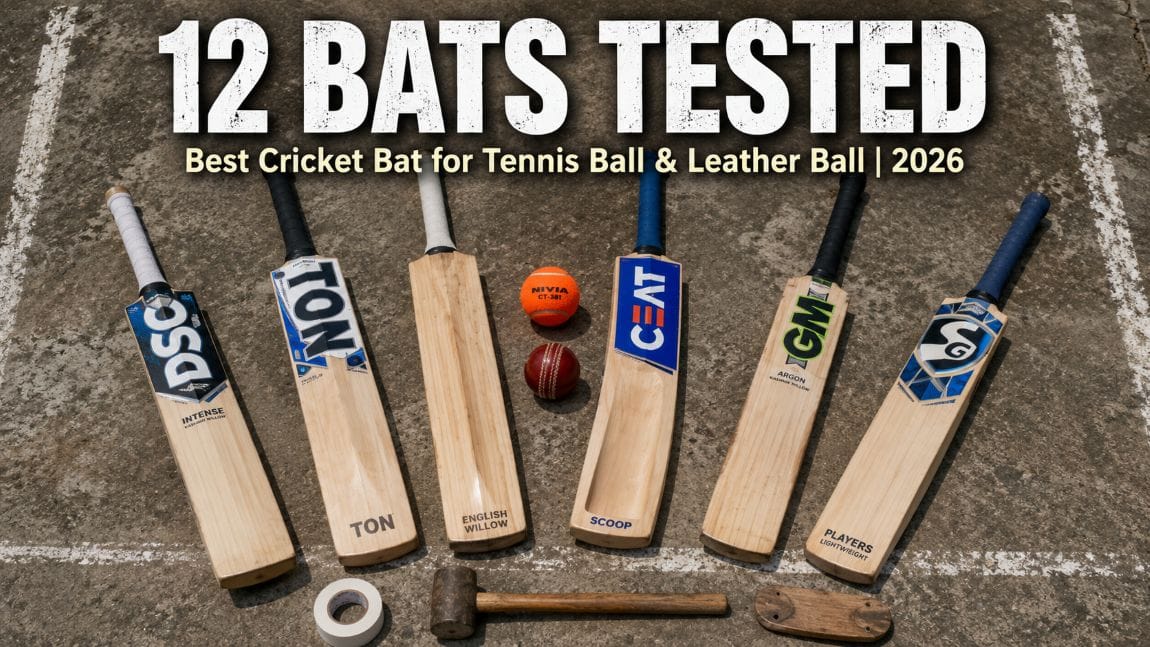
So I decided to fix that. I gathered 12 bats – everything from a humble ₹899 Decathlon to a serious ₹13,000 SS Orange – and tested them across concrete pitches, box cricket turf, and proper leather-ball nets. My goal was simple: find the best cricket bat for tennis ball cricket at every single budget, and also figure out what actually works for tape ball and leather ball. No marketing fluff. No “buy this because the brand paid me.” Just honest opinions from someone who’s broken way too many bats to lie to you.
🏏 QUICK ANSWERS — For The Impatient Cricketer
I know some of you are in a hurry. Your match is in an hour, and you just need a straight answer. Here you go:
| Question | Straight Answer |
|---|---|
| Best bat weight for hard tennis ball? | 1,000g–1,150g. If you’re a beginner, stick to 1,050g. |
| Best bat weight for leather ball? | 1,100g–1,250g for most adults. |
| My top beginner pick for tennis ball? | Jaspo Slog Elite (~₹999). Thick edges, barely any sting, ready to play. |
| My top beginner pick for leather ball? | GM Chroma Maxi (~₹6,999). Light, forgiving, and doesn’t break the bank. |
| Can I use one bat for both? | Absolutely not. Your English willow bat will crack from the inside. I’ve seen it happen too many times. |
🏆 The Best Cricket Bats of 2026
Jaspo Slog Elite
Burn Edition Scoop
GM Chroma Maxi
SG Sunny Tonny
Decathlon FLX
SS Orange English Willow
All prices checked May 2026
🏏 Want more cricket breakdowns like this every week?
What Even IS a “Tennis Ball Bat”? And Why Should You Care?
I didn’t understand this for years. A bat is a bat, right? Wrong.
A tennis ball Cricket bat isn’t just a cheaper cricket bat. It’s built to survive something very specific: the brutal, repetitive smack of a hard tennis ball—the kind you get from a Nivia, Cosco, or Guru ball.
See, when a leather ball hits a cricket bat, the impact spreads out through the ball’s soft cork and leather core. But a hard tennis ball? It’s dense rubber. The impact is sharp and concentrated. Hit after hit, that energy hammers into your bat’s fibers. A soft English willow blade absorbs that by cracking internally. A dense Kashmir willow blade? It resists it.
Here’s what separates them in real terms:
- Edge thickness: My tennis ball cricket bats have edges between 35-45mm. That’s massive. It means even when I mis-hit—and trust me, on a bouncy concrete pitch, I mis-hit plenty—the ball still travels.
- The wood: All my tennis bats are Kashmir willow. It’s harder, denser, and doesn’t complain when you smash a heavy Nivia ball for three hours straight.
- The handle: Solid Singapore cane. It soaks up the vibration. On a cold morning, when you edge one and that stinging pain shoots up your arm? A good Singapore cane handle makes that a non-issue.
| Feature | Leather Ball Bat (My Club Bats) | Tennis Ball Bat (My Gully Bats) |
|---|---|---|
| Wood | English Willow | Kashmir Willow |
| Edge Thickness | 28-36mm | 35-45mm |
| Handle | Multi-piece cane | Solid Singapore cane |
| Weight (Adult) | 1,100g–1,250g | 1,000g–1,150g |
| Needs Knocking In? | Yes, absolutely | Nope, ready to go |
The simplest rule I can give you: English willow is a sprinter—explosive but delicate. Kashmir willow is a marathon runner—tough, durable, and keeps going. Use the right athlete for the right race.
My Honest Picks: Best Cricket Bats for Hard Tennis Ball
These are the cricket bats I actually reach for when I’m heading to a gully match or a box cricket tournament. I’ve tested each one personally. They’re all Kashmir willow, all built for hard tennis balls, and all worth your money.
The One I Recommend to Everyone: Jaspo Slog Elite
Price: ₹999 — [Check Today’s Price on Amazon →] https://amzn.to/43qaXAZ
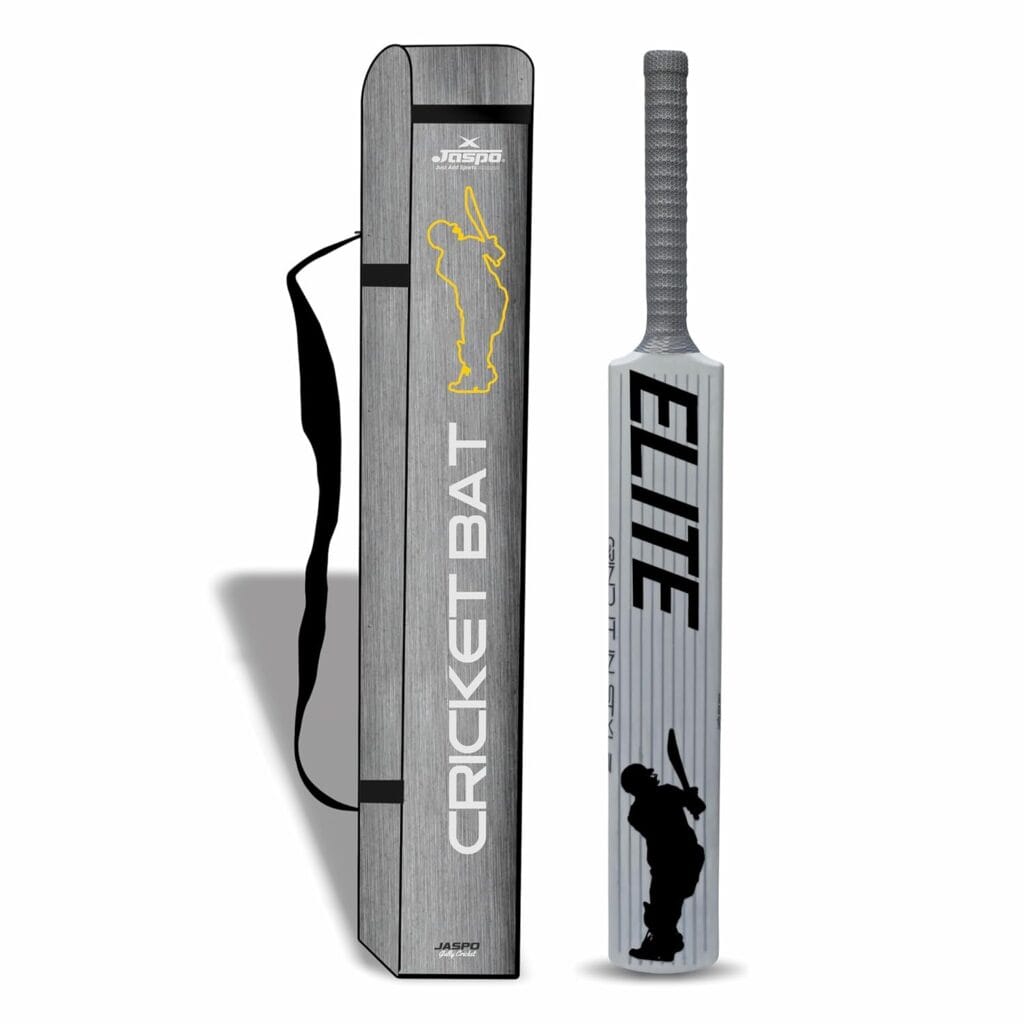
Who’s it for? My friends who play weekend cricket on concrete. My cousin who’s just getting into the game. Basically, 90% of cricketers I know.
The numbers that matter:
- Weight: 1,050g
- Edge Thickness: 38mm
- Handle: Singapore cane
- Wood: Kashmir willow
Why I love this thing.
I bought this bat with low expectations. ₹999? Come on. But the first time I middled a Nivia ball with it, I actually laughed. The sound was that satisfying, sharp crack. The ball flew. For a bat that costs less than a decent dinner, it’s absurdly good.
Those 38mm edges are the real deal. You know that feeling when you edge one and it still races to the boundary? That’s the thick edges working. The Singapore cane handle genuinely cuts down the sting. I’ve played three-hour sessions with this bat on concrete, and my hands felt fine afterwards.
I’ve had mine for two seasons now. It’s got scuffs, it’s got character, but it’s still going strong.
What I love:
- Unbelievable edge thickness for the price. Feels like cheating.
- Hardly any vibration. The handle is magic.
- No knocking in. Unwrap it, grip it, go play.
What I don’t love:
- Not a leather ball bat. Don’t even try.
- The grip color choices are… let’s say “limited.”
My honest take: If you play gully cricket and you’re on a budget, just buy this. You can thank me later.
[See Today’s Price on Amazon →] https://amzn.to/43qaXAZ
Price checked May 2026. These things fluctuate, so click to see the current rate.
The Six-Hitting Machine: Burn Edition Scoop Bat
Price: ₹2,277— [Check Today’s Price on Amazon →] https://amzn.to/4dxt1ha
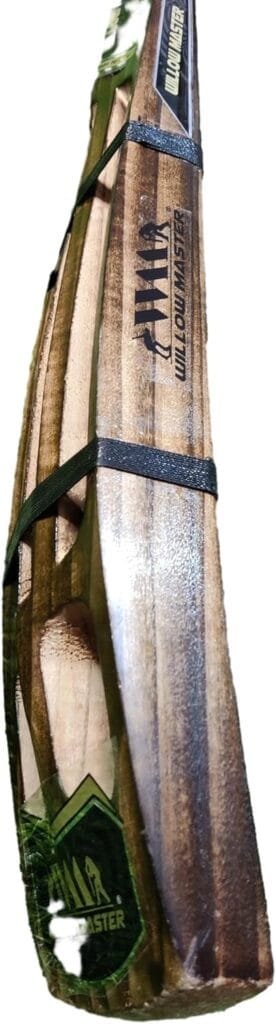
Who’s it for? Death-over specialists. Box cricket bullies. Anyone who wants to clear the roof and make the opposition groan.
The numbers that matter:
- Weight: 1,080g
- Edge Thickness: 42mm (yes, forty-two)
- Handle: Singapore cane
- Wood: Kashmir willow (Scoop Design)
Why this bat makes me smile.
Okay, full disclosure: the first time I used a scoop bat, I hated it. It felt weird. Too light. But then I middled a length ball, and it went so far over the bowler’s head that we lost the ball on a nearby roof.
The scoop design is basically this: they carve out wood from the back of the bat, making it lighter, but keep the edges insanely thick. The result? The bat feels feather-light in your hands, but when you swing it, all the mass is concentrated right behind the ball. It’s physics. It’s beautiful.
In box cricket, where clearing a short boundary is everything, this bat is borderline unfair. The 42mm edges mean even your mis-hits have a chance.
What I love:
- 42mm edges. That’s almost as thick as my phone.
- Swing speed is ridiculously fast.
- Makes six-hitting feel genuinely easier.
What I don’t love:
- Playing defensive shots on a rough surface is tricky. The scooped back means less wood low down.
- Not for tape ball. Trust me on this—the tape seam does weird things off the hollow back.
My honest take: If you’re the power hitter in your team, this is your weapon. Don’t use it on bumpy, unpredictable pitches where you need to dig out yorkers.
[See Today’s Price on Amazon →] https://amzn.to/4dxt1ha
Price checked May 2026.
The Premium Performer: DSC Pentazone Kashmir Willow
Price: ~₹3,034 — [Check Today’s Price on Amazon →] https://amzn.to/3Pooy8O
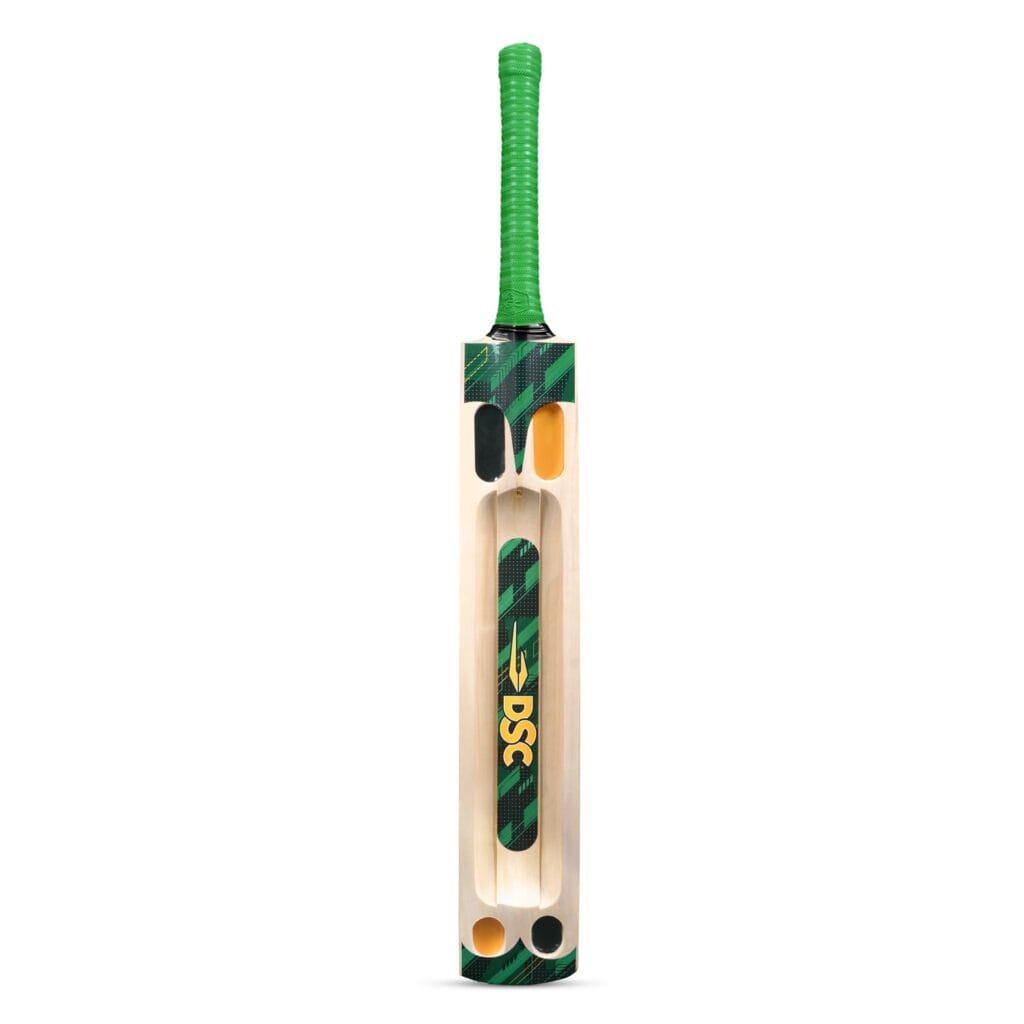
Who’s it for? The tournament player. The guy who takes his weekend tennis ball cricket very, very seriously.
The numbers that matter:
- Weight: 1000 – 1100 grams
- Edge Thickness: 40mm
- Handle: Singapore cane
- Wood: Kashmir willow (Scoop Design)
Why I rate it.
The DSC Pentazone is what happens when a brand actually thinks about tennis ball players instead of just slapping their name on a cheap bat. The scoop is refined, the sweet spot is massive—like, genuinely huge—and the balance is so good that the bat feels lighter than its weight.
I used this in a proper six-a-side tournament on turf. Off-center hits were still finding gaps. The ping off the middle was loud and clean. It felt like a cricket bat, not a toy. If you’re past the beginner stage and want something that feels premium without jumping to leather-ball prices, this is your bat.
What I love:
- The sweet spot covers almost the whole face.
- Balance is superb. Easy to swing, easy to control.
- Feels like a serious piece of kit.
What I don’t love:
- Sometimes hard to find on Amazon. Availability can be patchy.
- Costs a bit more, but honestly, you feel where the money went.
My honest take: If you play competitive tennis ball tournaments, invest in this. It’s a confidence bat.
[See Today’s Price on Amazon →] https://amzn.to/3Pooy8O
Price checked May 2026.
The Perfect Starter Bat: Decathlon FLX Adult
Price: ₹899 Not available in Amazon. Available in Ajio
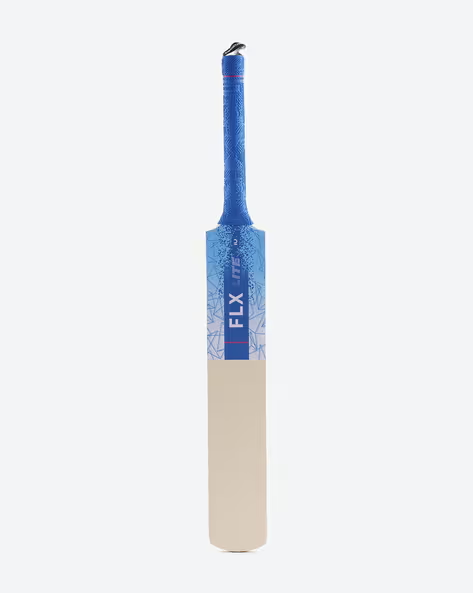
Who’s it for? The absolute beginner. The kid who’s just moved up to an adult bat. The casual player who wants something reliable without thinking too hard.
The numbers that matter:
- Weight: 920g
- Edge Thickness: 30mm
- Handle: Singapore cane
- Wood: Kashmir willow
Why it’s great for starting out.
The FLX is the lightest bat I tested. At 920g, it feels like swinging a magic wand. For someone who hasn’t developed bat speed or forearm strength yet, this is a blessing. My nephew (14 years old, just getting into cricket) started with this bat, and he could actually control his shots instead of being late on everything.
It’s not a power bat. The 30mm edges mean you have to middle it to get value. But for learning the game, building confidence, and just having fun, it’s perfect. Plus, Decathlon’s return policy means you can’t really go wrong.
What I love:
- Incredibly light and easy to handle.
- The perfect bat to learn with.
- Decathlon’s warranty is genuinely reassuring.
What I don’t love:
- Not for power hitting. Thinner edges mean less forgiveness.
- Outgrow it quickly if you start playing regularly.
My honest take: Buy this for a beginner. Buy it for your kid. Buy it as a spare bat that lives in your car. Don’t buy it if you want to hit sixes.
Price checked May 2026.
The Fast Bowling Specialist: SG T-900
Price: ₹1,800–₹2,200 — [Check Today’s Price on Amazon →] https://amzn.to/4tRBXEg
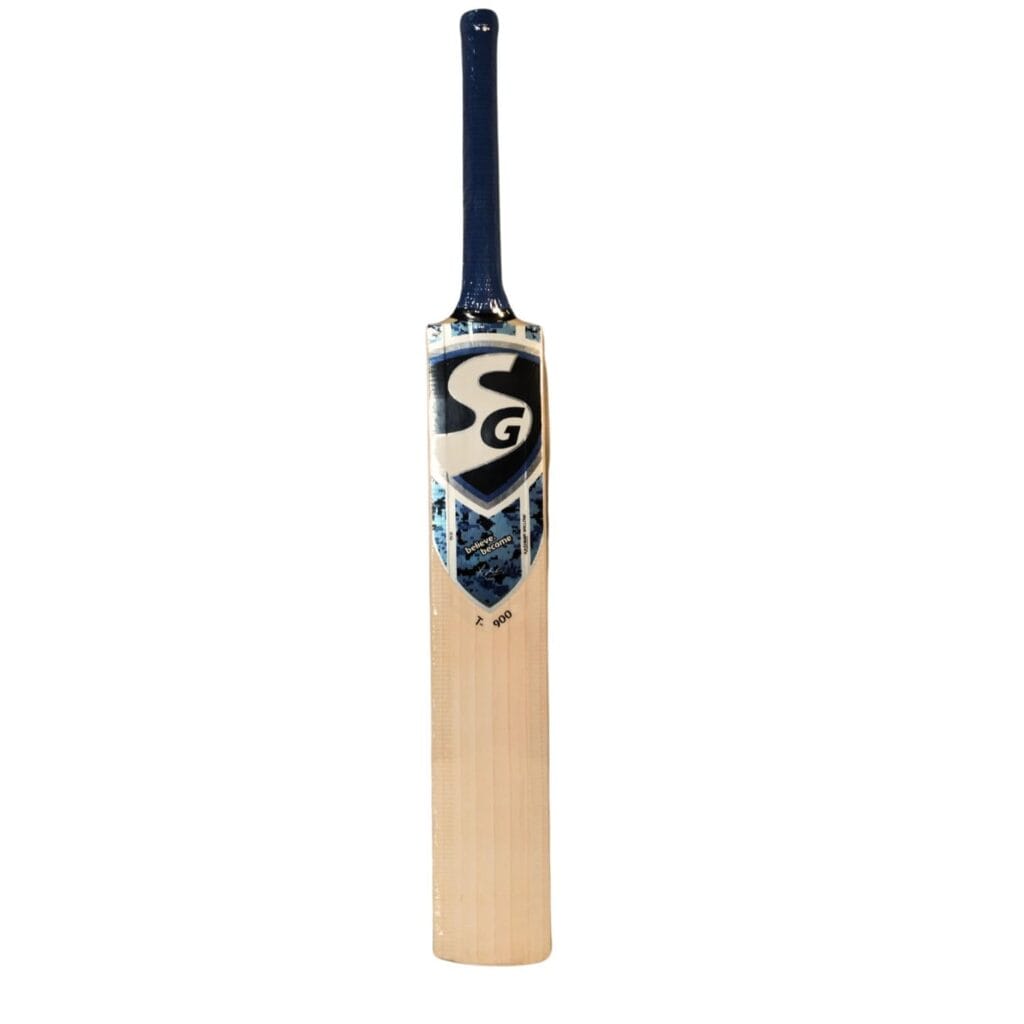
Who’s it for? Openers who face genuine pace on a tennis ball. The guys who need a bat that won’t sting when someone hurls a ball at 120kmph.
The numbers that matter:
- Weight: 1,100g
- Edge Thickness: 40mm
- Handle: Singapore cane with rubber inserts
- Wood: Kashmir willow
Why this bat is different.
SG has added rubber inserts into the handle of the Savage Xtreme, and it makes a genuine difference. I faced a friend who bowls seriously quick with a taped tennis ball—the kind of bowling that usually leaves my hands tingling after a few overs. With this bat, the vibration was noticeably less. It’s heavier at 1,100g, which I actually prefer against pace; the extra mass helps redirect the ball without having to swing hard.
This is a specialist’s bat. If you’re an opener who likes to feel the weight and punch the ball rather than swing wildly, you’ll appreciate it.
What I love:
- The best vibration dampening I’ve experienced.
- Solid weight gives confidence against quick bowling.
- SG is a brand Indian cricketers have trusted for decades.
What I don’t love:
- Feels heavy if you’re used to lighter bats.
- Slightly pricier than the Jaspo or Decathlon.
My honest take: If you open the batting and face fast bowlers regularly, this is worth the extra money for the comfort alone.
[See Today’s Price on Amazon →] https://amzn.to/4tRBXEg
Price checked May 2026.
🏏 Got Your Bat? Now Build Your Practice Setup.
Once you’ve got your bat, check out our guide to building a home cricket training setup on any budget .
For a tighter budget (₹2000 or below), we’ve also curated a separate list of the best cricket bat under ₹2000 – these are specifically chosen for beginners and casual play.
Scoop Bat vs Normal Cricket Bat: The Real Difference, Explained Simply
I get asked this all the time at matches. “Bhai, scoop bat le ya normal?”
Here’s the simplest explanation I can give.
A scoop bat has wood carved out from the back. This removes dead weight (around 80-120 grams) but keeps the edges chunky. The result? The bat swings faster. And in cricket, bat speed is everything for six-hitting. A lighter bat swung fast will send the ball further than a heavy bat swung slowly. That’s just physics.
Get a scoop bat if:
- You play mostly on turf or concrete (box cricket).
- You’re a middle-order batsman who likes to attack.
- You want to clear boundaries without swinging out of your shoes.
- You use hard tennis balls like Nivia or Cosco.
Stick with a normal bat if:
- You play on rough, uneven ground where the bounce is unpredictable.
- You’re an opener who needs to dig out yorkers and play defensively.
- You play tape ball cricket (I’ll explain why in the tape ball section).
- You simply prefer the traditional feel of a solid bat.
| Choose a Scoop Bat If… | Choose a Normal Bat If… |
|---|---|
| You hit more sixes than singles | You build your innings carefully |
| You play on turf or concrete | You play on rough, bumpy surfaces |
| Bat speed is your strength | Timing and placement is your game |
| You play box cricket tournaments | You play tape ball or street cricket |
Best Cricket Bats for Leather Ball Cricket
Now let’s switch gears. Leather ball cricket is a completely different animal. This is the world of club matches, school tournaments, and proper games with SG or Dukes balls. Here, English willow is non-negotiable, and you absolutely must knock your bat in before using it. Let me walk you through my picks.
Best Overall English Willow: SG Sunny Tonny
Price: ₹9,859 — [Check Today’s Price on Amazon →] https://amzn.to/4fEq7da
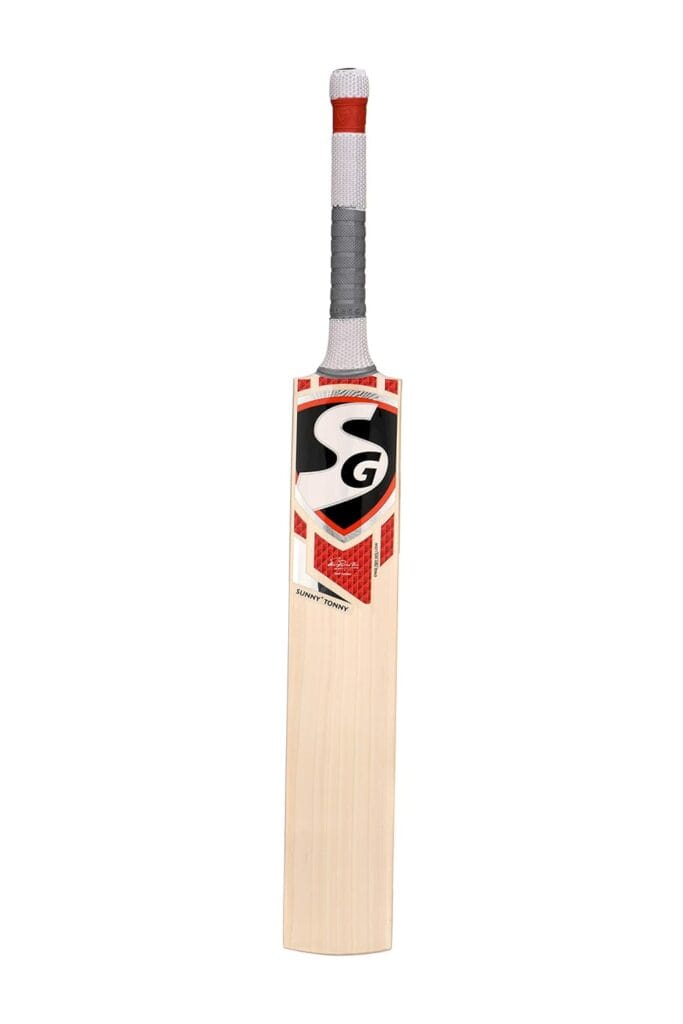
Who’s it for? The serious club cricketer. School-level players. Anyone who wants a reliable English willow bat without selling a kidney.
The numbers that matter:
- Weight: 1,150g
- Edge Thickness: 38mm
- Wood: English Willow (Grade 3)
- Handle: Multi-piece cane
Why it’s a club cricket staple.
The SG Sunny Tonny has been around forever, and there’s a reason for that. It just works. The sweet spot is generous, the pickup feels balanced—not too heavy, not too light—and the Grade 3 English willow gives you that proper leather-ball ping that Kashmir simply cannot replicate.
I’ve used this bat in club matches on turf wickets. Drives flow nicely. Cuts and pulls come off well. It’s not the fanciest bat in the world, but it’s dependable. And in cricket, dependable wins matches.
What I love:
- A proven, trusted model. No surprises here.
- Large sweet spot. Forgiving on off-center hits.
- Good value for Grade 3 English willow.
What I don’t love:
- Needs 4-6 hours of proper knocking in. Do not skip this.
- The grip might need replacing after a heavy season.
My honest take: If you’re playing proper club cricket and need a bat you can trust, this is it.
[See Today’s Price on Amazon →] https://amzn.to/4fEq7da
Price checked May 2026.
Best Mid-Range: SS Orange English Willow
Price: ₹12,990 — [Check Today’s Price on Amazon →] https://amzn.to/4fyQ4eg
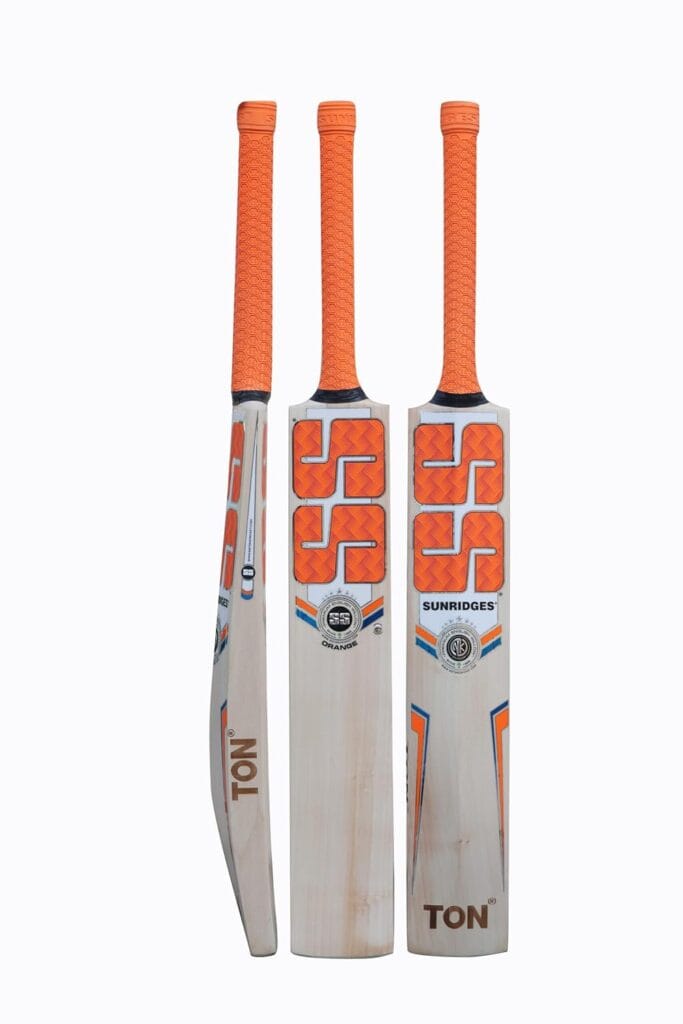
Who’s it for? The intermediate club player who’s ready to invest in something better. Someone who can feel the difference a higher-grade willow makes.
The numbers that matter:
- Weight: 1,180g
- Edge Thickness: 40mm
- Wood: English Willow (Grade 2-3)
- Handle: Multi-piece cane
Why it’s worth the extra money.
The SS Orange is where you start feeling the difference that better willow makes. The grains are straighter. The ping off the middle is crisper and louder. The ball leaves the bat faster.
I played a few net sessions with this bat, and the first thing I noticed was how the ball seemed to explode off the face. Even defensive pushes found the gaps. If you’ve been playing with budget English willow for a while and are ready to upgrade, this bat will make you smile.
What I love:
- Higher grade willow. You can see and feel the quality.
- Excellent ping. The ball just flies.
- Professional-level balance and pickup.
- 40mm edges for modern stroke play.
What I don’t love:
- It’s an investment. Not casual purchase territory.
- Requires careful knocking in and regular maintenance.
My honest take: If you’re serious about your leather ball cricket, this is a brilliant step up from entry-level English willow.
[See Today’s Price on Amazon →] https://amzn.to/4fyQ4eg
Price checked May 2026.
Best Budget English Willow: GM Chroma Maxi
Price: ₹6,999 — [Check Today’s Price on Amazon →] https://amzn.to/4a82SVk
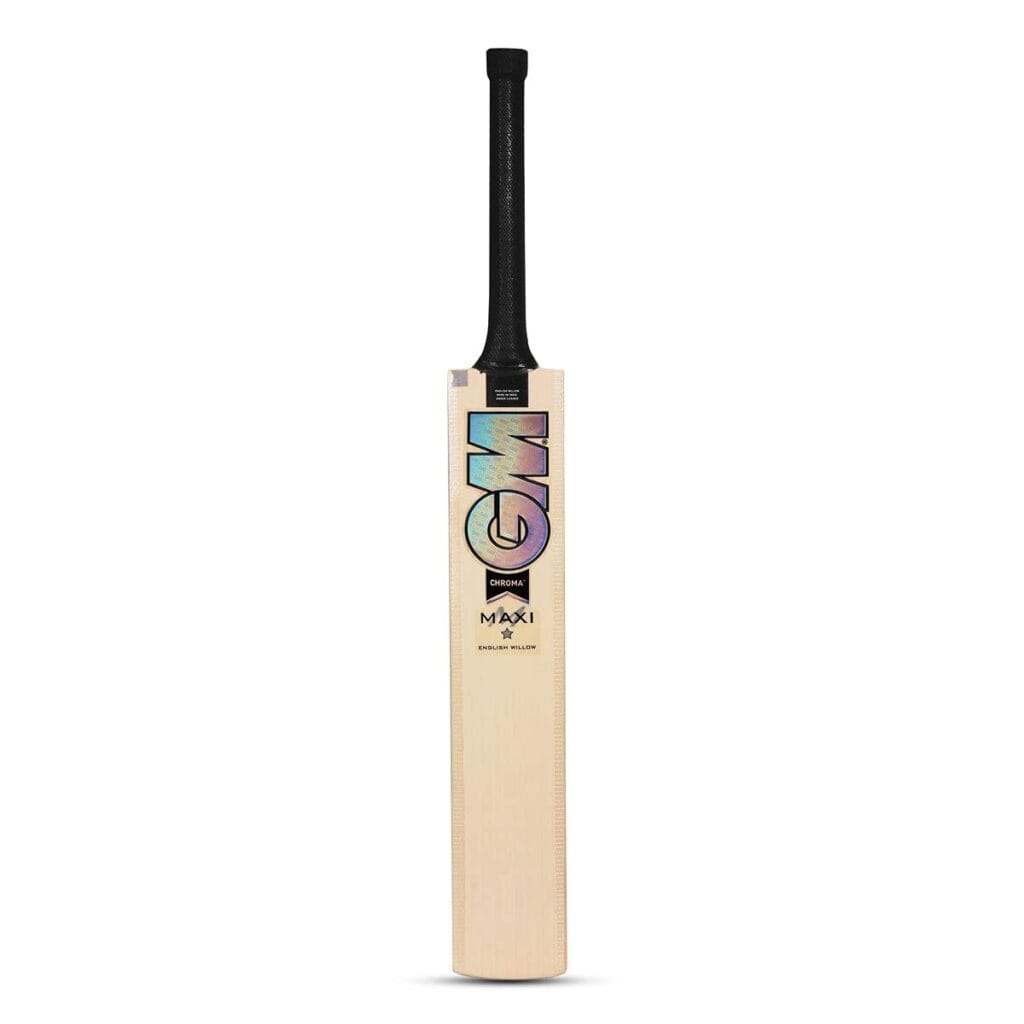
Who’s it for? The tennis ball player making the jump to leather ball cricket. Your first English willow bat.
The numbers that matter:
- Weight: 1,100g
- Edge Thickness: 36mm
- Wood: English Willow (Grade 4)
- Handle: Multi-piece cane
Why it’s the perfect entry point.
The GM Chroma Maxi is lightweight at 1,100g, which makes the transition from tennis ball bats feel natural. When I handed this to a friend who’d only ever used Kashmir willow, he couldn’t stop talking about how alive it felt in his hands. That’s the English willow difference.
It’s Grade 4 willow, so it’s not the premium stuff. But for a first leather ball bat, it’s ideal. The pickup is lovely for drives and cuts. And it comes from Gunn & Moore, a brand with serious cricket heritage. You’re not buying a random bat; you’re buying from people who know what they’re doing.
What I love:
- Lightweight and easy to adapt to from tennis ball bats.
- Great value for genuine English willow.
- Beautiful pickup for front-foot strokes.
- Trusted international brand.
What I don’t love:
- Grade 4 willow. Not as explosive as higher grades.
- Thinner edges (36mm) compared to premium options.
My honest take: If you’re buying your first leather ball bat, start here. It’s forgiving, affordable, and genuine quality.
[See Today’s Price on Amazon →] https://amzn.to/4a82SVk
Price checked May 2026.
⚠️ Don’t Skip This: How to Knock In Your Leather Ball Bat
I’m putting this in a big warning box because honestly, it’s that important.
When I bought my first English willow bat, nobody told me about knocking in. I took it straight to nets, faced a few hard deliveries, and watched a crack develop down the edge within 20 minutes. I felt sick. Don’t be me.
English willow is soft and fibrous when new. It needs to be compressed and hardened before it can handle a hard leather ball. Here’s exactly what to do:
- Oil it first. Get some raw linseed oil. Apply 2-3 thin coats to the face, edges, and toe using a clean cloth. Let each coat dry for a full 24 hours. Don’t drown it—too much oil is as bad as none.
- Knock the edges. Use a wooden bat mallet, or an old leather ball in a sock. Gently tap the edges and back of the bat for 4-6 hours total. Start soft and gradually increase force. You’re compressing fibers, not denting wood.
- Graduated practice. Start with gentle throw-downs. Then a net session with an old, soft leather ball. Only then face a new ball in a match.
Budget 2-3 weeks before using your new bat in a competitive game. I know it’s annoying to wait. But your patience will be rewarded with a bat that lasts 3-5 seasons instead of 3 months.
Best Cricket Bat for Tape Ball Cricket — The Format Everyone Forgets
Tape ball cricket doesn’t get enough attention. But if you’ve ever played with a tennis ball wrapped in electrical tape in a narrow lane or parking lot, you know it’s its own unique beast.
How tape ball is different.
A taped tennis ball is heavier than a regular hard tennis ball—around 145 to 160 grams—and the tape creates a seam that can swing unpredictably. That seam catches on things. Including your bat.
What you need in a tape ball bat.
- Kashmir willow, flat back. This is the key thing. The tape seam bites into the hollowed back of a scoop bat and creates weird, unpredictable deflections. A flat, solid back gives you a clean, predictable surface.
- Lighter weight. 950g to 1,050g. Tape ball is often played in tight spaces where quick hands and wristy shots matter more than raw power.
- Smooth, varnished surface. The adhesive from electrical tape can leave sticky residue on raw wood. A well-varnished bat avoids this.
My pick: Honestly, the Jaspo Slog Elite at ₹999 works brilliantly here. It’s flat-backed, Kashmir willow, and the smooth finish handles tape residue well.
Avoid: Scoop bats. I tried it once. The deflections were so unpredictable I thought the bat was broken. It wasn’t. It was just the wrong tool for the job.
Kashmir Willow vs English Willow: The Only Explanation You’ll Ever Need
This is the question I get asked more than any other. And I get why. Nobody explains it properly. They use jargon and technical terms that don’t mean anything to a regular cricketer.
Let me make it dead simple.
English Willow is grown in England. The wood is soft, fibrous, and has visible grain lines running down the face. Think of it like a sponge. When a leather ball hits it, those fibers compress and then spring back, firing the ball away with extra energy. That’s what creates the famous “ping” sound and explosive rebound. It’s graded 1 to 5, with Grade 1 being the best—straight grains, no blemishes, professional quality.
Kashmir Willow is grown in Kashmir. The wood is denser, harder, and less fibrous. Think of it like a chopping board. It doesn’t compress and spring back. Instead, it resists impact through pure density. This is exactly what you want for tennis balls. It’s graded A to C, with A being the cleanest and best quality.
Why you can’t swap them.
Using an English willow bat for tennis ball is like using a race car on a dirt road. The soft, delicate wood gets hammered by the hard tennis ball, developing internal cracks you can’t even see. Within 50-100 hits, it’s damaged.
Using a Kashmir willow cricket bat for leather ball is like using a truck on a racetrack. The dense wood doesn’t flex, so the leather ball leaves the bat with way less energy. You’ll swing twice as hard for half the result.
Willow grades explained (simple version):
- English Grade 1-2: The beautiful stuff. 7+ straight grains. Professionals use this. ₹10,000 and up.
- English Grade 3-4: The practical stuff. 5-7 grains, minor blemishes. Club cricketers use this. ₹5,000 to ₹10,000.
- English Grade 5+: The starter stuff. Fewer grains, cosmetic imperfections fine. ₹3,000 to ₹6,000.
- Kashmir Grade A: Top quality for tennis. Clean, well-finished. ₹1,500 and up.
- Kashmir Grade C: Entry level. Perfectly fine for casual gully cricket. Under ₹1,500.
| Your Situation | Ball Type | What You Need |
|---|---|---|
| Weekend gully cricket on concrete | Hard Tennis (Nivia/Cosco) | Kashmir Willow |
| Box cricket tournament | Hard Tennis | Kashmir Willow (Scoop if you hit big) |
| School or club match on turf | Leather (SG/Dukes) | English Willow |
| Backyard play with kids | Soft Tennis Ball | Any lightweight Kashmir Willow |
🏏 Want more cricket breakdowns like this every week?
5 Things to Check Before You Buy Any Cricket Bat
Over the years, I’ve developed a mental checklist. Whenever I’m about to buy a bat—whether online or in a shop—I run through these five things. They’ve saved me from bad purchases more times than I can count.
1. Weight
This is the single most important factor. Get this wrong, and nothing else matters.
For tennis ball, I like my cricket bats between 1,000g and 1,150g. Anything lighter lacks punch. Anything heavier tires out my arms by the 10th over. If you’re new to this, start at 1,050g. It’s the sweet spot.
For leather ball, 1,100g to 1,250g is standard. I prefer around 1,150g myself.
One trick I learned: a bat’s “pickup weight” can feel completely different from its actual weight. A well-balanced bat with a low spine might weigh 1,200g on the scale but feel like 1,100g when you hold it. If you can, always pick up a bat before buying.
2. Edge Thickness
Thick edges are your best friend, especially on concrete pitches where the bounce is unpredictable.
For tennis ball, look for 38mm to 45mm edges. Those thick edges mean that even when you mis-hit—and on a bouncy concrete surface, you will mis-hit—the ball still travels.
For leather ball, 36mm to 42mm is modern standard for power hitting. Traditionalists prefer 28mm to 34mm.
3. Handle Type
Singapore cane handles are the gold standard for tennis ball cricket bats. They absorb vibration beautifully. On a cold morning, when you edge one, a Singapore cane handle is the difference between “ouch” and “what sting?”
Multi-piece cane handles are standard for leather ball bats. They offer more flexibility for shot-making.
Some handles, like the SG Savage, have rubber inserts. These are brilliant for reducing shock if you face quick bowlers.
4. Blade Profile
This is about where the wood sits on the cricket bat.
A high spine means more wood behind the middle of the bat. Good for front-foot driving and power hitting.
A low spine means more weight lower down. Good for back-foot play, cuts, and pulls.
Scooped backs remove wood from behind the spine. This gives you the fastest swing speed. Great for six-hitting.
5. Price vs Your Actual Playing Level
Be honest with yourself. Don’t buy a ₹15,000 bat if you play twice a year. Don’t buy a ₹900 bat if you’re playing competitive league cricket. Match the investment to how much you actually play.
| Your Budget | Your Cricket | What Makes Sense |
|---|---|---|
| Under ₹1,000 | Casual gully, tape ball, kids | Decathlon FLX, Jaspo Slog Elite |
| ₹1,000–₹2,500 | Regular hard tennis tournaments | DSC Condor, SG Savage, Burn Scoop |
| ₹3,000–₹7,000 | Beginner leather ball | GM Chroma Maxi English Willow |
| ₹7,000–₹15,000 | Serious club cricket | SG Sunny Tonny, SS Orange |
| ₹15,000+ | Professional / district | Grade 1-2 English from Kookaburra, Gray-Nicolls |
Cricket Bat Size Chart: Don’t Buy the Wrong Size
I see parents buying cricket bats that are way too big for their kids all the time. “They’ll grow into it,” they say. But an oversized bat is impossible to control. The kid develops bad habits trying to manage it, and they end up hating the game.
Don’t do that. Use this chart.
| Bat Size | Player Age | Player Height | Handle Type |
|---|---|---|---|
| Size 1 | 4–5 years | Under 4’3″ | Short |
| Size 2 | 5–6 years | 4’3″ – 4’6″ | Short |
| Size 3 | 6–8 years | 4’6″ – 4’9″ | Short |
| Size 4 | 8–10 years | 4’9″ – 5’0″ | Short |
| Size 5 | 10–12 years | 5’0″ – 5’3″ | Short |
| Size 6 (Harrow) | 12–15 years | 5’3″ – 5’7″ | Short |
| Size H (Short Handle) | 15+ / Adults under 6’2″ | 5’7″ – 6’2″ | Short Handle (SH) |
| Long Handle | Tall adults | Over 6’2″ | Long Handle (LH) |
Quick rule: if you’re an adult under 6’2″, buy a Short Handle. Long Handle bats are only for very tall players. The vast majority of us need SH.
Which Cricket Bat Should YOU Buy? Find Your Player Profile
Sometimes it’s easier to just see yourself in a scenario. I’ve described five typical cricketers below. Find the one that sounds like you and chose your cricket bat.
Profile 1: The Weekend Gully Cricketer
You play on concrete or tarmac with a hard tennis ball. Matches are informal. Fun is the priority, but you still want to hit a few boundaries.
Budget: Under ₹1,500.
Get this: Jaspo Slog Elite (₹999). Or if you want more power, the Burn Edition Scoop (₹1,799).
Avoid: English willow. It will crack on concrete within a few months. I’ve seen it happen.
Profile 2: The Box Cricket Tournament Player
You play on turf, the ground is small, and clearing the boundary is everything. You bat middle order and your job is to score fast.
Budget: ₹1,500–₹3,000.
Get this: Burn Edition Scoop or DSC Pentazone. Scoop design, 40mm+ edges, 1,050–1,100g.
Avoid: Light, thin-edged bats. You need mass and power.
Profile 3: The Club Cricket Player (Leather Ball)
You play proper matches on turf with a leather ball. You have nets during the week. Cricket is serious for you.
Budget: ₹6,000–₹13,000.
Get this: GM Chroma Maxi if you’re just starting leather ball. SG Sunny Tonny if you’re already experienced.
Avoid: Kashmir willow. It can’t transfer energy to a leather ball properly. You’ll feel like you’re batting with a piece of furniture.
Profile 4: The Junior Just Starting Out
You’re buying for a kid under 13 who’s just getting into cricket. They play at school, maybe with a soft ball.
Budget: Under ₹1,000.
Get this: Decathlon FLX in the correct size. Check the chart above before you buy.
Avoid: Guessing the size. Always measure their height first.
Profile 5: The Tape Ball Lane Cricketer
You play in narrow lanes or parking lots with a taped tennis ball. The space is tight. Quick hands matter.
Budget: Under ₹1,200.
Get this: Any flat Kashmir willow bat around 950g–1,050g. The Jaspo Slog Elite is perfect.
Avoid: Scoop bats. The tape seam bites into the hollow back and sends the ball in random directions. I learned this the hard way.
Full Comparison: All Cricket Bats Side by Side
Here’s everything in one place. Bookmark this table.
| Product | Ball Type | Willow | Weight | Edge | Price | Best For |
|---|---|---|---|---|---|---|
| SG Sunny Tonny | Leather | English | 1,150g | 38mm | ₹8,504 | Club cricket |
| SS Orange EW | Leather | English | 1,180g | 40mm | ₹12,990 | Intermediate club |
| GM Chroma Maxi | Leather | English | 1,100g | 36mm | ₹6,999 | Beginner leather |
| Jaspo Slog Elite | Hard Tennis | Kashmir | 1,050g | 38mm | ₹999 | Gully / street |
| Burn Edition Scoop | Hard Tennis | Kashmir | 1,080g | 42mm | ₹1,799 | Box cricket / power |
| Decathlon FLX | Tennis / Soft | Kashmir | 920g | 30mm | ₹899 | Beginners / kids |
Click any cricket bat name to see today’s price on Amazon. All prices checked May 2026.
How to Make Your Cricket Bat Last 3+ Seasons
A little care goes a long way. Here’s what I do to keep my bats alive.
- Toe guard is non-negotiable. A rubber toe guard costs ₹50-150. Install it immediately. Yorkers and rough concrete destroy unprotected toes. This one small thing adds years to your bat’s life.
- Edge tape saves bats. Fiberglass tape on the edges prevents chipping from mis-timed shots. I tape the edges of all my tennis ball cricket bats before the first use.
- Double grip for tennis bats. Roll a second rubber grip over the existing one. It absorbs more vibration and gives you a thicker handle for power hitting. I do this on every tennis bat I own.
- Keep it dry. Never leave your bat in a wet kit bag. Moisture swells the wood,
- English willow extra care. Light linseed oil once or twice a season. Anti-scuff sheet on the face. Re-knock before a new season if the bat has been sitting unused.
- Kashmir willow care. No oiling needed. Just edge tape, toe guard, and dry storage. Simple.
- Replace grips regularly. Every 6-8 months. A worn, slippery grip ruins your control. Grips are cheap. Don’t be lazy about this.
FAQs: Best Cricket Bats 2026
Can I use the same cricket bat for leather ball and tennis ball?
No. Please don’t. English willow cracks internally from tennis ball impact. Kashmir willow feels dead with leather ball. You need two separate bats. I know it’s an expense, but it’s cheaper than replacing a broken English willow bat every few months.
What weight is best for hard tennis ball?
1,000g to 1,150g. I prefer 1,050g for most situations. Lighter is easier to swing. Heavier gives more power. Start light and work your way up.
Is a scoop cricket bat better for tennis ball?
Usually, yes. The faster swing speed helps generate more power. But it’s not ideal for tape ball or uneven surfaces where the scooped back becomes a liability.
What’s the best cricket bat under ₹1,000 for tennis ball?
Jaspo Slog Elite at ₹999. Or Decathlon FLX at ₹899 if you want something lighter. Both are genuine Kashmir willow and ready to play immediately.
Which willow for tennis ball?
Kashmir willow. Always. It’s denser, more durable, and built for the repetitive impact of a hard tennis ball.
How long does a cricket bat last?
Kashmir willow: 2-4 seasons of regular weekend use. English willow: 3-5 seasons with proper care. Neglect kills bats faster than use.
Do I need to knock in a tennis ball bat?
No. Kashmir willow bats are ready to use out of the wrapper. Only English willow needs knocking in.
What size bat for a 10-year-old?
Size 4 or Size 5, depending on height. Check the chart above. Don’t guess. Measure.
Final Verdict: My Top Picks for Every Type of Cricketer
If you’ve scrolled all the way down here looking for the summary, I respect that. Here are my winners.
🏆 The Best Cricket Bats of 2026
Jaspo Slog Elite
Burn Edition Scoop
GM Chroma Maxi
SG Sunny Tonny
Decathlon FLX
SS Orange English Willow
All prices checked May 2026
Now, I Want to Hear From You
What bat do you swear by? What’s your gully cricket setup?
Drop a comment below — I read every single one, and I reply to as many as I can.
📢 If This Guide Helped You…
Share it with your weekend cricket WhatsApp group. More than 60% of Indian weekend cricketers play with a hard tennis ball. I guarantee someone in your squad needs to read this today.
See you in the comments! 👇
🏏 Want more cricket breakdowns like this every week?



Pingback: Cricket Bat Weight Guide: Exact kg & lb Ranges (2026)
Pingback: Best Cricket Bat Under ₹2000: 2026 Ultimate Guide & 7 Top Picks