
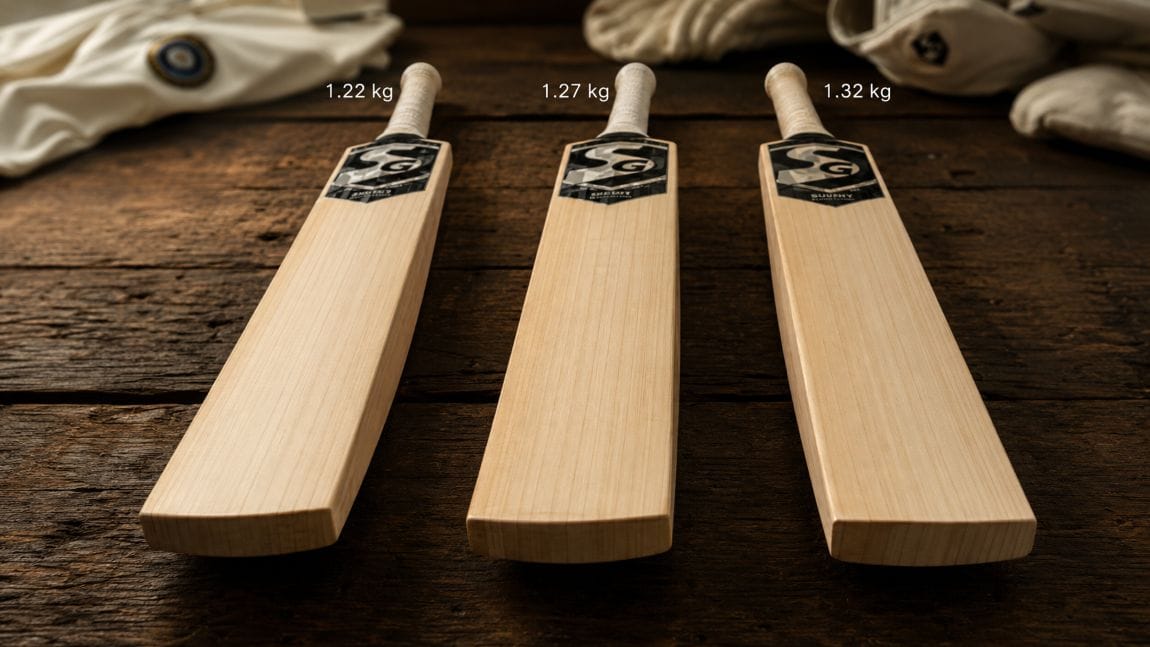
Here is something that happens to almost every new cricketer. You walk into a sports shop, pick up the bat that looks the best, maybe give it one swing in the aisle, and buy it. Three months later you wonder why your cover drive feels clunky and your wrists are sore by the 10th over.
Cricket bat weight is almost always the culprit — and almost nobody talks about it properly.
Most guides give you a vague range and send you on your way. This one does not. Below you will find exact kg and lb ranges for every type of player, a weight table you can screenshot and carry to the shop, the real story behind bat pickup, and dedicated sections for women and tennis ball cricket that simply do not exist anywhere else.
Getting cricket bat weight right is the single most impactful equipment decision most players never think carefully about.
Let us start with the answer, before anything else.
🏏 Want more cricket breakdowns like this every week?
Cricket Bat Weight Chart: Quick Reference for Every Player
Use this cricket bat weight chart as your starting point. Everything after it explains the why behind each number.
| Player Type | Age | Weight (kg) | Weight (lbs/oz) | Best Format |
| Kids | Under 10 | 0.5 – 0.7 kg | 1lb 2oz – 1lb 8oz | Garden / casual |
| Junior | 10–12 | 0.7 – 1.0 kg | 1lb 8oz – 2lb 3oz | School / tennis ball |
| Youth | 13–16 | 1.0 – 1.18 kg | 2lb 3oz – 2lb 10oz | All formats |
| Women beginners | 16+ | 1.0 – 1.10 kg | 2lb 3oz – 2lb 7oz | All formats |
| Women club players | 16+ | 1.05 – 1.18 kg | 2lb 5oz – 2lb 10oz | All formats |
| Beginner adults | 17+ | 1.22 – 1.25 kg | 2lb 11oz – 2lb 12oz | Tennis ball / leather |
| Stroke players | Adult | 1.22 – 1.27 kg | 2lb 11oz – 2lb 14oz | T20 / ODI |
| All-round batters | Adult | 1.27 – 1.31 kg | 2lb 13oz – 2lb 14oz | ODI / Test |
| Power hitters | Adult | 1.31 – 1.36 kg | 2lb 14oz – 3lb | T20 power play |
| Tennis ball (cement) | Adult | 1.05 – 1.18 kg | 2lb 5oz – 2lb 10oz | Street / gully |
| Masters (45+) | 45+ | 1.18 – 1.25 kg | 2lb 10oz – 2lb 12oz | Club / social |
Why Cricket Bat Weight Has a Bigger Impact Than You Think
Most cricketers understand that a heavy bat hits harder. What they miss is that a heavy bat also swings slower — and that second effect usually cancels out the first one.
Here is the physics in simple terms. The power you generate when hitting a ball is a product of your bat’s mass and the square of its speed at impact. Square of speed. That means if a bat that is 100g heavier causes you to swing just 5% slower, you have already lost more power than the extra mass gives you. And you will swing slower with a heavier bat if your forearms and wrists are not trained to compensate.
Beyond power, cricket bat weight directly affects:
- Bat speed: a lighter bat moves faster to the ball, giving you more time and a wider timing window
- Shot timing: the most underrated factor — your brain calculates when to swing based on how fast your bat moves. Change the bat weight and your timing recalibrates, slowly and painfully
- Wrist control: ramp shots, flicks, reverse sweeps — all of these need wrist rotation. Heavy bats resist that rotation
- Fatigue: playing 40 overs is not the same as playing 4. A bat that feels fine in the shop feels like a dumbbell by the 20th over if it is even 100g too heavy
- Injury: this one does not get talked about enough. A bat too heavy for your strength causes your technique to compensate — bent leading elbow, dominant bottom hand, forward press that collapses. These are not technique flaws. They are weight management strategies that your body developed without asking you
Virat Kohli uses a bat of approximately 1.22 kg — lighter than what most club players carry. He does not need a heavy bat to hit sixes because his bat speed generates more than enough force. Sachin Tendulkar famously used bats close to 1.47 kg early in his career, but that was underpinned by wrist strength that took years of training to develop. Copying his bat weight without his wrists is one of the most common mistakes in amateur cricket.
If you want to know the importance of death overs in T20 and how you can tackle death overs with right cricket bat weight, read the article Why Most Teams Lose T20 Matches in the Death Overs
Cricket Bat Weight in kg vs lbs: What the Numbers Actually Mean
If you are shopping online in India or Sri Lanka, bat weights are usually listed in kg. If you are buying from a UK site or a traditional cricket store, you will see lbs and ounces. The same bat can look very different depending on the label.
Quick conversion reference:
One myth worth clearing up immediately: there is no maximum cricket bat weight under MCC Laws. The regulations set maximum dimensions — 965mm length, 108mm width — but zero weight limit. The idea that 3 lb (1.36 kg) is the legal limit is simply wrong and has been repeated online so many times it is now treated as fact.
The other thing most guides miss is how willow type changes the weight equation. Kashmir willow bats, which dominate the Indian market, typically weigh 50–100g more than an English willow bat with the same blade profile and grade number. That 1.25 kg Kashmir willow bat in your hands may perform more like a 1.30–1.32 kg English willow bat in terms of how it feels to swing. This matters enormously if you are selecting a bat based on the label weight without picking it up.
And then there is knocking-in. A new bat absorbs 60–80ml of linseed oil during the preparation process. That adds 40–70g of genuine mass. If you test a bat in a shop before knocking-in, you are feeling a bat that will be heavier once it is ready to use. Always account for this.
| lbs / oz | kg | Who it suits |
| 2 lb 7 oz | 1.10 kg | Juniors, women beginners, light tennis ball |
| 2 lb 10 oz | 1.19 kg | Lightweight adults, stroke players |
| 2 lb 11 oz | 1.22 kg | Standard beginner adult / T20 player |
| 2 lb 12 oz | 1.25 kg | All-round beginner to intermediate |
| 2 lb 13 oz | 1.27 kg | Club cricket all-rounder sweet spot |
| 2 lb 14 oz | 1.30 kg | Power-conscious all-round batter |
| 3 lb 0 oz | 1.36 kg | Power hitters with trained strength |
Bat Pickup: The Factor That Matters More Than Scale Weight
Two bats sit on the counter in front of you. Both weigh 1.27 kg on the scale. You pick up the first one and it feels balanced and easy to move. You pick up the second one and it feels like the toe is dragging down. Same weight. Completely different feel. This is bat pickup — and it is the single most important factor most buyers ignore.
Bat pickup refers to how heavy or light a bat feels when you hold it in your batting stance and play a shot. It is determined by where the bat’s weight is concentrated, not by the total number on the scale.
Three things determine bat pickup:
What is bat pickup in cricket?
Bat pickup is how heavy a bat feels when held in your natural batting grip and stance — as opposed to its weight on a scale. Two bats at identical scale weight can feel dramatically different based on their weight distribution, swell position, and handle flexibility. A bat with weight concentrated near the handle feels lighter (good pickup). A bat with weight concentrated at the toe feels heavier (poor or dead pickup).
- Swell position: a mid-swell bat distributes mass centrally and picks up well. A low-swell bat pushes weight towards the toe, which feels heavier in the hands even at the same scale reading
- Spine height: thick edges and a high spine create a top-heavy feel. Some batters love this for a driving feel; others find it makes the bat feel unwieldy on pull shots
- Handle type: a flexible handle absorbs some of the swing resistance and makes the bat feel more responsive. A stiff handle transmits the full weight to your hands
When you pick up a bat at the shop, play a few shadow shots — a forward defence, a pull shot, and a ramp. The bat should feel like a natural extension of your arms. If you are consciously managing the bat’s weight rather than just swinging it, put it back.
This is also why Kohli’s 1.22 kg bat and a club player’s 1.22 kg bat can feel completely different. Kohli’s is built by his manufacturer to pick up like 1.1 kg. Not all bats at the same weight are the same bat.
If budget is a concern, check out our dedicated round‑up of the best cricket bat under ₹2000 – it includes honest notes on how a lighter weight can actually help you bat longer.
Choosing Cricket Bat Weight Based on Your Playing Style
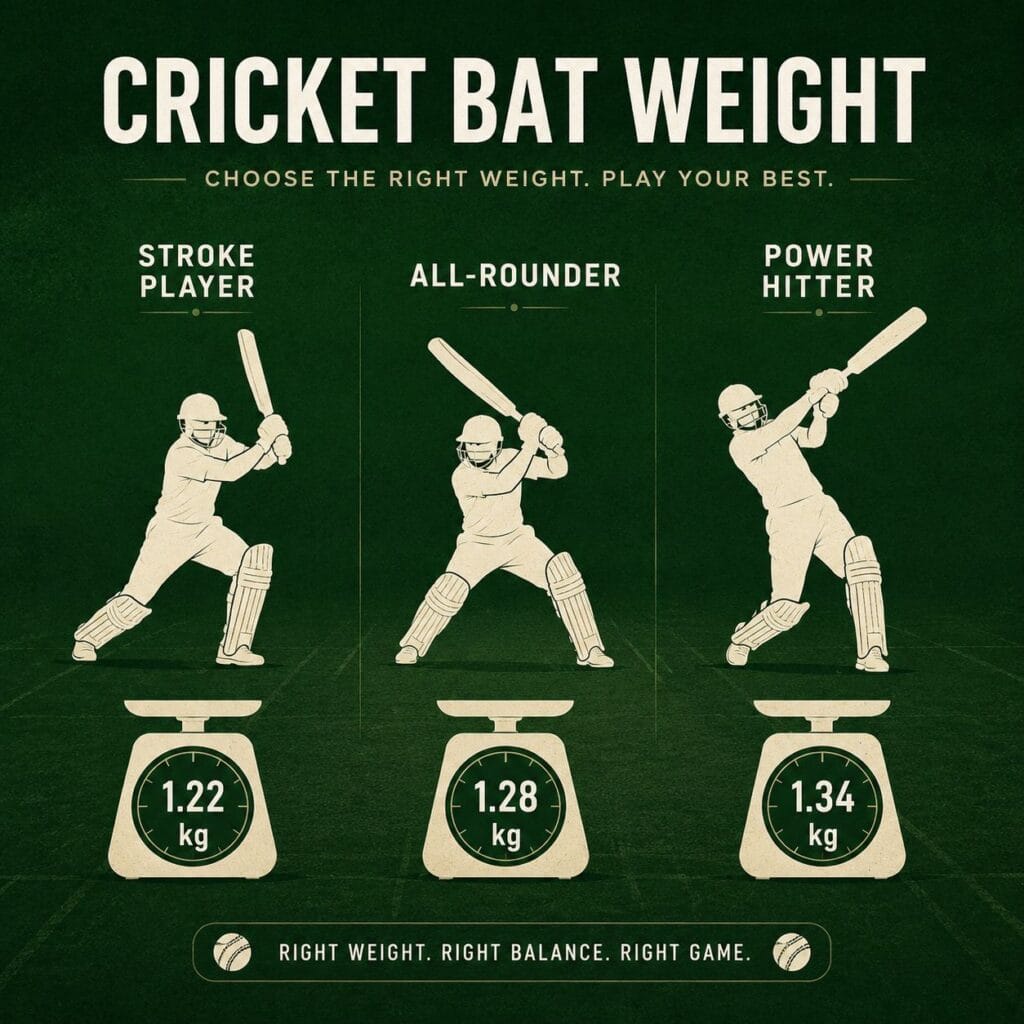
Before you look at age charts or strength tests, think about the shots you play most. Your playing style tells you more about the right cricket bat weight than your age does.
Stroke Players and Timing Batters: 1.22–1.27 kg
Before settling on a cricket bat weight, think about the shots that win you the most runs. If your best shots are the cover drive, the flick off the pads, the late cut, and the ramp — you are a timing batter. Your runs come from meeting the ball well, not from muscling it. A lighter bat in the 1.22–1.27 kg range lets your bat accelerate faster, which means you can play later, adjust to movement, and generate pace from the ball’s own speed rather than from brute force.
Opening batters particularly benefit from lighter bats. You are facing the new ball, often swinging, and you need to make micro-adjustments in real time. A bat that is 100g heavier gives you less margin for error.
Classic examples: Virat Kohli (~1.22 kg), Babar Azam (~1.22 kg), Steve Smith (~1.20 kg). None of these players struggle to hit sixes. All of them prioritise bat speed and timing over mass.
All-Round Batters: 1.27–1.31 kg — The Sweet Spot
This is where most club cricketers should land. The 1.27–1.31 kg range gives you enough bat speed for timing-based shots while adding enough mass for clean hitting when you want to put the ball away.
If you bat in the middle order and need to both build an innings and accelerate in the death overs, this range works across both modes. Most international players sit here — it is not a coincidence. Ben Stokes (~1.25 kg) and Rohit Sharma (~1.29 kg) both occupy this space, which tells you it suits players who combine aggression with craft.
If you are not sure where you fall on the stroke player to power hitter spectrum, start here. You can always refine later.
Power Hitters: 1.31–1.36 kg
Heavier bats make sense only when the player has the physical capacity to maintain swing speed despite the extra mass. If you bat at 6 or below in T20, hit predominantly flat and hard, have trained forearms, and can comfortably pass the 30-second extension test (more on that below), then a heavier bat in the 1.31–1.36 kg range can genuinely add distance to your big shots.
MS Dhoni used bats around 1.32 kg for much of his career. He was also known for exceptional wrist and forearm strength developed over years. His bat weight worked because of his body, not in spite of it.
If you are choosing a heavy bat because you want to hit big and not because your body can support it, you will lose more in timing than you gain in momentum. Every time.
What playing style are you? Drop your bat weight and playing position in the comments — we read every one and occasionally feature responses in follow-up articles.
Best Cricket Bat Weight by Format: T20, ODI, and Test Cricket
Format matters more than most players realise when choosing cricket bat weight. The demands on your bat are genuinely different across T20, ODI, and Test cricket — and if you play more than one format regularly, this is worth thinking about seriously.
Here is a practical thought for club players who take both red-ball and white-ball cricket seriously: consider having two bats. One in the 1.22–1.25 kg range for T20 nights, and one in the 1.27–1.31 kg range for your Saturday league games. The difference in how each format feels will be immediately noticeable, and your timing in each will improve within a session.
This is not a luxury approach — it is what serious club players at district and county second XI level routinely do. And with Kashmir willow bats available at excellent quality for under ₹1500, owning a format-specific bat is more accessible than it used to be.
| Format | Recommended Weight | Why |
| T20 / IPL | 1.22 – 1.27 kg | Bat speed is everything. You need to improvise — ramps, scoops, switch hits. A lighter bat lets you play these a full fraction of a second later, which is the difference between timing it and getting a top edge. |
| One Day (ODI) | 1.25 – 1.31 kg | You need control in the Powerplay and power in the death. A mid-weight bat serves both phases without needing to compromise on either. |
| Test Cricket | 1.27 – 1.34 kg | Longer innings mean you have time to set up shots rather than react to them. The extra mass helps with the harder, older ball and with driving through a well-set field. |
| Club Cricket (all formats) | 1.25 – 1.31 kg | The universal sweet spot for players who play everything. |
Cricket Bat Weight by Age and Physical Strength
Choosing the correct cricket bat weight for juniors is arguably more important than for adults — because the wrong weight at 12 creates technique problems that last years. Age matters less than strength and technique development, but they are correlated closely enough that an age-band guide is genuinely useful — especially for parents buying for younger players.
The biggest and most damaging mistake in junior cricket is buying a bat to grow into. A 10-year-old using a 1.3 kg adult bat is not learning to bat. They are learning to manage a bat that is too heavy — and the technique problems that creates can take years to undo.
Masters cricket deserves a specific note. As you get older, your fast-twitch muscle fibres reduce and your wrist strength naturally declines — even if you feel fit. A bat that was right at 30 may be 100–150g too heavy at 50. Going lighter is not admitting defeat. It is playing smarter. Several England over-50s internationals made this switch in their 40s and saw their batting average improve.
The 30-second extension test is the simplest practical check at any age. Hold the bat by the handle with your dominant hand, arm fully extended, bat horizontal to the ground. Hold still for 30 seconds. If your arm shakes or drops significantly: the bat is too heavy for sustained innings play. This is not a strength test — it is a fatigue prediction test.
| Age Group | Recommended Weight (kg) | Common Mistake | Technique Risk if Too Heavy |
| Under 10 | 0.5 – 0.7 kg | Parents buy ‘grow into’ size | Bent leading elbow, scooping from bottom hand |
| 10–12 | 0.7 – 1.0 kg | Copying older players’ setup | Loss of balance, wrist-dominant technique |
| 13–16 | 1.0 – 1.18 kg | Jumping to adult bat early | Fatigue-based footwork breakdown after 15 balls |
| 17–19 | 1.18 – 1.27 kg | Matching county pros’ bat specs | Shoulder strain, collapsing forward press |
| Adult (strong) | 1.25 – 1.34 kg | Choosing by brand over weight | Timing collapse after 15 overs |
| Adult (average) | 1.22 – 1.28 kg | Using a ‘pro weight’ bat | Bat drag, shot execution slowing |
| Masters (45+) | 1.18 – 1.25 kg | Sticking with the same bat from 20 years ago | Wrist and elbow injury, slower recovery |
Women’s Cricket Bat Weight: The Complete Guide
Let us be direct about something: most bat weight guides assume a male adult body as the default and treat women’s cricket as an afterthought. You will notice that none of the major competitor articles in this space have a dedicated section for women. That means women players searching for this information either get generic advice that does not apply to them, or nothing at all. The right cricket bat weight for women is not simply a lighter version of the men’s recommendation — it requires its own framework based on different biomechanics and playing styles.
This section fixes that.
Women’s cricket has changed dramatically. The Women’s IPL has drawn a new generation of players and fans. Smriti Mandhana’s cover drives and Harmanpreet Kaur’s clean hitting are watched by millions. And yet the equipment guidance for women playing club and school cricket is still years behind.
A few things worth knowing that most shops will not tell you:
- Women’s bats sold specifically as ‘women’s cricket bats’ are often just relabelled standard bats. Always check the actual weight. The marketing label means very little
- The Harrow size bat (32 inches, slightly shorter than standard) is genuinely worth considering for many women. At the same scale weight, it picks up lighter than a full short-handle bat because its balance point is closer to your hands
- Handle grip thickness is underrated. A thinner grip reduces the effort needed to hold and control the bat, which effectively makes any bat feel lighter without changing the scale weight at all
- If you have smaller hands, a slim-grip handle with a lighter profile bat will outperform a standard setup at the same weight — especially on pull shots and flicks
Smriti Mandhana’s bat weight (~1.18 kg) is interesting because she is not a power hitter by primary instinct — she is a timing batter. Her bat is light enough to access the cover drive and the flick with full bat speed, and she generates power from clean contact rather than mass. Harmanpreet at ~1.22 kg sits slightly heavier, which suits her more aggressive, bottom-hand-driven approach.
If you are a women’s club player and you have been told your technique is weak, check your bat weight first. A bat that is 150g too heavy will cause every technique problem your coach is seeing — and it will not go away with more practice. It will go away when you change the bat.
| Player Category | Weight (kg) | Weight (lbs) | Notes |
| Girls under 13 | 0.5 – 0.85 kg | 1lb 2oz – 1lb 14oz | Same approach as boys at this age; pickup matters most |
| Girls 13–16 | 0.85 – 1.05 kg | 1lb 14oz – 2lb 5oz | Lighter than boys equivalent; wrist strength differs |
| Women beginners | 1.0 – 1.10 kg | 2lb 3oz – 2lb 7oz | Standard short handle with lighter blade profile |
| Women club players | 1.05 – 1.18 kg | 2lb 5oz – 2lb 10oz | Sweet spot for most adult women cricketers |
| Women power hitters | 1.15 – 1.22 kg | 2lb 9oz – 2lb 11oz | Upper end; only if you have the wrist strength |
| International elite | 1.10 – 1.22 kg | 2lb 7oz – 2lb 11oz | Smriti Mandhana ~1.18 kg, Harmanpreet ~1.22 kg |
Women’s cricket has evolved rapidly over the last decade, and modern players now focus heavily on bat balance, pickup, and maneuverability rather than simply using lighter bats by default. Cricketers like Smriti Mandhana and Harmanpreet Kaur use carefully balanced setups that match their individual playing styles and formats. The rise of young talents such as Nandini Sharma also highlights how strength training, bat control, and modern preparation are shaping the next generation of women’s cricket in India. Read more in: Who Is Nandini Sharma? The Inspiring Rise to India’s T20 World Cup Squad.
Cricket Bat Weight for Tennis Ball Cricket: The Guide South Asian Players Have Been Waiting For
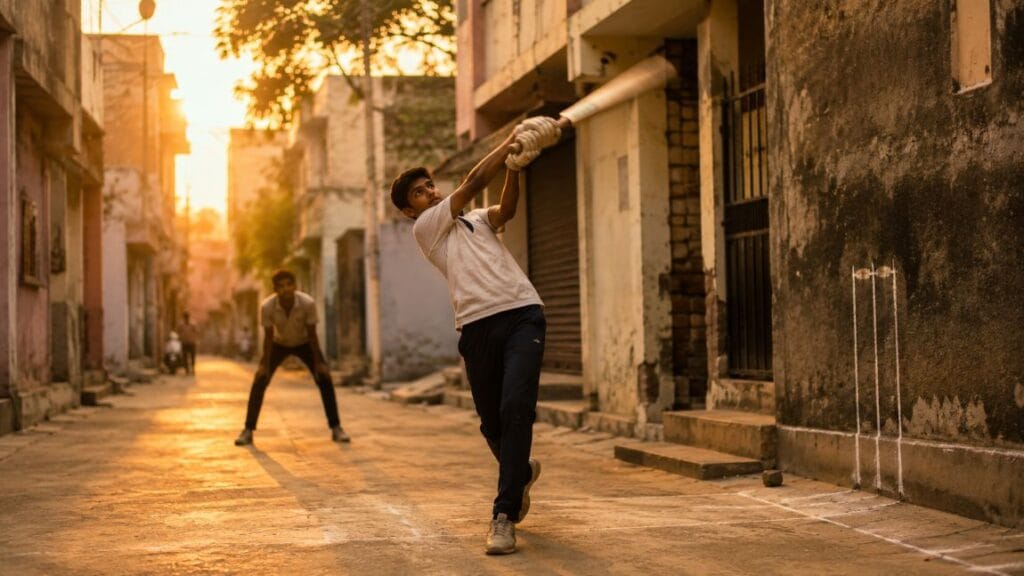
Tennis ball cricket is how the majority of cricket in the world actually happens. On cement rooftops in Mumbai, marble dust pitches in Karachi, narrow gullies in Colombo, and corporate box cricket venues across every Indian metro. Hundreds of millions of people play tennis ball cricket, and almost no cricket bat weight guide addresses it specifically.
Here is the uncomfortable truth: the advice for leather ball cricket does not automatically transfer to tennis ball cricket. And the most common advice — get a heavier bat for more power — is exactly backwards.
The myth that a heavier bat hits bigger sixes in tennis ball cricket is one of the most persistent and damaging in the game. Here is why it persists: it feels true when you mishit a shot with a heavy bat and it still goes far. That is mass doing the work. But when you connect perfectly with a light bat, it goes further. The difference between a toe-edge six and a middle-of-the-bat six is bat speed — and bat speed goes up as bat weight goes down, if your technique is sound.
Most experienced gully and tape-ball cricketers already know this. They instinctively play with lighter bats. The problem is they rarely articulate why, so newer players assume the opposite.
One practical point on bat type: for tennis ball cricket, the blade material matters less than for leather ball. Poplar wood and Kashmir willow dominate this format and both perform well. What matters more is the edge thickness — look for bats with 35–40mm edges. Thicker edges give you a bigger sweet spot without needing heavy mass behind the blade, which is exactly what you want.
Anti-vibration handles also matter more in tennis ball cricket than in leather ball cricket. Cement pitches transmit considerably more shock through the handle on off-centre hits, and a quality rubber grip reduces fatigue over a long innings. Cricket bat weight for tennis ball cricket follows completely different rules from leather ball cricket, and getting this wrong is the most common equipment mistake in South Asian club cricket.
Why Tennis Ball Cricket Demands a Lighter Bat
- A tennis ball weighs approximately 58g. A leather ball weighs 155g — nearly three times as much. The physics of striking a lighter object rewards bat speed far more than bat mass
- Tennis ball cricket formats are usually 6–10 overs per side. You are hitting from ball one, without any build-up phase. Maximum bat speed from the first delivery is non-negotiable
- Most tennis ball pitches — cement, matting over concrete, marble dust — produce fast, unpredictable bounce. You need quick pickup and the ability to adjust your shot mid-execution. A lighter bat does this; a heavy bat does not
- The shots that score runs in tennis ball cricket — ramps, scoops, big hits over mid-on, flat drives — all require wrist rotation and fast bat acceleration. These are compromised by excess bat weight
Recommended Cricket Bat Weight by Surface
| Surface | Recommended Weight (kg) | Why |
| Cement / concrete | 1.05 – 1.18 kg | Fast bounce demands fast pickup; lighter bat = quicker adjustment |
| Turf / grass | 1.10 – 1.20 kg | Slightly more grip; modest extra weight acceptable |
| Matting over concrete | 1.05 – 1.15 kg | Pace and seam; you need the lightest possible adjustment window |
| Marble dust / powder | 1.0 – 1.12 kg | Very fast surface; go as light as you can handle comfortably |
| Indoor / box cricket | 1.0 – 1.10 kg | Small boundaries; pure bat speed, no room for power from mass |
Tennis Ball Format Guide
| Format | Common Name | Bat Weight | Priority |
| Gully / street cricket | Gali cricket | 0.9 – 1.1 kg | Maximum bat speed, improvisation |
| Tape-ball cricket | Tape ball | 1.0 – 1.15 kg | Late play against swing; lighter is better |
| Corporate / office cricket | Box cricket | 1.0 – 1.1 kg | Controlled hitting, small venue |
| T10 tennis tournaments | Night cricket | 1.05 – 1.18 kg | Semi-serious; treat like T20 selection |
🏏 Want more cricket breakdowns like this every week?
If you are serious about tennis ball cricket and want a bat built specifically for power hitting on cement and turf surfaces, we have tested the best options available in India right now. Our Best Tennis Cricket Bat for Power Hitting guide covers blade profiles, edge thickness, Kashmir willow grades, and which bats give you the best bat speed at the right weight — so you are not guessing at the shop.
How Willow Grade and Bat Material Affect Cricket Bat Weight
Most buyers focus on willow grade as a quality indicator. Fewer realise it is also a weight indicator — and that two bats with the same label weight can perform very differently depending on the grade and the wood.
The Kashmir willow point is particularly important for Indian buyers. When a KW bat is labelled 1.25 kg, its denser grain means it will feel and perform more like a 1.30–1.32 kg English willow bat of the same dimensions. This is not a quality defect — it is just the physics of a denser wood. But it means you should factor this in when selecting.
One more thing nobody mentions: Grade 1 English willow is not just the best quality — it is also the most consistent in weight for a given bat profile. When you order a Grade 1 bat at 1.24 kg, you will almost always get something very close to that. At Grade 4, the same spec can vary by 80–100g between individual bats cut from different parts of the willow cleft. This is why pickup testing in person matters so much with lower-grade bats.
| Grade | Quality | Weight Effect | Who It Suits |
| Grade 1 EW | Straightest grain, no blemishes | Lightest for given dimensions | Serious club to professional |
| Grade 2 EW | 1–2 minor blemishes | Similar to Grade 1 | Regular club players |
| Grade 3 EW | Butterfly grain, more marks | Up to 50g heavier for same size | Recreational cricketers |
| Grade 4–5 EW | Irregular grain, multiple knots | Up to 100g heavier | Practice bats, beginners |
| Kashmir Willow | Denser grain structure | 50–100g heavier than equivalent EW grade | Budget buyers, tennis ball |
What Bat Weight Do Professional Cricketers Actually Use?
Professional bat weights are rarely published officially — you will not find them on the bat manufacturers’ websites. What we know comes from bat maker interviews, coaching documentation, and records from professional players who have discussed their preferences publicly. Treat these as close approximations rather than exact figures.
The Sachin Tendulkar number deserves a specific mention. In his early career, he used bats close to 1.47 kg — genuinely extraordinary. Most club players physically cannot swing a bat that heavy at match pace for more than a few overs. Sachin could, because of years of wrist-strengthening work and exceptional hand-eye coordination that compensated for any timing cost. He gradually reduced his bat weight as he moved into the middle and later phases of his career, which tells its own story.
The broader lesson from this table: the best players in the world are not using the heaviest bats. Most are using bats in the 1.18–1.29 kg range. The exceptions — Dhoni, Sachin — built their entire game around specific physical strengths that took years to develop. For the rest of us, lighter is usually smarter.
| Player | Country | Bat Weight (approx) | Key Bat Trait |
| Virat Kohli | India | ~1.22 kg (2lb 11oz) | Light, balanced, mid-swell; timing over power |
| Rohit Sharma | India | ~1.29 kg (2lb 13oz) | Mid-weight; suits power-timing balance |
| Sachin Tendulkar (retd) | India | ~1.47 kg early career (reduced later) | Exceptionally heavy; unique wrist strength |
| MS Dhoni (retd) | India | ~1.32 kg (2lb 14oz) | Heavier; finisher role; bottom-hand dominant |
| Babar Azam | Pakistan | ~1.22 kg (2lb 11oz) | Light; elegant cover drive-optimised |
| Ben Stokes | England | ~1.25 kg (2lb 12oz) | Balanced; suits aggressive all-round play |
| Steve Smith | Australia | ~1.20 kg (2lb 10oz) | Light; unorthodox stance needs quick movement |
| Smriti Mandhana | India (W) | ~1.18 kg (2lb 10oz) | Light, timing-focused; textbook stroke play |
| Harmanpreet Kaur | India (W) | ~1.22 kg (2lb 11oz) | Upper end for women; power-hitting approach |
How Handle Length Affects Cricket Bat Weight and Pickup
Most people think of bat size as a length-and-age consideration. Fewer realise it directly affects how heavy the bat feels in your hands — without changing the scale reading at all.
Here is the practical application: if you are a tall player using a short handle bat, your hands are holding the bat lower relative to your body’s natural extension point. This puts you slightly out of position on the pull shot and makes the bat feel toe-heavy because of leverage physics. Moving to a long handle bat does not just give you more reach — it restores the natural balance between your arm length and the bat’s centre of mass.
For women and slightly-built men, the Harrow size is genuinely worth trying before you assume you need a full adult bat. At the same scale weight, a Harrow bat picks up noticeably lighter than a standard short handle because the balance point sits closer to your grip. Many coaches now recommend this size as the default starting point for women who are new to leather ball cricket.
| Handle Type | Total Length | Effect on Swing Weight | Best For |
| Short Handle (SH) | 33 inches | Standard benchmark | Most adults under 6’2″ |
| Long Handle (LH) | 34.5 inches | Shifts balance point; can feel lighter at the toe | Tall players 6’2″+; stand-tall batters |
| Harrow (H) | 32 inches | Lighter overall; excellent pickup for smaller adults | Women, youth, slight-framed adults |
| Small Adult (SA) | 32.5 inches | Intermediate; good for women or smaller men | Players transitioning from youth |
8 Cricket Bat Weight Mistakes That Are Ruining Your Game
These are the eight mistakes that coaches see most often — and that are entirely preventable once you know what to look for.
| Mistake | Why Players Make It | The Fix |
| Copying your favourite pro’s bat weight | Hero worship; manufacturer marketing | Pros have years of specific strength training. Test what you can swing 200 times without fatigue, not what Kohli uses. |
| Choosing by brand, not by weight | Brand trust, advertising | Always ask for or look up the specific gram weight before buying. Brand is irrelevant if the weight is wrong. |
| Ignoring pickup for scale weight | Scale weight seems objective | Always pick up and play shadow shots. Scale weight is a starting point, not a verdict. Trust your hands. |
| Buying heavy for power in tennis ball cricket | Heavier = more runs myth | With a 58g tennis ball, bat speed matters far more than bat mass. Go lighter, swing faster. |
| Giving juniors adult bats ‘to grow into’ | Cost saving, good intentions | A 10-year-old with a 1.3 kg bat develops permanent technique flaws. Buy the right size. The cost of fixing technique later is far higher. |
| Not accounting for format | One bat for everything | T20 and Test cricket have genuinely different requirements. If you play both seriously, consider two bats. |
| Forgetting knocking-in weight gain | Weighing before preparation | A bat gains 40–70g after oiling and knocking-in. Choose your target weight accordingly. |
| Assuming heavier always means more power | Physics intuition is wrong here | Bat speed squared determines power, not bat mass. A faster swing with a lighter bat beats a slow swing with a heavier one. |
How to Find Your Right Cricket Bat Weight: 3 Tests You Can Do Right Now
You do not need a lab or a coach to find your right cricket bat weight. These three tests work at home, in a shop, or at the nets — and together they give you a more accurate answer than any age chart.
How to Find Your Right Cricket Bat Weight
Test 1: The 30-Second Extension Test
1. Hold the bat by the handle with your dominant hand only
2. Extend your arm fully out, parallel to the ground, bat horizontal
3. Hold completely still for 30 seconds without the bat dropping or your arm shaking significantly
4. If you cannot hold it steadily: the bat is too heavy for sustained innings play
5. If it feels weightless: you may be able to handle slightly more mass for added power
This test predicts fatigue, not immediate performance. A bat might feel fine for 10 balls and wrong for 40 overs.
Test 2: The Shadow Drive Test
1. Take your natural batting stance
2. Play 20 continuous cover drives in shadow — no ball, just the shot
3. Watch or feel whether your technique changes between drive 1 and drive 20
4. If your leading elbow starts bending or your bottom hand starts taking over: the bat is too heavy
5. Your mechanics should look the same on drive 20 as on drive 1
This test reveals technique breakdown before it shows up in your actual batting — a much more useful signal.
Test 3: The Pickup and Feel Test
1. Hold the bat in your normal grip and close your eyes
2. Mentally play three shots: a forward defence, a pull shot, and a ramp or scoop
3. The bat should feel like a natural part of your hands — not something you are compensating for
4. Open your eyes and note the scale weight
5. If the bat felt right but the weight surprises you, trust your hands over the label
Your body is better at assessing pickup than your brain. The number on the bat is a starting point, not the answer.
Frequently Asked Questions About Cricket Bat Weight
These are the most common questions we receive about cricket bat weight, answered directly.
What is the ideal cricket bat weight for beginners?
For adult beginners, the ideal cricket bat weight is 1.22–1.25 kg (2 lb 11 oz – 2 lb 12 oz). This range gives you enough mass for solid contact while keeping bat speed high enough that timing feels natural. For junior beginners, refer to the age-band table above — going even lighter is almost always the right call.
Is a heavier cricket bat better for hitting sixes?
Not for most players. Power at impact is determined by bat speed squared times mass. If a heavier bat slows your swing by even 5%, you lose more in speed than you gain in mass. Only players with specifically trained forearm and wrist strength can use extra bat weight without losing swing speed. For the other 95% of cricketers, a well-timed shot with a lighter bat travels further than a poorly-timed shot with a heavier one.
What is the maximum legal cricket bat weight?
There is no maximum. The MCC Laws of Cricket regulate maximum bat dimensions — 965mm length and 108mm width — but set no weight limit. The belief that 3 lb (1.36 kg) is the legal maximum is incorrect. It is simply the upper practical limit for most players.
What bat weight is best for tennis ball cricket?
For most surfaces, 1.05–1.18 kg is the optimal range for tennis ball cricket. On very fast cement pitches, go to the lower end of that range — 1.05–1.12 kg. The common belief that heavier bats hit bigger sixes with a tennis ball is physically incorrect. With a 58g ball, bat speed generates far more power than bat mass.
What bat weight should a woman use for cricket?
Most women club cricketers play best with a bat in the 1.05–1.18 kg range. Women power hitters may go up to 1.22 kg. The Harrow or Small Adult size often picks up lighter than a standard short handle at the same scale weight — worth trying before committing to a full adult bat.
Does bat weight affect timing?
Directly and significantly. A bat that is too heavy slows your swing, which means your bat arrives at the ball slightly late relative to where your brain predicted. This turns perfectly-timed drives into inside edges and mistimed pushes. Lighter bats accelerate faster, giving you more time to read the delivery and adjust — which is why timing-based batters almost universally prefer lighter bats.
Is bat pickup more important than bat weight?
Yes, in most practical situations. Two bats at identical scale weight can feel completely different due to swell position, spine height, and handle type. A 1.30 kg bat with excellent pickup often outperforms a 1.22 kg bat with poor pickup. Always judge a bat by how it moves in your hands, not by the label.
How do I know if my cricket bat is too heavy?
Four signs: (1) You cannot hold the bat extended with one arm for 30 seconds without shaking. (2) Your technique changes noticeably after 15 continuous shadow drives. (3) You feel wrist or forearm fatigue inside 10 overs. (4) You find yourself pushing the bat at the ball rather than swinging it through. Any one of these is a signal to go lighter.
Finding Your Right Cricket Bat Weight: The Final Word
Cricket bat weight is one of those things that looks simple and turns out to be a layered decision. The range that works for a teenage stroke player on a cement pitch is completely different from what works for a 45-year-old leather ball club cricketer in the middle order.
But the underlying logic is consistent: choose the heaviest bat you can swing at full speed without fatigue, not the heaviest bat you can lift. That distinction — swinging versus lifting — is everything. A bat you can lift is one you can pose with. A bat you can swing is one you can bat with.
Start with the weight table at the top of this guide. Apply the playing style and format filters. Do the three tests. Then pick up the bat in person and trust your hands. The number on the label is the beginning of your decision, not the end of it.
If you found this cricket bat weight guide useful, our cricket bat buying guide walks you through the full selection process including wood grade, profile, and brand. And if you want to test how your reaction time interacts with your bat weight choice, try our reaction speed test — it takes 60 seconds and the result will change how you think about bat selection.
GET STARTED !!
REACTION SPEED TEST
The right cricket bat weight will not fix a poor technique — but the wrong one will actively prevent a good technique from developing.
🏏 Want more cricket breakdowns like this every week?

Pingback: Why Tennis Cricket Bats Create Better T20 Batters
Pingback: Best Cricket Bat Under ₹2000: 2026 Ultimate Guide & 7 Top Picks
Pingback: Best Kashmir Willow Bats Under ₹2000 | 2026 Guide