

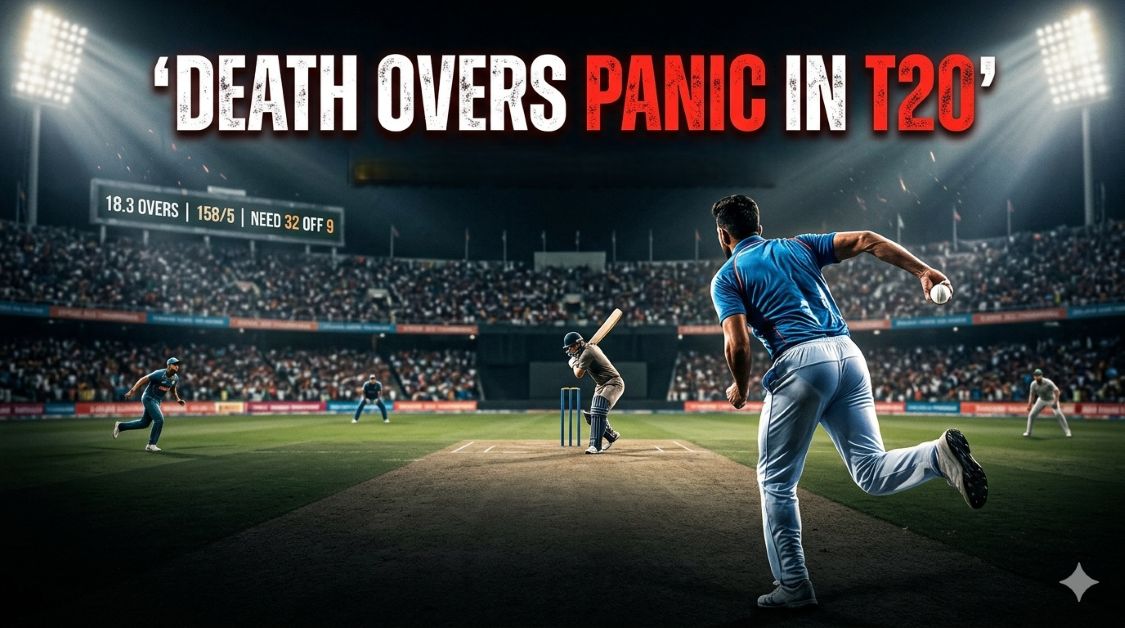
In the early years of T20 cricket, 45 runs from the last five overs felt like a mountain. Today? Teams chase 70 like it’s a warm-up drill.
If you’ve watched the IPL recently, you’ve probably felt this shift. Matches that look settled at the 15-over mark suddenly explode. Bowlers lose control. Batters swing freely. Captains look like they’re playing speed chess.
The death overs have quietly become the most decisive phase in T20 cricket.
And the scary part? Most teams still don’t fully understand how to win them.
Why This Topic Matters in Modern Cricket
T20 cricket has evolved faster in the last five years than in the previous fifteen.
Three major changes have reshaped the game:
- Bigger bats and deeper batting lineups
- Data-driven matchups and planning
- Fearless finishing culture
Teams no longer aim for par scores. They aim for death overs acceleration.
Modern T20 games are increasingly split into three mini-matches:
- Powerplay survival
- Middle-overs positioning
- Death-overs domination
Win the third phase, and the first two almost don’t matter.
That’s why analysts often say: T20s aren’t won in 20 overs — they’re won in the last five.
Core Analysis: The Science Behind Death Overs
1️⃣ The Run Rate Explosion Effect
Scoring patterns in T20s are not linear.
Run rates typically follow this curve:
- Overs 1–6: High risk, field restrictions
- Overs 7–15: Consolidation phase
- Overs 16–20: Maximum acceleration
Why does the final phase explode?
Because by over 16:
- Batters are set
- Match context is clear
- Wickets in hand become currency
A batting side with 6–7 wickets in hand after 15 overs can attack with near-zero fear. The cost of losing a wicket drops dramatically, while the reward of every boundary skyrockets.
This is the risk-reward tipping point of T20 cricket.
2️⃣ Why Yorkers Are No Longer Enough
For years, the yorker was the death-over king.
But modern finishers have adapted:
- They pre-meditate movement
- They stand deep in the crease
- They convert yorkers into low full tosses
This forced bowlers to evolve. Today’s death overs arsenal includes:
- Wide yorkers
- Hard-length cross-seam deliveries
- Slower bouncers
- Off-pace cutters into the pitch
The key shift: unpredictability beats accuracy.
A predictable yorker is now easier to hit than an unpredictable slower ball.
3️⃣ Matchups: The Hidden Chess Game
Death overs are no longer bowler vs batter.
They’re data vs instinct.
Teams now plan death overs based on:
- Batter hitting arcs
- Boundary size dimensions
- Pace vs spin strike-rate matchups
- Slower ball effectiveness
Example patterns we see regularly:
- Pace-off vs strong pace hitters
- Wide lines vs leg-side dominant batters
- Short boundaries avoided at all costs
Captains today think in matchups, not overs.
4️⃣ The Rise of Specialist Finishers
The death overs revolution created a new role: the finisher specialist.
This role didn’t exist clearly a decade ago. Now every team hunts for players who:
- Start fast immediately
- Hit boundaries without sighters
- Thrive under scoreboard pressure
Finishing has become a distinct skill set, not just an extension of batting.
Key traits of elite finishers:
- Base stability and power generation
- Strong hitting zones down the ground and leg side
- Ability to read slower balls early
- Mental comfort with chaos
Death overs are no longer survival. They’re a power-hitting skill test. Impact player rule give an added advantage to the teams in IPL to substitute in a power hitter in the death overs for explosive finish. Teams uses the impact players for their advantage as per the situation.
5️⃣ Why Bowlers Feel the Pressure First
Death overs are where skill meets psychology — and for bowlers, the mental battle often begins before the run-up even starts.
By the time the innings reaches the 16th over, the pressure equation in T20 cricket becomes heavily one-sided. Batters swing with freedom. Fielders spread to the boundary. The crowd senses a surge. And the bowler? He’s expected to deliver perfection with almost no margin for error.
This is why the final overs are widely considered the toughest job in T20 cricket.
Tiny Margins, Massive Consequences
In most phases of cricket, mistakes can be recovered. Not in the death overs.
A slight error in execution instantly becomes runs:
- A yorker that becomes a low full toss → smashed down the ground
- A slower ball that sits up → deposited into the stands
- A length ball missed by inches → disappears over midwicket
The punishment is immediate and visible. One mistimed delivery can undo five overs of disciplined bowling.
From an analytics perspective, death overs have the highest boundary percentage in the innings. That means every ball carries greater risk than reward for the bowler.
This constant threat makes execution feel heavier than ever.
Batters Have Freedom, Bowlers Carry Responsibility
The pressure imbalance is real.
Batters in the final overs think:
- “I have license to attack.”
- “If I get out, it’s acceptable.”
- “Every boundary changes the game.”
Bowlers think:
- “I cannot miss my length.”
- “I cannot repeat patterns.”
- “I cannot leak momentum.”
This mental asymmetry defines death overs strategy in T20 cricket.
The batting side plays with opportunity.
The bowling side plays with consequence.
And consequence always feels heavier than opportunity.
Predictability Is the Enemy
One of the biggest psychological challenges for death bowlers is avoiding patterns.
Batters actively search for repetition:
- Two yorkers in a row → expect the third
- Slower ball after boundary → anticipate pace-off again
- Same field twice → signals same plan
Modern T20 finishers are trained to read patterns quickly. The moment they sense predictability, they premeditate their movement.
That means bowlers must constantly balance:
- Variation vs control
- Surprise vs execution
- Risk vs predictability
Thinking this deeply before every delivery adds cognitive pressure to physical skill.
Momentum Feels Visible and Immediate
Momentum in death overs shifts faster than anywhere else in the match.
An over can go:
- Dot ball
- Single
- Six
- Four
- Wide
- Six
Suddenly a quiet over becomes a 20-run disaster.
This rapid momentum swing creates a snowball effect:
- Fielders move deeper
- Captain changes plan
- Crowd noise increases
- Batter confidence skyrockets
The bowler feels the game slipping in real time — ball by ball.
Few sporting moments feel more intense than standing at the top of the run-up knowing the match could change in the next six seconds.
The Emotional Toll of Visibility
When a batter hits a boundary, it feels heroic.
When a bowler concedes one, it feels public.
Every mistake is:
- Loud
- Immediate
- Replayed on the big screen
- Discussed instantly by commentators
This visibility amplifies pressure. Death bowling becomes as much about emotional control as technical skill.
That’s why elite death bowlers focus heavily on:
- Breathing routines
- Pre-ball rituals
- Simplified plans
- Resetting after boundaries
Mental recovery between deliveries is a skill in itself.
The Reality of Death Bowling
Death overs are not just the hardest overs to bowl.
They are the most unforgiving minutes in cricket.
Batters chase opportunity.
Bowlers fight consequence.
And in a format decided by fine margins, that psychological imbalance is what makes death overs the most pressure-packed phase of the game.
Tactical / Strategic Breakdown
Batting Strategy in Death Overs
Modern teams follow a clear blueprint:
1. Preserve wickets until over 15
Wickets in hand = license to attack.
2. Target specific bowlers
Teams identify the weakest death bowler early.
3. Hit straight and leg side
These are the highest-percentage boundary zones late in the innings.
4. Pre-meditated movement
Shuffles and deep-crease setups convert yorkers into hittable deliveries.
5. Accept risk as part of scoring
Dot balls hurt more than wickets late in the innings.
Bowling Strategy in Death Overs
Elite death bowling relies on three principles:
Unpredictability
Never bowl the same ball twice in a row.
Field-driven planning
Deliveries must match field placements perfectly.
Execution under pressure
Skill matters. Nerve matters more.
Successful death bowlers think in sequences, not individual balls.
Captaincy Decisions That Decide Matches
Captaincy in the death overs is less about leadership speeches and more about high-speed problem solving under pressure. By the time the 15th over ends, captains already know the pitch behaviour, dew factor, boundary dimensions, and which bowlers are holding their nerve.
The final phase becomes a tactical sprint where every decision directly affects 10–15 runs — and in T20 cricket, that’s often the difference between winning and losing.
Let’s break down the captaincy choices that quietly decide matches.
1️⃣ Who Bowls the 16th vs the 20th Over — The Hidden Trap
Casual fans assume the best death bowler must always bowl the final over. In reality, the 16th over is often the turning point of the innings.
Why?
Because this is the moment batters launch the final assault.
A poor 16th over can create unstoppable momentum.
Captains typically plan death overs in “over pairs”:
- Overs 16–17 → momentum overs
- Overs 18–20 → finishing overs
If the wrong bowler leaks 18–20 runs in the 16th over:
- Set batters get confidence
- New batters get freedom
- Required run rate pressure disappears
Smart captains sometimes use their best bowler earlier to break momentum instead of saving them for the 20th. This is counter-intuitive but often match-winning.
The lesson: death overs are about stopping momentum, not just finishing the innings.
2️⃣ Field Placements: Micro-Adjustments That Save Boundaries
Death-over field settings are not static. They change ball by ball.
Modern captains think in hitting zones, not traditional fields.
Instead of generic deep fielders, captains now ask:
- Where does this batter miss-hit?
- Which boundary is longer?
- Which side has wind advantage?
- Where will the slower ball land?
For example:
- Against leg-side power hitters → protect cow corner and long-on.
- Against scoop players → fine leg and third man become key.
- Against straight hitters → long-off and long-on go deeper.
A single fielder moving five metres can turn a six into a catch.
That’s the level of detail modern captaincy requires.
3️⃣ Managing Bowlers’ Confidence After Boundaries
Death overs are emotionally brutal for bowlers.
One six can quickly become:
- A wide yorker missed
- A slower ball overcompensated
- A panic bouncer
Suddenly, an 8-run over becomes 22.
This is where captaincy becomes psychological.
Elite captains do three subtle things:
- Walk up immediately after a boundary
- Simplify the next plan to one clear option
- Reset the bowler’s breathing and rhythm
Instead of overloading bowlers with tactics, great captains reduce noise.
They give bowlers clarity, not complexity.
In pressure moments, simple plans beat perfect plans.
4️⃣ Reading Batter Intent Before It Happens
Death overs are about anticipation.
Captains must read cues like:
- Batter moving early in the crease
- Grip change on the bat
- Shuffle across the stumps
- Body position before the run-up starts
These micro-signals often reveal premeditated shots.
Quick field or bowling changes in response can prevent boundaries before they happen. This is anticipation-based captaincy, one of the most underrated skills in T20 cricket.
5️⃣ Over Allocation Can Decide the Match
One of the biggest captaincy mistakes is rigid planning.
Pre-match plans often say:
- Bowler A → overs 18 & 20
- Bowler B → over 19
But matches rarely follow scripts.
Great captains adapt based on:
- Matchups
- Confidence levels
- Batter strike rotation
- Pitch behaviour under lights
Flexibility beats pre-planning in the final overs.
Because in T20 cricket, the game changes every six balls.
The Captain’s Real Job in Death Overs
At the death, captains become:
- Data analyst
- Psychologist
- Chess player
- Risk manager
And they must do all of it in under 30 seconds between deliveries.
That’s why the last five overs often reveal the smartest cricket minds on the field.
The Future of Death Overs (Next 5 Years)
The death overs arms race is just beginning.
Here’s what we’re likely to see:
1. Even deeper batting lineups
No easy overs. No tailenders to target.
2. Data-driven field placements
AI-assisted matchup planning is coming.
3. New bowling variations
Expect more hybrid deliveries and pace changes.
4. Specialist death-overs training
Dedicated practice phases for overs 16–20.
5. The rise of dual-skill players
All-rounders who finish AND bowl death overs will be gold.
The final five overs are becoming a specialist mini-format within T20 cricket.
Conclusion
T20 cricket used to be about explosive starts.
Now it’s about explosive finishes.
The last five overs compress pressure, skill, strategy and chaos into 30 deliveries. That’s why they decide matches more often than any other phase.
And as batting power keeps rising, the battle between finishers and death bowlers will only get more fascinating.
The next evolution of T20 cricket won’t happen in the powerplay.
It will happen when the scoreboard hits 15 overs.
FAQs
Why are death overs important in T20 cricket?
They produce the highest run rates and often decide the final margin of victory.
They produce the highest run rates and often decide the final margin of victory.
They produce the highest run rates and often decide the final margin of victory.
Why are slower balls effective in death overs?
Batters swing early expecting pace, making off-pace deliveries harder to time.
What skills make a good death bowler?
Yorker accuracy, variation, mental strength, and field awareness.
Why do teams save wickets for the end?
Wickets in hand allow aggressive hitting with minimal risk late in the innings.



Pingback: Cricket Bat Weight Guide: Exact kg & lb Ranges (2026)