
Most IPL owners celebrate in the stands.
Some post on social media.
Very few walk into the emotional centre of the team.
That is what makes different.
Over the last few IPL seasons, the owner has become one of the most visible and discussed personalities in the league, especially Sanjiv Goenka of LSG. Not because of flashy marketing campaigns or celebrity appearances, but because of how directly involved he appears with the team.
And that has created one of the most fascinating debates in modern IPL cricket:
Does strong owner involvement help teams become sharper and more accountable?
Or does it slowly damage dressing-room freedom and leadership clarity?
The answer is not simple. That’s exactly why this conversation matters.
Why This Topic Matters in Modern Cricket
The IPL is no longer just cricket.
It is franchise management, brand building, analytics, player psychology, auction strategy, leadership culture, and high-pressure entertainment rolled into one.
Owners today are not passive investors. They shape:
- Team identity
- Coaching structures
- Auction priorities
- Leadership decisions
- Public messaging
Some owners stay invisible and trust cricket professionals completely.
Others take a far more hands-on role.
The reason the LSG situation stands out is because IPL dressing rooms are built on trust and emotional balance. T20 cricket moves too fast for fear-driven environments.
One emotionally tense interaction can impact:
- Captaincy clarity
- Player confidence
- Risk-taking ability
- Team culture
Modern T20 teams thrive when players feel free enough to make brave decisions under pressure.
That is why visible owner influence becomes such a massive talking point.
The Rise of the “Corporate Franchise” Model
LSG often feels less like a traditional cricket team and more like a high-performance corporate structure.
That is not automatically bad.
In fact, several successful sports organizations across the world function this way:
- Clear accountability
- Performance pressure
- Defined expectations
- Aggressive ambition
From the outside, Sanjiv Goenka appears to value professionalism and immediate results.
That mentality can absolutely improve standards.
But cricket is different from most businesses.
A batter out of form cannot simply be “managed” like a corporate employee. Confidence in T20 cricket is fragile. Decision-making becomes slower when players start worrying about reactions instead of execution.
This is where the balance becomes complicated.
The KL Rahul Episode Changed Public Perception
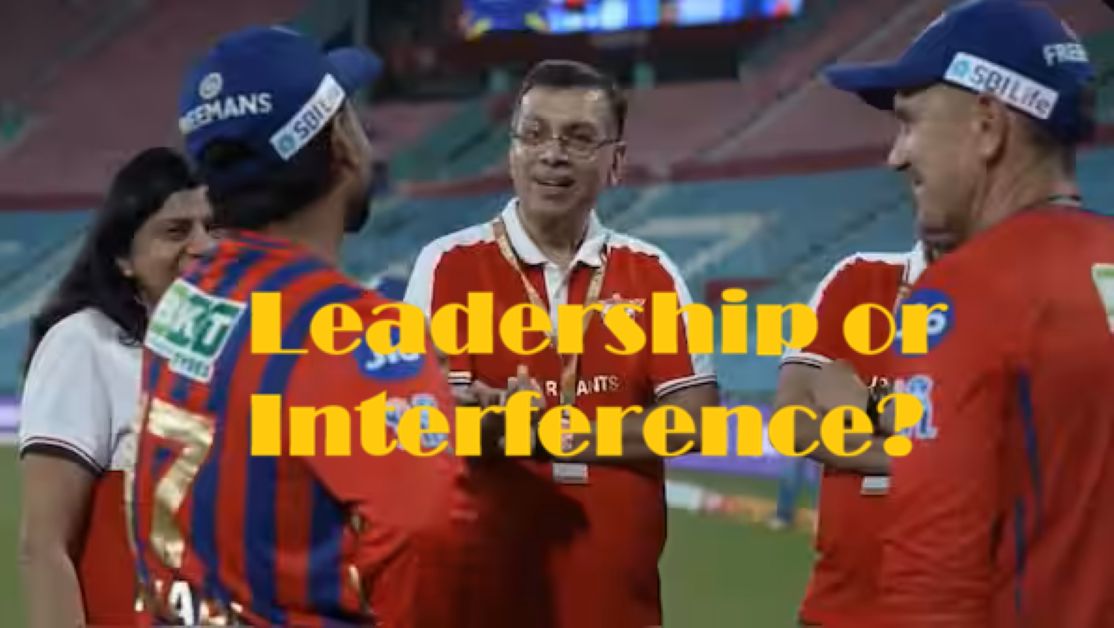
The biggest turning point came during the visible on-field conversation between Sanjiv Goenka and after a heavy defeat.
The visuals spread instantly across cricket social media.
Fans were divided.
Some believed:
- Owners have every right to demand accountability
- IPL is a billion-dollar competition
- Poor performances deserve tough conversations
Others felt:
- Public criticism weakens captains
- Leadership should stay internal
- Emotional reactions create instability
What made the moment significant was not just the conversation itself.
It was the symbolism.
Captains in cricket traditionally represent authority. When owners appear publicly dominant, fans start questioning who truly controls the team.
That changes perception inside and outside the dressing room.
Can Too Much Oversight Hurt T20 Decision-Making?
T20 cricket is built on instinct.
Captains constantly make split-second calls:
- Bowling changes
- Matchups
- Field placements
- Batting order tweaks
- Pace-off variations
The best T20 teams usually empower leadership groups to make fearless decisions.
When leadership becomes overly scrutinized, captains can become conservative.
That is dangerous in modern T20 cricket.
Aggressive teams win because they accept risk.
Look at successful IPL teams over the years:
- Flexible batting orders
- Unpredictable bowling plans
- Tactical bravery under pressure
Those systems require trust.
If players begin worrying about reactions after every failure, innovation naturally decreases.
This is why emotionally secure environments matter so much in franchise cricket.
But Strong Owners Can Also Build Winning Cultures
The debate becomes interesting because there is another side to this story.
Hands-on ownership is not automatically toxic.
Several successful franchises globally thrive because owners create relentless standards.
Strong owners can:
- Prevent complacency
- Demand professionalism
- Invest heavily in infrastructure
- Push strategic accountability
- Build long-term vision
The IPL is brutally competitive.
Sometimes relaxed environments become too comfortable.
Teams that consistently underperform often suffer from:
- Weak accountability
- Confused leadership
- Poor auction planning
- Lack of urgency
From this perspective, Sanjiv Goenka’s visible passion can also be interpreted as ambition.
LSG qualified for playoffs in their first two IPL seasons. That does not happen accidentally.
The franchise clearly has structure and intent.
The real issue is not involvement itself.
It is how that involvement is expressed publicly.
The Emotional Side of T20 Cricket
Analytics dominate modern cricket conversations, but emotional management is still massively underrated.
T20 players operate under extreme mental pressure:
- Constant travel
- Social media scrutiny
- Auction pressure
- Fear of losing contracts
- Instant criticism after failures
That environment requires emotional intelligence from management.
The best franchises often create psychological safety alongside accountability.
Players perform better when they know:
- One failure will not define them
- Captains are backed publicly
- Leadership trusts their instincts
This is why some of the most successful IPL environments feel calm externally even during poor runs.
The dressing room atmosphere matters more than fans realize.
Tactical Breakdown: How Owner Influence Can Affect Matches
Batting Strategy
Modern T20 batting relies on freedom.
Batters today are encouraged to:
- Attack early
- Take matchup risks
- Maintain intent even after wickets
Fear-based environments often create slower batting.
Players start protecting their place instead of maximizing impact.
That usually leads to:
- Safer shot selection
- Lower boundary intent
- Conservative powerplay batting
Ironically, over-control can reduce the aggressive mindset required to win T20 games.
Bowling Strategy
Bowling in IPL cricket requires courage.
Death bowlers especially need freedom to fail.
A yorker missed by two inches becomes a full toss six.
That does not automatically mean poor execution planning.
Teams with emotionally secure bowling groups usually:
- Persist with attacking plans
- Back specialists through bad games
- Encourage tactical experimentation
Pressure-heavy environments sometimes create defensive bowling patterns:
- Predictable slower balls
- Boundary protection fields
- Safer lengths
That can hurt wicket-taking ability.
For deeper bowling analysis, readers interested in death bowling strategy can explore future content around death-over psychology and execution.
Captaincy Decisions
Captaincy becomes hardest when external pressure grows.
A captain under intense scrutiny may avoid:
- Bold bowling changes
- Surprise tactical moves
- Flexible batting promotions
Yet IPL success increasingly depends on unpredictability.
The best T20 captains trust instinct.
That instinct weakens when leadership confidence drops.
This is why public backing matters so much in franchise cricket.
What LSG Actually Represents in the IPL
LSG may simply represent the future of IPL ownership.
Franchises today are becoming:
- More data-driven
- More corporate
- More performance-focused
- More commercially intense
The emotional, player-friendly model of older teams may slowly evolve into something far more ruthless.
That shift could fundamentally change IPL culture.
Owners will increasingly expect:
- Immediate results
- Brand discipline
- Strategic transparency
- Constant competitiveness
The challenge is ensuring that professionalism does not suffocate creativity.
Because creativity is still the heart of T20 cricket.
The Future of IPL Ownership in the Next Five Years
Over the next five years, franchise owners will likely become even more influential.
We may see:
- Greater involvement in tactical planning
- AI-driven performance analysis
- More aggressive player evaluations
- Increased branding control
- Stronger public accountability
But the smartest franchises will understand one thing:
Cricket teams are not spreadsheets.
The human side of sport still matters.
Future IPL success will probably belong to teams that balance:
- High-performance systems
- Emotional intelligence
- Tactical freedom
- Strong accountability
Too much freedom creates chaos.
Too much control creates fear.
The best franchises will find the middle ground.
Final Thoughts
The Sanjiv Goenka debate is really about a bigger IPL question.
How much control should owners actually have?
There is no perfect answer.
Strong leadership can absolutely transform franchises.
But T20 cricket also depends on confidence, instinct, and emotional clarity.
That balance is incredibly delicate.
LSG’s journey may ultimately become one of the defining case studies of modern franchise cricket — where business ambition collides with the unpredictable psychology of sport.
And in the IPL era, that tension is only going to grow.
FAQs
Why is Sanjiv Goenka’s involvement with LSG controversial?
Because his visible interactions with players and leadership have raised debates about whether strong owner involvement helps or harms team culture.
Do IPL owners influence cricket decisions?
Do IPL owners influence cricket decisions?
Can public criticism affect cricket captains?
Public scrutiny can impact captain confidence, tactical freedom, and dressing-room atmosphere, especially in high-pressure T20 environments.
Is strong franchise ownership always bad in IPL?
No. Strong ownership can improve accountability, professionalism, and long-term planning when balanced correctly.
Why does team culture matter so much in T20 cricket?
T20 cricket relies heavily on confidence, aggressive decision-making, and emotional freedom under pressure.



Pingback: Chennai Super Kings 2026 Squad Analysis: New Era Led by Ruturaj Gaikwad & Sanju Samson