

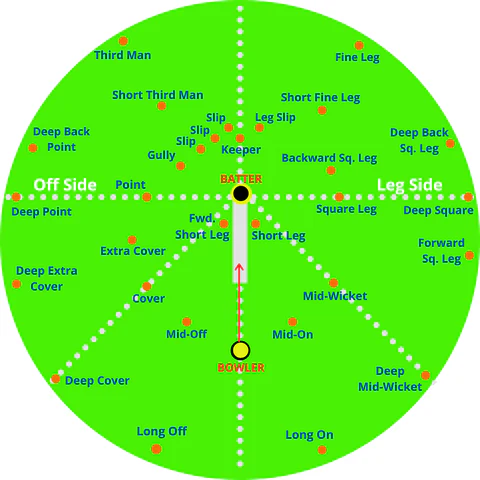
Cricket fielding positions have a way of making new fans feel completely lost. One minute you’re enjoying the match, and the next the commentator screams “short mid-wicket!” and you’re nodding like you understood that.
Don’t worry — every cricket fan has been there. The truth is, once you see the pattern behind the names, cricket fielding positions stop being confusing and start making total sense.
By the end of this guide, you’ll know every major position, what each one does, and a few memory tricks that actually stick.
Quick answers — cricket fielding positions
How many fielding positions are there in cricket?
There are around 30+ named fielding positions, but only 11 players field at a time. Most are combinations of distance (close/deep), angle, and side (off/leg).
What is the easiest way to remember all cricket fielding positions?
Use the formula: Distance + Angle + Side. Example — Deep + Square + Leg = Deep Square Leg. Learn this pattern and you can decode any position instantly.
What is the difference between off side and leg side?
Off side faces the front of the bat. Leg side is behind the batter’s legs. Memory trick: “Off = off the face of the bat.”
What does “deep” or “long” mean in a fielding position?
Both mean the fielder is near the boundary. Long-on, Deep mid-wicket, Deep square leg — any position with these words = boundary rider.
Why do fast bowlers always set slips and gully?
Fast bowlers generate edge catches. When the batter nicks the ball it flies behind and sideways — slips and gully are placed exactly in those zones.
What is the clock trick for field positions?
Visualise the field as a clock: 12 o’clock = straight (bowler area), 3 o’clock = off side square, 9 o’clock = leg side square, and the boundary = deep positions around the clock edge.
🏏 Want more cricket breakdowns like this every week?
Why Learning Cricket Fielding Positions Matters
Knowing Cricket fielding positions helps you:
- Understand match commentary and tactics
- Improve cricket knowledge (great for fans & beginners)
- Play smarter cricket if you’re a player
- Enjoy watching matches much more
The good news? You don’t need to memorize 30+ positions individually. There’s a pattern that makes everything easy.
Step 1: Understand the Golden Rule of Cricket Fielding Positions
Every fielding position is named using 3 simple references:
- Off Side vs Leg Side
- Close vs Deep
- Angle from the batter
Once you understand these three, you can decode any fielding position instantly.
Step 2: Off Side vs Leg Side (The Biggest Confusion Solved)
Imagine the batter standing at the crease.
- Off Side → The side facing the bat’s front (where the bat hits straight)
- Leg Side (On Side) → The side behind the batter’s legs
👉 Memory Trick:
“Off = Off the face of the bat”
This divides the field into two halves.
Step 3: The 3 Distance Zones (Super Important)
Every fielding position belongs to one of three distance zones.
| Distance | Meaning | Examples |
|---|---|---|
| Close | Near the batter | Slip, Short Leg |
| Infield | Inside the circle | Cover, Mid-off |
| Outfield | Near boundary | Deep Cover, Long-on |
👉 Memory Trick:
Close → Circle → Boundary
Just remember this order moving outward.
Step 4: Divide the Field into 5 Main Angles
This is the magic trick that makes remembering EASY.
From the batter’s perspective, the field has 5 main angles:
- Behind the batter
- Square (sideways)
- Slightly forward
- Straight ahead
- Very straight (long positions)
We apply these angles on both Off & Leg side.
Now let’s decode each zone 👇
Behind the Batter Positions (Wicket Area)
These are easiest to remember.
Core Positions
- Wicketkeeper
- Slip
- Second Slip / Third Slip
- Gully
- Leg Slip
👉 Memory Trick:
“Keeper catches, Slips catch mistakes.”
Fast bowlers love these positions because edges fly here.
Square Positions (Sideways from Batter)
Think of this as 90° angle from batter.
Off Side
- Point
- Backward Point
Leg Side
- Square Leg
- Backward Square Leg
👉 Memory Trick:
“Point = pointing sideways.”
This is one of the easiest positions to visualize.
Slightly Forward Positions
Now we move slightly toward the bowler.
Off Side
- Cover
- Extra Cover
Leg Side
- Mid-wicket
👉 Memory Trick:
“Covers stop cover drives.”
Any shot called a cover drive goes exactly here.
Straight Positions (Near the Bowler)
These are extremely important.
Off Side
- Mid-off
Leg Side
- Mid-on
👉 Memory Trick:
“Mid-off & Mid-on are the bowler’s bodyguards.”
They stand closest to the bowler.
Very Straight Positions (Boundary Riders)
Now we go deep near the boundary.
Off Side
- Long-off
- Deep Cover
- Deep Point
Leg Side
- Long-on
- Deep Mid-wicket
- Deep Square Leg
- Fine Leg
👉 Memory Trick:
“If you see the word DEEP or LONG → Boundary.”
Super easy rule.
Step 5: The Ultimate Memory Formula (This Changes Everything)
Here’s the cheat code to remember all positions:
👉 Position Name Formula
Distance + Angle + Side
Examples:
- Deep + Square + Leg = Deep Square Leg
- Short + Fine + Leg = Short Fine Leg
- Deep + Cover = Deep Cover
Once you understand this formula, you can create positions yourself.
That’s how commentators remember them.
Quick Cheat Sheet to Memorize Faster
OFF SIDE (Front of bat)
Behind → Slip, Gully
Square → Point
Forward → Cover
Straight → Mid-off
Boundary → Long-off / Deep Cover
LEG SIDE (Behind legs)
Behind → Leg Slip
Square → Square Leg
Forward → Mid-wicket
Straight → Mid-on
Boundary → Long-on / Fine Leg
Read this 3 times and you’ll remember forever.
How Commentators Instantly Know Field Placements
Captains set fields based on:
- Batter’s strong shots
- Bowler type (pace/spin)
- Match situation
- Run saving vs wicket taking
Example:
- Fast bowler → Slips & Gully
- Spinner → Short leg & silly point
- Death overs → Deep boundary fielders
Understanding positions helps you understand match strategy.
Final Memory Hack (Best Trick)
Visualize the field as a clock:
- 12 o’clock → Straight (Bowler area)
- 3 o’clock → Off side square
- 9 o’clock → Leg side square
- Boundary = Deep positions
This trick helps beginners remember everything quickly.
Conclusion
Learning cricket fielding positions isn’t about memorizing 30 names.
It’s about understanding the pattern behind them.
Remember the 5 keys:
- Off vs Leg side
- Close → Circle → Boundary
- 5 field angles
- Distance + Angle + Side formula
- Clock visualization trick
Practice these once, and you’ll never feel confused during commentary again.
Read more the topic http://news.bbc.co.uk/sport2/hi/cricket/rules_and_equipment/4179600.stm
Read other posts:
- https://overthewicket.in/chennai-super-kings-2026-squad-analysis-new-era-led-by-ruturaj-gaikwad-sanju-samson/
- https://overthewicket.in/can-sanju-samson-deliver-again-ipl-form-ahead-of-mi-rivalry/
- https://overthewicket.in/why-ipl-is-the-richest-cricket-league/
- https://overthewicket.in/statement-comeback-by-dc-won-by-7-wickets/
- https://overthewicket.in/how-many-creases-are-there-in-cricket-the-simple-answer-every-fan-gets-wrong/
🏏 Want more cricket breakdowns like this every week?