

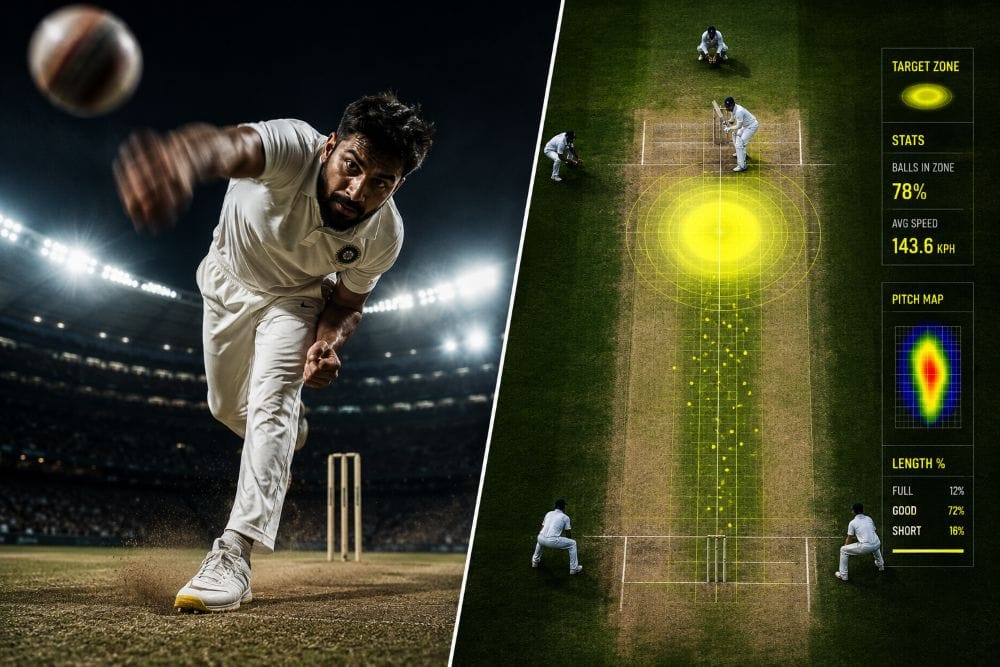
Look, I’m going to say something that might piss off a few bowlers: the yorker isn’t some magical delivery that only Bumrah can bowl. It’s a habit. A boring, repetitive, grind-it-out habit that most of us are either too lazy or too scared to build properly.
I’ve lost count of the IPL death overs I’ve watched where a fast bowler charges in with everything — pace, adrenaline, a dream field set by the captain — and then lands it right in the slot. Half volley. Batter swings through the line. Six. Game done. And every single time, I sit there thinking the same thing: he knew what to bowl. He just couldn’t bowl what he knew.
That gap between knowing and executing? That’s the whole game right there. It’s what makes Bumrah Bumrah. And it’s what makes a perfectly nailed yorker the most thrilling delivery in cricket — and the most catastrophic when it goes wrong by six inches.
I’ve spent way too many hours breaking down what actually makes a yorker work under pressure. Not the coaching manual stuff — “aim at the feet” — but the real mechanical and mental reasons it falls apart when 60,000 people are screaming and a power hitter is swinging for the stands. I’ve studied Bumrah’s run-up frame by frame. I’ve watched Jamie Overton talk about pre-match planning at CSK. I’ve groaned at full tosses in the 19th over and celebrated toe-crushers that made batters look clueless.
Below, I’ve broken down the five biggest reasons bowlers miss their yorker — and exactly how to fix each one — using real moments from IPL 2026, including that CSK vs LSG game on May 10 where death-over bowling decided everything.
If you’re chasing a career as a fast bowler in India, I’ve also put together a full guide here: The Ultimate Guide to Fast Bowling in Cricket (Beginner to Pro) .
Alright, let’s get into it. Your yorker is about to get a lot harder to hit.
⚡ Quick Answer: How to Bowl a Yorker Consistently
Consistent yorkers come down to 5 specific, fixable mistakes — not magic. Nail a robotic run-up, lock your eyes on a fixed target, drive your shoulder down through release, commit to the ball before your run-up, and master off-stump/wide lines. Below, we break down each fix with real IPL 2026 examples.
The 5 Fixes at a Glance:- 🏃 Fix 1: Run-up inconsistency kills your release point — make it robotic.
- 👀 Fix 2: Vague targeting leads to vague lengths — lock eyes on a specific spot.
- 💪 Fix 3: Lazy shoulder rotation creates half-volleys — drive down aggressively.
- 🧠 Fix 4: Last-second panic changes mechanics — decide before you run in.
- 🎯 Fix 5: Middle-stump yorkers get flicked — use off-stump and wide lines.
👇 Scroll down for the full IPL 2026 analysis, including Overton’s success & Kamboj’s costly miss.
Why This Topic Matters in Modern Cricket
The T20 era didn’t just speed up cricket — it fundamentally broke the old rules of death-over bowling. Back in 2008-2012, a decent length ball at 135kph could do a job in the last four overs.
Today? That same ball gets launched into the second tier by a batter with a 180+ strike rate, hitting pre-meditated shots before you even complete your action.
The yorker has become the last true equaliser in T20 cricket. When everything else fails — slower balls get scooped, back-of-a-length gets pulled, wide yorkers get slapped through the off side — the toe-crusher at off stump remains the one delivery that makes a T20 specialist batter genuinely uncomfortable.
The optimal yorker landing zone is just 5–10 centimetres in front of the popping crease — a box roughly 50cm by 20cm. That’s it. One wrong signal from your shoulder and it’s a full toss. One inch short and it’s a half volley begging to be hit.
In IPL 2026, we’ve already seen this play out multiple times. The teams with bowlers who can consistently nail that box in the 16th-to-20th over window have a measurable advantage. Those who can’t are shipping 20+ runs per over by the end of innings.
This is why learning how to bowl a yorker consistently is, in 2026, arguably the most important skill a pace bowler can develop. if you want to know more on importance of Yorkers in todays cricket checkout our article Why Yorkers Are the Most Dangerous Ball in T20 Cricket – Science, Stats & Strategy
Core Analysis: 5 Reasons Bowlers Miss Their Yorker (And How to Fix Each One)
Let me be clear: I’m not going to tell you to “aim at the batsman’s feet” and call it a day. Every cricket coaching manual says that. What I want to do here is go deeper — into the actual mechanical and mental reasons the yorker breaks down in match pressure.
1. Inconsistent Run-Up Kills Your Release Point
This is the silent killer that nobody talks about enough. A yorker demands an extremely precise release point. If your run-up varies by even two or three strides — in terms of pace, rhythm, or foot position at the crease — your release point shifts, and the ball goes either too full (full toss) or too short (half-volley). Both are punishable.
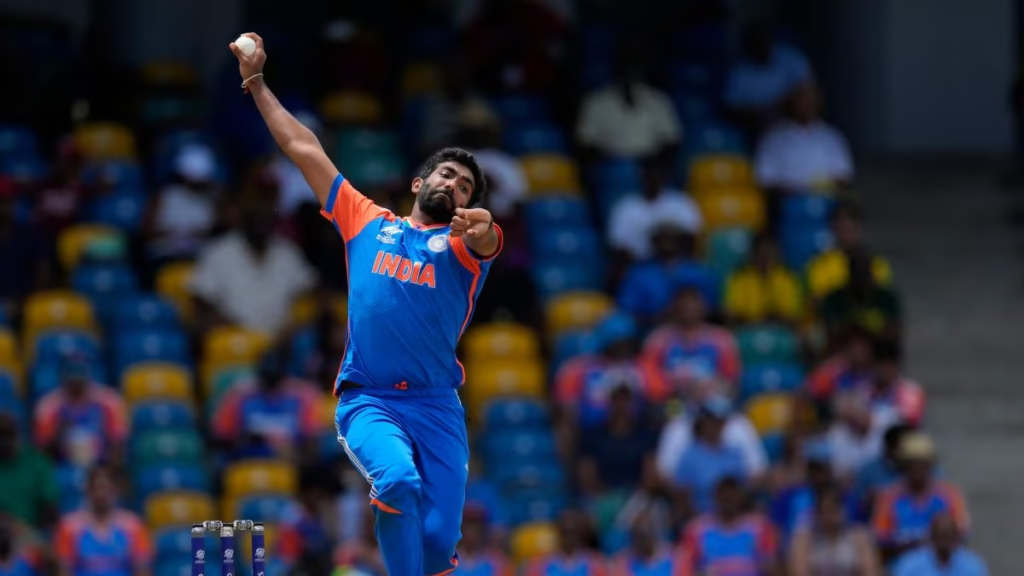
What Bumrah does — and what you’ll notice if you watch him carefully, is that his run-up is almost robotically consistent. The bounce, the gathering stride, the bound: every delivery looks like a copy-paste from a coaching manual.
That repeatability is why he can bowl yorkers under pressure. His release point barely changes, so his length barely changes. The fix here is straightforward but boring: during practice, bowl yorkers off a full run-up, not a short walk-up. Match conditions replicate match execution. (External reference: CricVision’s yorker drilling guide — cricvision.co.in)
2. Your Eyes Are Looking in the Wrong Place
Most bowlers in the nets focus on the ball in their hand, or they look vaguely at the pitch and “feel” for the right length. Elite yorker bowlers use a fixed visual target. Some use the crease line. Bumrah is known to lock onto the base of off stump during his run-in. Some bowlers use the batsman’s toes as an anchor point. The key is that your eyes must commit to a specific target before delivery, not during it.
This sounds simple but it’s fundamentally different from how most medium-fast bowlers are coached at junior level. The default instruction — “aim for a good length” — actually trains the eyes to be vague. For a yorker, vagueness is fatal. Pick a dot on the pitch. Run at it. Release over it.
3. Shoulder Rotation Drops at the Point of Release
The yorker requires you to drive your bowling shoulder down and through the target more aggressively than a standard full delivery. This downward shoulder drive is what keeps the ball full enough without turning into a full toss. When bowlers are tired — in over 18, 19, or 20, after a long spell — the shoulder gets lazy. It doesn’t drive fully. The ball comes out slightly higher. And that half-volley costs six runs.
This is entirely a fitness and mechanics issue. Strong rotator cuff conditioning, combined with deliberate shoulder-rotation drills in training, directly improves yorker consistency in the back end of innings.
4. The “Safety Ball” Mental Trap
Here’s something analytics consistently reveals about death-over bowling: bowlers who miss their yorker most often are the ones who decided to bowl it at the last second because the batter set up to swing. They were going to bowl something else, saw the batter shuffle, panicked, and tried to “jam in” a yorker. That last-second change destroys your mechanics because the muscle memory hasn’t been activated with the right cues.
The CSK vs LSG game on May 10, 2026, at Chepauk gave us a perfect example of the opposite — a bowler committed to his plan and executing it. Jamie Overton, who’s been CSK’s bowling standout this IPL season with 14 wickets in 10 games, talked openly about his philosophy: “It’s mainly the lines,” he said. “I’ve got to bowl a bit fuller [in India]. A lot of planning goes on to where I want to execute.” That pre-match mental commitment — deciding his lines before he walks to his mark — is exactly what separates planned execution from panicked improvisation.
5. Width Is as Important as Length
Most club-level bowlers, when they talk about a yorker, imagine it as a middle-stump delivery. And while the toe-crusher at middle-and-leg is devastating, it’s also the easiest to flick fine for four. The elite yorker has two primary lines: one into the right-hander’s toes at off stump (restricts the arc of the bat), and one wide of off stump (forces a stretch that destroys timing). Against power hitters who open their stance and target straight, the off-stump toe-crusher is your weapon. Against batters who shuffle across and look to hit through leg, the wide yorker creates a boundary-saving length.
In LSG vs CSK on May 15, 2026, the commentary specifically noted that CSK pacer Anshul Kamboj “missed the yorker again on the shorter side” — and Nicholas Pooran destroyed that misjudgement for six. It’s the perfect case study in how a few centimetres of length error, at the wrong moment, turns a potential dot ball into a match-defining six.
Your Turn to Weigh In
Every bowler struggles with the yorker differently. What’s YOUR biggest challenge when trying to nail the toe-crusher?
🔴 I read and reply to every comment. Your insight might help the next bowler who finds this page.
Tactical & Strategic Breakdown
Bowling Strategy: When to Pull Out the Yorker
The most common mistake coaches make is treating the yorker as a last over only delivery. That’s an outdated approach. Modern data suggests yorkers are most effective when used as surprise deliveries in overs 7-10 as well — when batters have settled into rhythm and aren’t expecting extreme full length. It breaks partnerships. It changes momentum.
Here’s how elite teams actually deploy the yorker across an innings:
Powerplay (Overs 1-6): Rare, but devastatingly effective against top-order batters who are playing themselves in. A first-ball yorker to a settled Test opener playing T20 resets the entire game psychologically.
Middle Overs (7-15): This is where bowlers like Overton in IPL 2026 have found enormous success. He bowled 18 of his 28 IPL 2026 overs in this phase, at an economy of 7.61 — superb for the middle overs in this era. His approach was stump-to-stump hard lengths with the threat of a yorker, which kept batters second-guessing their back-foot options.
Death Overs (16-20): This is the classic yorker territory. The challenge is that batters in 2026 are pre-meditated. Platforms like Bumrah’s, where he alters between slower yorkers, knuckle balls, and pace yorkers, are the gold standard. Against tail-enders, the inswinging toe-crusher at 140kph+ remains almost unplayable.
Captaincy Decisions: Setting the Yorker Field
A yorker bowled with the wrong field is a wasted yorker. For the off-stump yorker, you need deep fine leg and deep square leg (for the jam-down deflection), mid-off inside the circle (to cut off the chip), and a wide third man (for the outside edge that squirts away). The mistake many T20 captains make is overloading the boundary and leaving the “danger zones” of the yorker unguarded, essentially inviting batters to take the risk of a chip or guide.
The Future Trend: Where Yorker Bowling Is Heading (2026–2031)
Over the next five years, I expect four significant evolutions in how yorkers are used and coached at elite level:
1. AI-Powered Length Monitoring in Practice: Analytics platforms will begin tracking a bowler’s yorker landing zone in real time during nets — giving instant feedback on centimetre-level deviation from the target. Teams like CSK, who already invest heavily in data, will integrate this into regular training.
2. The Slower Yorker Becomes Standard: The toe-crusher at full pace is increasingly being tracked and read by elite batters. The next evolution is the slower yorker — bowled at 15-20kph below peak pace, landing in the same spot. Bhuvneshwar Kumar has been a pioneer of this, and expect more bowlers to make it their go-to death option.
3. Reverse-Swing Yorker Revival: With pitches wearing faster in Indian conditions — as we saw at Ekana and Chepauk in IPL 2026 — the old ball will start reverse-swinging earlier. A reverse-swinging toe-crusher at 140kph+ is almost unplayable. Bowlers who can combine reverse swing with yorker accuracy will become premium T20 commodities.
4. Specialised Yorker Coaches: Just as batting coaches have now specialised into “hitting” coaches and “technical” coaches, expect death-over bowling coaches who work exclusively on yorker execution, pressure drills, and field-setting psychology to become mainstream at franchise cricket level.
Conclusion
The yorker is not a mystery. It’s not some magic delivery that only Bumrah can bowl. It’s a skill built brick by brick through consistent run-up mechanics, fixed visual targets, strong shoulder rotation, and the mental commitment to execute before you reach your crease — not during. What makes it hard isn’t the delivery itself. It’s the 19.5 overs of T20 chaos that come before it, and whether you can shut all of that out and still aim at a 50cm box.
What IPL 2026 has shown us — through Overton’s middle-over mastery at CSK, Bhuvneshwar’s death-over brilliance at the top of the Purple Cap standings, and Kamboj’s match-shaping consistency — is that the bowlers who invest in this skill, systematically and deliberately, win matches. The ones who rely on pace and hope get found out when it matters most.
The next time your yorker lands as a half-volley, don’t blame nerves. Check your run-up. Check your eyes. Check your shoulder. Fix one thing at a time. That’s how you bowl a yorker consistently — and how you change the game.
FAQs
What is the ideal landing spot for a yorker in cricket?
The perfect yorker lands 5–10 centimetres in front of the batsman’s popping crease, directly in line with the stumps or just outside off stump. This small zone makes it nearly impossible to play attacking shots without risking being bowled or hitting the ball straight to a fielder.
How do I bowl a yorker consistently in T20 cricket?
The key is a consistent run-up, a fixed visual target (such as the base of off stump or the crease line), and strong shoulder rotation at the point of release. Practise landing the ball on a cone or shoe placed at the target spot before adding batsman-specific pressure. Muscle memory built in the nets is what holds under match pressure.
Why do bowlers bowl full tosses when trying to bowl yorkers?
A full toss usually happens because the bowler either shortens their run-up subconsciously, drops their shoulder too early, or changes their release point mid-delivery. It also happens when a bowler decides to bowl a yorker too late — the mechanics aren’t prepared, and the ball comes out higher than intended.
What are the different types of yorkers in cricket?
The main types are: the toe-crusher (aimed at the batsman’s toes on middle-and-leg), the off-stump yorker (forces an awkward angled defence), the wide yorker (drags the batsman wide outside off stump), the inswinging yorker (moves into the batter late), and the slower yorker (same length at reduced pace to deceive timing).
Who is the best yorker bowler in IPL 2026?
Jasprit Bumrah remains the gold standard globally, though Bhuvneshwar Kumar has led the IPL 2026 Purple Cap standings and is consistently one of the most accurate death-over bowlers in the tournament this season.
How many overs should you bowl yorkers in a T20 innings?
There’s no fixed number, but analytics suggests yorkers are most effective as surprise deliveries across all phases — not just in the death. Bowling 2–3 yorkers per over in overs 18-20 is standard, but a well-timed yorker in overs 7-10 can break partnerships and change momentum dramatically.
Can spinners bowl yorkers?
Yes — though it’s called a “full-pitched” or “flat” delivery rather than a classical yorker. Finger-spin bowlers like Ravichandran Ashwin have used very full-length deliveries effectively, particularly against batters who try to premeditate sweeps. Wrist spinners use a similar concept with their arm ball or googly at full length.
How does field placement affect a yorker’s effectiveness?
Enormously. The off-stump yorker needs deep fine leg, wide third man, and a saving mid-off to account for deflections, edges, and chips. Without the right field, even a perfect yorker can leak two runs instead of a dot ball. Captains who understand the specific “danger zones” of each yorker type get significantly more value from their bowlers.
Why does the yorker become harder to bowl at the end of a long T20 innings?
Fatigue is the main factor — specifically, shoulder and core muscle fatigue that reduces the precision of the release. Mental fatigue also plays a role, as bowlers who’ve been hit earlier in the innings may second-guess themselves. Pre-match planning — deciding exactly where you’ll bowl before you walk to your mark — is the proven antidote to this.
What drills can improve yorker accuracy at home or in the nets?
Two of the most effective drills are: (1) the cone drill — placing a shoe or cone at the target spot and aiming to hit it repeatedly over 20 deliveries, tracking accuracy rate; and (2) the no-run-up yorker drill — bowling yorkers from a standing position at the crease, which isolates shoulder rotation and release-point mechanics from run-up variables.



Pingback: Fast Bowling Master Guide: Beginner to Pro