
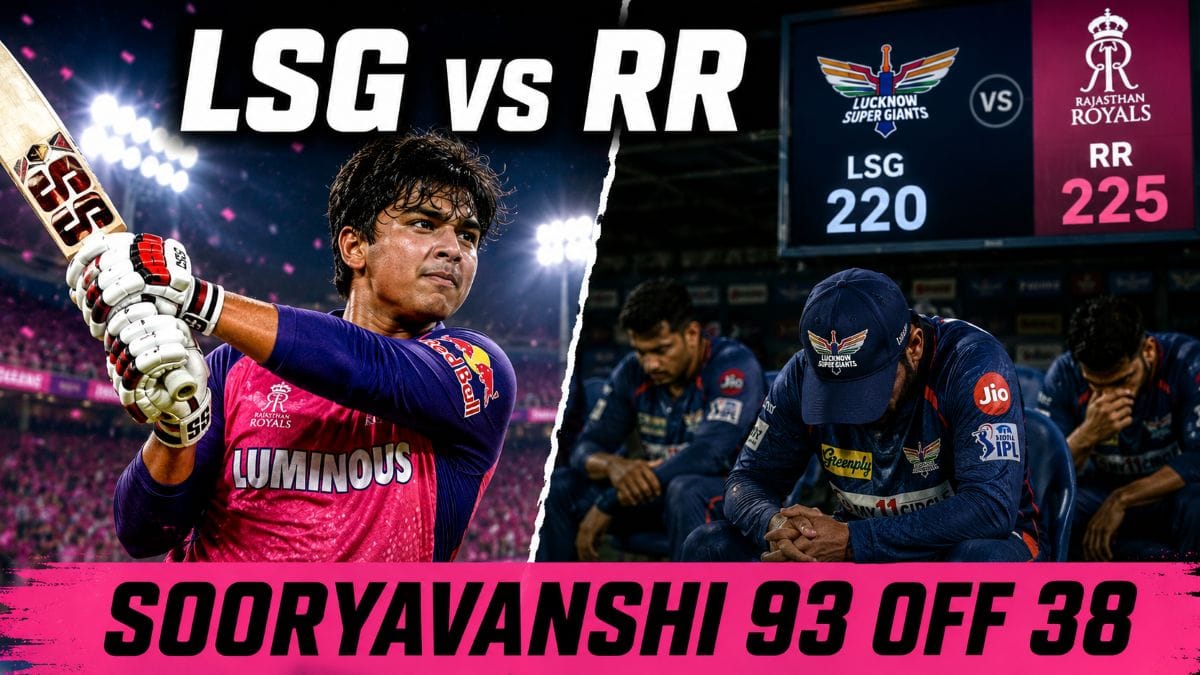
Match: LSG vs RR, IPL 2026, Match 64 | Sawai Mansingh Stadium, Jaipur | May 19, 2026
Result: Rajasthan Royals beat Lucknow Super Giants by 7 wickets (LSG 220/5, RR 225/3 in 19.1 overs) Player of the Match: Vaibhav Sooryavanshi — 93 off 38 balls.
The match that refused to be just a cricket game
There’s a footnote in Vaibhav Sooryavanshi’s career that most people have forgotten by now. His IPL debut — the very first time he walked out to bat in the Indian Premier League — was against Lucknow Super Giants, on April 19, 2025. He was 14 years old. He hit his first ball for six.
Fast forward fourteen months to May 19, 2026. Same opponent. Same player. Except nothing else is the same. Sooryavanshi is now 15, has a century on his IPL debut season, is the leading run-scorer of IPL 2026, and just dismantled LSG’s bowling attack for 93 off 38 balls to drag Rajasthan Royals into the playoff spots.
That kind of narrative doesn’t come along often in cricket. A teenager walks into the IPL as a debutant against a specific team, then returns over a year later as the most dangerous batter in the competition — and wrecks that same team again, in a higher-stakes game, with even more violence.
The match itself was extraordinary on paper: 445 total runs scored across 39.1 overs, the highest ever match aggregate in any game between RR and LSG in IPL history. But the numbers only tell you what happened. This piece tells you why, and what it means for both sides.
LSG’s innings: how Mitchell Marsh’s 96 became the story of a summit never reached
LSG vs RR match was not less than a war. Lucknow’s innings felt, for about 12 overs, like it was building toward something legendary.
Mitchell Marsh and Josh Inglis took guard and immediately treated the Jaipur pitch like a batting paradise — which, in fairness, it was. The two of them put on 109 runs in just 50 balls for the opening wicket. Inglis was the early aggressor: 60 off 29 balls, with 7 fours and 3 sixes at a strike rate of 206. He played like someone who’d been told the match was only 10 overs long. Marsh, meanwhile, looked imperious. By the time the powerplay ended, LSG had 83 runs on the board without losing a wicket, and the analytics tools were projecting a total north of 250.
Then Yash Raj Punja bowled.
This is the moment that the scorecards don’t adequately capture. Punja, RR’s left-arm spinner, isn’t a household name. He isn’t the headline act. But his four-over spell of 2/35 — those figures don’t look remarkable until you understand when they came. He bowled through the middle phase, overs 8 to 12, when LSG should have been pressing for 260. Instead, Punja tied them down, took key wickets, and cut off roughly 30 runs that LSG should have scored on that surface. The final total of 220 isn’t a bad one. But at the halfway point of the innings, LSG were on track for something that might have been unchase-able. Punja is the reason that didn’t happen.
The final flourish of LSG’s innings was equal parts impressive and frustrating for their fans. Mitchell Marsh, batting with the calm authority of someone who’d already played a great knock, was cruising toward what would have been his third IPL century — and then ran himself out on the second-last ball of the innings. Yashasvi Jaiswal’s throw was direct, and Marsh was four runs short of 100. A self-inflicted wound. Jofra Archer then bowled Ayush Badoni on the final ball for a duck — Badoni’s fifth duck of the season for LSG, which, grimly, is now a franchise record (breaking Krunal Pandya’s mark of four).
LSG finished at 220/5. On another night, with better death-over execution, that’s 240.
Sooryavanshi’s 93: what 38 balls looked like from the other end
Rajasthan’s chase was always going to live or die by how their top order handled the pressure of a 221-run target. Through the powerplay, it looked composed rather than explosive. Jaiswal and Sooryavanshi put on 71 runs in the six power play overs — a solid platform, but not yet a statement. Jaiswal was the dominant partner early, scoring the bulk of those runs while Sooryavanshi played what looked like a measured foil’s role.
Then Akash Singh dismissed Jaiswal for 43 off 23 balls, and everything changed.
Sooryavanshi had scored 27 off 15 balls at that point. In the next 23 balls, he scored 66 more. With ten sixes. At a strike rate of 244.
His fifty came up in 23 balls. He was essentially unstoppable — not because LSG bowled badly, but because he made good balls look ordinary. A length delivery became a flat six over mid-wicket. A wide yorker attempt became a slap through the covers. When Mohsin Khan finally had him caught for 93 off 38, the required rate had already been knocked out of the game. RR needed 41 off the last 36 balls with eight wickets in hand. It was a formality.
To put the innings in context: Sooryavanshi is now the leading run-scorer in IPL 2026, and with 53 sixes this season, he is closing in on Chris Gayle’s all-time IPL single-season record of 59. He also became the fastest player in history to hit 100 T20 sixes — a record he broke earlier this month. He is 15 years old, in school, and is making men who’ve played international cricket for a decade look ordinary.
Dhruv Jurel’s unbeaten 53 off 38 balls deserves credit too — his anchor role after Sooryavanshi departed is what made the finish smooth rather than nervy. Jurel timed the chase perfectly, kept the run rate in check, and finished it with a six over fine leg.
The journey of Vaibhav Sooryavanshi rising to the orange cap holder in IPL 2026 is remarkable. Checkout our article on his biography Vaibhav Suryavanshi: The Untold Story of India’s Rising Cricket Sensation.
Three tactical moments that decided this match
Most match reports will give you the what. Here’s the why.
1. Punja bowling in the middle overs, not the edges
In the LSG vs RR match, Jaiswal’s decision to bring Punja on during the powerplay-to-death transition phase — rather than saving him for the death — was a calculated risk that paid off. Marsh and Inglis had feasted on pace in the powerplay. Punja’s variations in flight and pace unsettled the rhythm. His two wickets in those middle overs didn’t just change the scorecard; they changed the momentum of the entire innings. This is the tactical chess move that doesn’t show up in the highlights package.
2. Marsh’s run-out and what it cost LSG
Marsh running himself out for 96 on the penultimate ball isn’t just a personal tragedy — it’s a team cost. A Marsh century almost certainly changes LSG’s total by 10 to 15 runs. More importantly, it changes the psychology of the chase. There’s a reason teams want set batters finishing innings, not arriving at the crease on the final ball. The run-out was a product of aggressive intent — he was backing himself to get back for the second — but it left LSG 4 runs short of a score that could have applied far more pressure on RR.
3. Pant’s bowling call that he regretted immediately
In his post-match press conference, Rishabh Pant was unusually candid about one specific decision: not bowling Shahbaz Ahmed earlier in the chase because of RR’s left-handed batters in the lineup. Pant deployed Digvesh Rathi instead, factoring the left-hand/right-hand matchup. But with Sooryavanshi — a left-hander — in full flight, holding back a specialist spinner while the game slipped away was a decision he acknowledged could have gone differently. There’s no guarantee Shahbaz would have dismissed Sooryavanshi. But the hesitation in the bowling changes, and Pant’s own admission, tells you LSG knew they were out of answers.
LSG season review 2026: how title contenders ended up fighting for last place
Before the season started, this wasn’t supposed to be LSG’s story.
Lucknow entered IPL 2026 with what looked like a genuinely threatening squad on paper. A power-packed top order with Marsh, Inglis, and Pooran. Rishabh Pant — the most expensive signing in IPL auction history — as captain and finisher. Bowling depth anchored by Mayank Yadav and Akash Singh. They were the side that analysts couldn’t stop talking about in pre-season previews.
And then the season started, and nothing worked in sequence.
Pant’s campaign has been the most discussed thread. He arrived at LSG carrying enormous expectations — not just as a batter, but as the face of a franchise trying to build an identity around his personality and explosiveness. Instead, he scored 204 runs across nine innings at a strike rate of 128 — numbers that, for an ordinary IPL middle-order batter, would be average. For the player LSG paid the most for, they’re difficult to defend. He also batted in three different positions — opener, No. 3, and No. 4 — across the season, which tells you everything about the tactical uncertainty at the franchise.
Nicholas Pooran was similarly troubled. After a strong IPL 2025 at No. 3, he was shifted around the order throughout this campaign before being restored to his natural position — nine games in, after the damage was done. In his post-match interview last night, Pooran was refreshingly honest: “I haven’t been good enough.” It’s a statement that could apply to the franchise as a whole.
What made LSG’s implosion particularly hard to watch was the pattern of it. Every time they seemed to be building momentum — a strong performance, a big total — something unravelled in the next game. The middle order couldn’t sustain pressure. Bowling changes in death overs were inconsistent. Set batters kept getting out at the wrong time. There was no inning that defined their season in the way that Sooryavanshi’s 93 defined RR’s campaign.
LSG became the first team knocked out of playoff contention in IPL 2026. They’re now fighting to avoid the wooden spoon. For a team that entered the tournament as title contenders, that’s a story that will be picked apart all winter.
RR IPL 2026 playoffs race: what this win changes
Rajasthan’s win last night was about more than three points on the table.
It ended a three-game losing streak that was starting to get uncomfortable. It was their last home game of IPL 2026, and they sent the Jaipur crowd home with something to remember. More importantly, it put RR in fourth place on the points table with 14 points from 13 games — and gave them the simplest possible equation heading into their final match.
Win against Mumbai Indians on May 24, and RR are in the playoffs. No net run rate math needed. No hoping other results go their way. Just one game.
That’s a position they’d have taken at the start of the season. But it’s also a precarious one — MI, despite a difficult campaign of their own, have shown they can be dangerous in knockout-or-bust situations. And Jasprit Bumrah remains one of the best bowlers in the world, regardless of context.
The good news for RR is the momentum and the personnel. Sooryavanshi looks like he’s physically incapable of having a bad game right now. Jaiswal’s captaincy is growing in confidence — his 43 off 23 before handing the baton to Sooryavanshi was a captain’s innings in the truest sense. And Jurel, quietly, is becoming one of the most reliable middle-order batters in the competition.
The bowling has questions — the death-over economy has been an issue all season — but against an MI side that has also leaked runs from their attack, that may matter less than the batting firepower RR bring.
LSG vs RR scorecard — IPL 2026, Match 64
Final scorecard:
| Team | Score | Top batter | Top bowler |
|---|---|---|---|
| LSG | 220/5 (20 overs) | Mitchell Marsh — 96 (57) | — |
| RR | 225/3 (19.1 overs) | Vaibhav Sooryavanshi — 93 (38) | Yash Raj Punja — 2/35 |
RR’s takeaway: Sooryavanshi can win you a game from any position. Punja is a legitimate match-winner in the middle overs, not just a containing option. Jurel is the anchor this team needs when the pyrotechnics calm down. And the dressing room, for the first time in four matches, looks like it believes in itself again.
LSG’s takeaway: This season will demand hard questions — about Pant’s role, about how they build a middle order that doesn’t depend on two openers going berserk, and about what tactical framework Justin Langer brings into the auction room next year. The bowling, especially Akash Singh and Mayank Yadav, has been the one bright spot. The rest needs a rethink.
There’s one last thing worth saying. Sooryavanshi’s first IPL ball, in his debut against LSG in 2025, went for six. His 93 last night ended with ten of them. At some point, LSG’s bowling coaches will need to have a very specific meeting about this particular left-hander from Bihar — because he’s only going to get better, and they’re going to keep seeing him.
If you’re looking to understand the full physical demands of pace bowling, don’t miss our Ultimate Guide to Fast Bowling in Cricket (Beginner to Pro)



Pingback: IPL 2026 Final | RCB vs GT: ₹70 Crore Leadership Test