

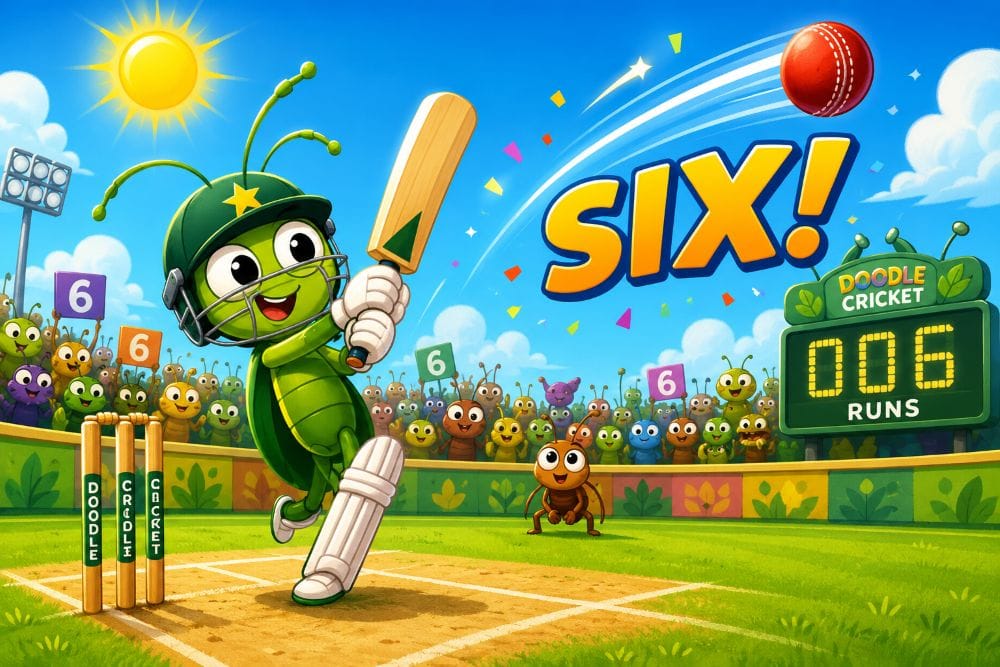
The weirdest cricket addiction I’ve ever seen didn’t happen in a stadium, academy, or IPL match. It happened in an office break room when I watched grown adults take turns playing Doodle Cricket like their reputation depended on it.
At first glance, it looks like a harmless Google mini-game. Cartoon insects. Bright colours. One button to bat. That’s it. Yet millions keep returning to it years after its release — even in an era of ultra-realistic console cricket games. That contradiction kept nagging at me. Why does a silly browser game keep winning our attention?
In this article, we’ll unpack why Doodle Cricket became one of the most replayed cricket games ever created, what its design secretly teaches us about cricket psychology, and why it represents the future of cricket entertainment. If you enjoyed our pillar post The Ultimate Guide to Fast Bowling in Cricket (Beginner to Pro), this article explores the entertainment side of cricket culture — how fans fall in love with the sport before they ever step on a pitch.
Why This Topic Matters in Modern Cricket Entertainment
Cricket isn’t just a sport anymore. It’s an entertainment ecosystem. The T20 revolution changed how fans consume cricket. Matches became shorter. Highlights became faster. Attention spans became tighter. Today’s fans jump between reels, fantasy leagues, stats dashboards, and gaming experiences.
This shift matters because fandom now begins before someone watches a full match. That’s exactly where Doodle Cricket becomes important. It quietly became one of cricket’s biggest digital gateways.
Think about it:
- A kid searches Google during lunch break
- Sees a cricket game
- Plays for 5 minutes
- Learns scoring, timing, boundaries
- Feels the joy of batting
That is cricket onboarding in 2026. Not TV. Not commentary. Not stadium tickets.
A browser game. The modern cricket fan journey often starts with interaction first, watching later.
The Origin Story: Why Google Made Doodle Cricket
Google released Doodle Cricket in 2017 during the ICC Champions Trophy. The idea was simple: celebrate a global event with a fun, interactive doodle. But what makes this fascinating is what happened after the tournament ended.
Most doodles disappear. This one didn’t. It became one of the most searched and replayed Google games globally. That tells us something important: the game accidentally solved a massive engagement problem.
Traditional cricket gaming requires commitment:
- Installing apps
- Learning controls
- Spending time understanding gameplay
Doodle Cricket removed every barrier. No download. No tutorial. No learning curve.
You click. You bat. You smile.
That frictionless design is the foundation of its success.
The Simplicity Trap
Most cricket video games try to simulate cricket reality. But real cricket is complicated. And complexity is the enemy of casual engagement.
Think about real cricket variables:
- Pitch conditions
- Swing and seam physics
- Player attributes
- Shot selection mechanics
- Field settings
- Match formats
For hardcore fans, this is heaven.
For casual players, this is friction.
Doodle Cricket did something radical. It stripped cricket down to its emotional core.
The game focuses on a single mechanic: timing the ball.
That’s genius.
Because timing is the most emotionally satisfying part of batting. Ask any cricketer what a perfect shot feels like, and they won’t talk about technique first. They’ll talk about the feeling.
The ball meets the bat perfectly.
The fielders don’t move.
The sound feels right.
Doodle Cricket compresses that emotional reward into seconds. That’s why players don’t feel overwhelmed. They feel instantly competent.
And competence creates engagement.
Instant Dopamine Cricket
Digital entertainment today runs on dopamine loops. Social media, reels, mobile games — all follow a pattern of quick reward and quick restart.
Doodle Cricket is engineered entirely around this loop.
Every ball gives:
- Immediate result
- Instant feedback
- Clear success or failure
There’s no downtime between deliveries. No waiting for overs to end. No slow build-up. It feels like playing a never-ending Super Over.
This rapid reward cycle triggers the brain’s desire to repeat the action. The faster the feedback loop, the stronger the habit.
That’s why you rarely play one game of Doodle Cricket. You play five. Then ten.
The Illusion of Skill Progression
One of the smartest tricks in the game is invisible difficulty scaling. At the start, players score easily. Shots feel effortless. Boundaries come quickly. Confidence builds fast.
Then something changes. The bowlers subtly speed up. Timing windows shrink. Field placements feel tighter. Dismissals feel unlucky.
The game never tells you it became harder. But you feel it. This creates the illusion of skill progression. Players believe improvement is within reach. That belief drives replay behaviour.
This is the same psychological hook used in:
- Arcade games
- Endless runners
- Mobile gaming hits
And now, cricket.
The Universal Cricket Fantasy
Every cricket fan shares the same fantasy.
Walking in. First ball. Six.
Real cricket rarely gives that experience. There’s pressure, technique barriers, and fear of failure.
Doodle Cricket removes all of it.
You are always batting.
You are always the hero.
You are always one shot away from glory.
This taps directly into childhood street cricket memories. The game feels like gully cricket — simple, joyful, repeatable.
Nostalgia is powerful. And nostalgia creates emotional attachment.
The Rise of Bite-Sized Cricket Content
Doodle Cricket isn’t an isolated success. It’s part of a broader trend.
Cricket consumption is shifting toward:
- Short highlights
- Quick analysis clips
- Fantasy cricket dashboards
- Interactive experiences
Fans increasingly want micro-moments of cricket instead of full-length consumption.
A 5-minute game fits perfectly into modern lifestyles.
This explains why cricket boards and broadcasters are investing heavily in digital engagement tools.
Doodle Cricket predicted this shift years earlier.
The Future of Casual Cricket Gaming
Over the next five years, casual cricket gaming will explode.
Expect to see:
- AI powered cricket mini games
- Interactive match simulations
- Gamified cricket learning tools
- Cricket content inside browsers and social apps
Cricket is competing for attention against global entertainment giants. To stay relevant, the sport must meet audiences where they already spend time.
Casual gaming is the easiest gateway.
The next generation of fans may first experience cricket not through TV or stadiums — but through interactive digital experiences.
And that changes how cricket grows globally.
Conclusion
Doodle Cricket looks like a joke game. But its success tells a serious story about the future of cricket fandom.
It proves cricket doesn’t always need realism or long formats to capture attention. Sometimes all it needs is accessibility, timing, and instant joy.
The next billion cricket fans might not fall in love with cricket through Test matches.
They might fall in love with it through a simple browser game.